Six kinds of robot arm, and why they are not interchangeable
When automation buyers and integrators first meet the term "robot arm", they discover that the market is not one product line, it is six of them. Each solves a different production problem, and the difference is structural, not just in payload or reach.
A plain-language definition helps. A robot arm is a programmable mechanical device that imitates a human arm, made of a base, links, and several joint motors. It can translate, lift and rotate with high precision, replacing humans in repetitive, high-frequency or high-strength work. The key word, though, is the last one: a single arm body, by itself, can do nothing. It is only the skeleton. You pair it with a gripper, suction cup, polishing head or vision system before it can actually grasp, machine or inspect a part.
Five common structures, plus one special property
The market recognises five distinct arm structures, and a sixth class that is not a structure at all but a safety property layered on top of one.
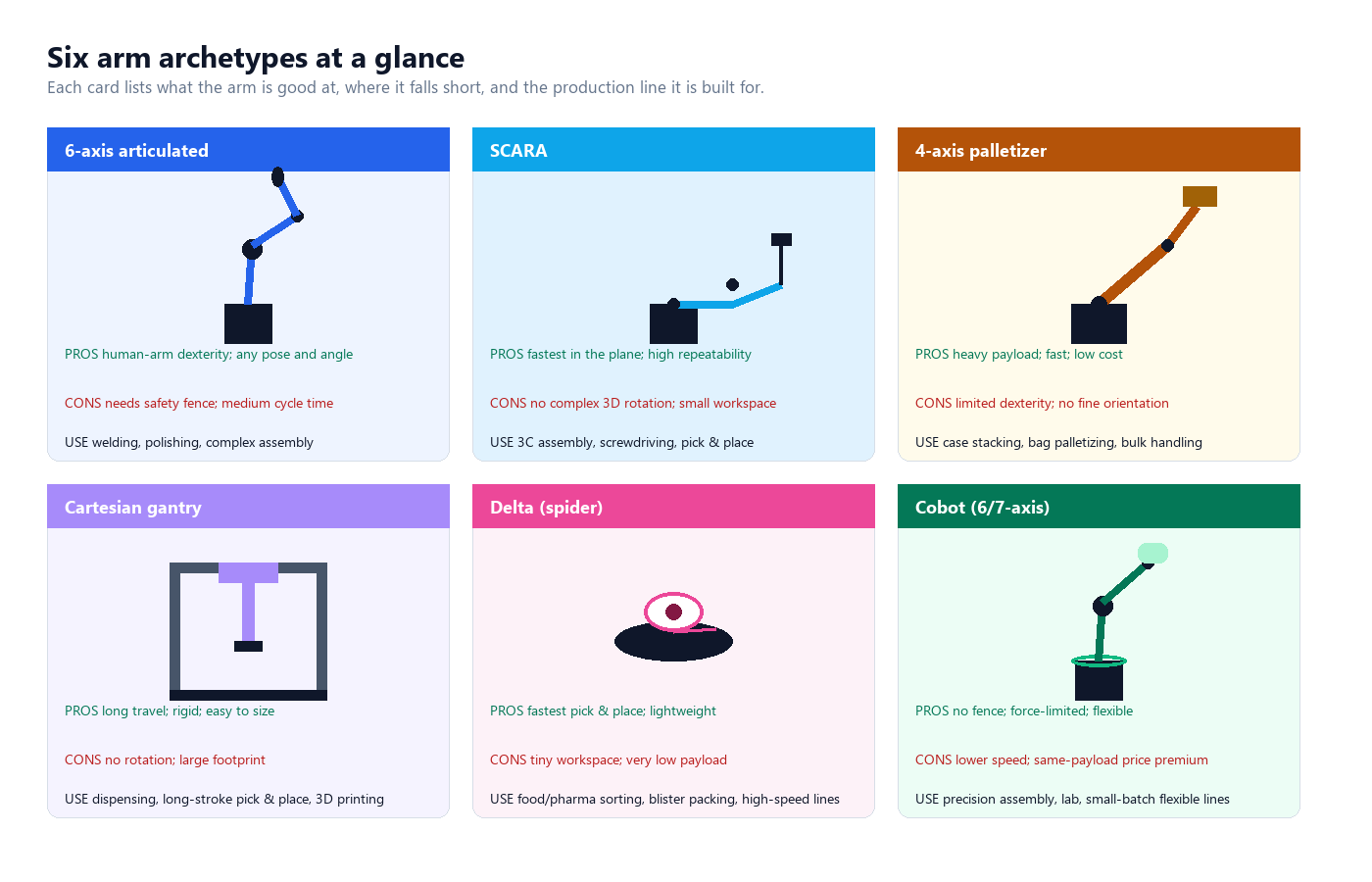
- Six-axis articulated is the closest to a human arm. Six joints can rotate freely, so the arm can move in any direction and tilt the workpiece at any angle. Its strength is universal reach: it is the default for welding, polishing, painting, complex assembly, and machine tending. The cost is the same as its flexibility: it needs a safety fence, and the cycle time is mid-range.
- SCARA is the king of the plane. Horizontal motion is extremely fast, and repeatability is in the hundredths of a millimetre, but it cannot flip a part upside-down. It is the workhorse for 3C electronics assembly, screwdriving, component insertion, PCB transfer and small-piece sorting.
- Four-axis palletizer is built for brute force. It has fewer degrees of freedom, so it cannot orient a part finely, but it carries a heavy payload quickly and cheaply. You see it on lines that stack cases, palletise bags, and move bulky material.
- Cartesian gantry walks only in straight lines. X, Y and Z rails move a carriage up and down the workspace, with no rotational joints. It is rigid, has long travel, and is easy to size and install. It is the natural choice for dispensing, coating, long-stroke pick-and-place, and most 3D printers.
- Delta parallel arm looks like a spider. Three or four light parallel linkages drive a single moving plate, which makes it the fastest structure on the market. The price is a small workspace and a very low payload. It is the pick for food sorting, pharmaceutical blister packing, and any high-speed line moving small, light, regular items.
- Cobot (collaborative robot) is not a separate structure. It is a six- or seven-axis arm that adds safety properties: force or torque sensing at the joints, low inertia, and a controller that caps output force. Most models can run next to a human without a fence. The trade-off is the same as for any safety-rated device: speed is lower, and the price for a given payload is higher than a fenced industrial arm. Cobots are at home in precision assembly, quality inspection, flexible polishing, and small-batch multi-variant production.
The three questions newcomers ask
A buyer who already knows the six archetypes usually has three more questions left.
Why pick a seven-axis arm over a six-axis one? The extra joint adds one more degree of redundancy, which makes the arm better at avoiding obstacles and smoother in its approach. Seven-axis arms appear mostly in high-end cobots and in medical or research settings where the wrist must reach a constrained pose without colliding with the workpiece.
Is a cobot the same thing as a six-axis arm? No, and the distinction matters. A six-axis arm is a structure; cobot is a safety property. There are fenced six-axis industrial arms and there are six-axis cobots. The two follow completely different application logic, even when they share a kinematic diagram.
Is more degrees of freedom always better? No. If the work is a simple screwdriving operation in a plane, a SCARA is the most cost-effective choice. Reaching for a six- or seven-axis arm just because it has more joints adds cost, programming time, and integration risk. The right metric is "what does the workpiece need", not "how many joints can we throw at it".
A short decision path
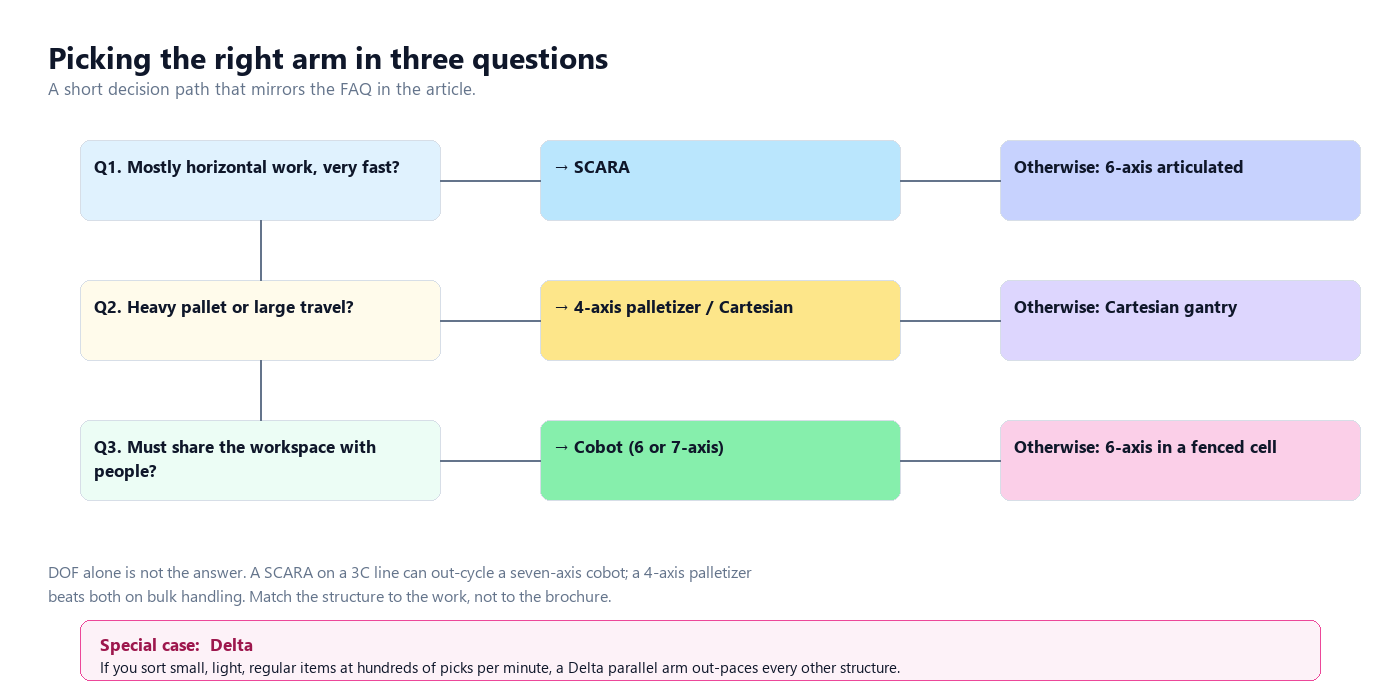
If the work is mostly horizontal and very fast, the answer is usually a SCARA. If the work is heavy palletising or long linear travel, a four-axis palletizer or a Cartesian gantry is the right structure. If the work has to share space with people, a cobot is the natural fit. Everything else is a job for a fenced six-axis. The special case is a Delta: when small, light, regular items need to be moved at hundreds of picks per minute, a parallel arm out-cycles every other structure, by a lot.
DOF alone is not the answer. Match the structure to the work, not to the brochure.
This article is a condensed summary of a public Chinese-language primer. IOTTourChina covers open-source IoT hardware and the silicon behind it as part of its developer-insights series. This article is supplementary reading for that series.