A hobbyist's half-year of teaching a DIY robot arm to see
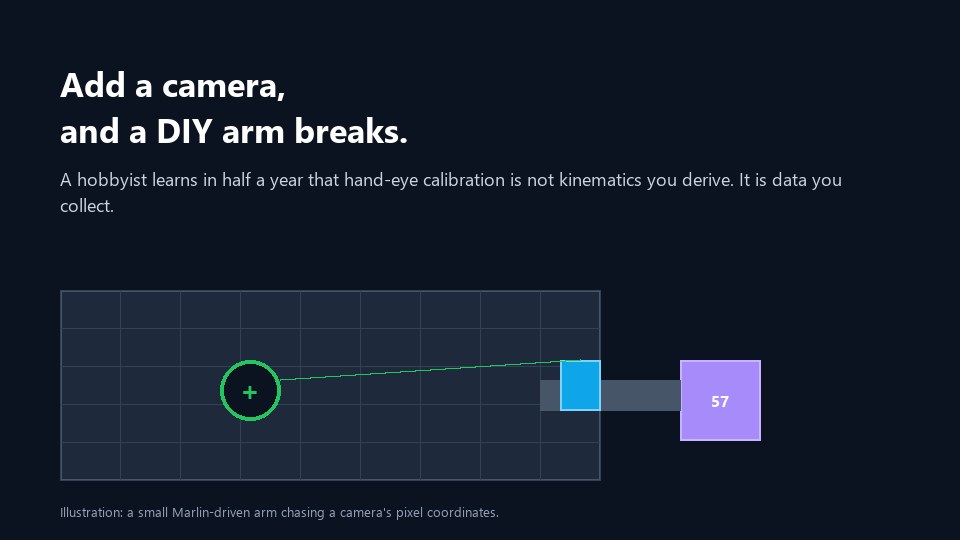
The robot arm itself had been finished years earlier. A MeArm-style linkage, a NEMA 23 (57-size) stepper motor with a precision reducer, Marlin firmware running on a RAMPS 1.4 board. It could home, move to coordinates, and close the gripper reliably.
What came next was supposed to be simple. Mount a camera. Recognise the target. Hand the target coordinates to the arm. Pick it up. That is the story every tutorial tells, and the story I believed.
Half a year later, the thing that broke my project was not the arm. It was the eyes.
The first month, I went in circles
Python I had been using for years, and I had been teaching it. Arduino, Marlin, stepper control, those were familiar. OpenCV, image recognition, coordinate transforms were new to me. None of that worried me. The tools looked ordinary, the documentation looked ample, and the AI assistants felt knowledgeable. A few weeks felt generous; a few days felt plausible.
What actually happened was a month of running in place. The camera could identify the target. Python could read the position. The arm could move to coordinates. Wire the three together and the result went wrong in every direction. The gripper missed, drifted, or moved the wrong way entirely. I spent most evenings that month talking to different AI assistants.
Inverse kinematics. Perspective transforms. Coordinate calibration. Hand-eye calibration. Each approach arrived with a confident explanation. Each one, once wired up, fell short by the last few per cent. I started to wonder whether the AI assistants themselves were wrong. Each gave a different answer; each answer was internally consistent; none of them fixed my problem.
What the AI assistants were actually answering
Eventually I noticed something the assistants had not said. They were not wrong. They were answering a different question.
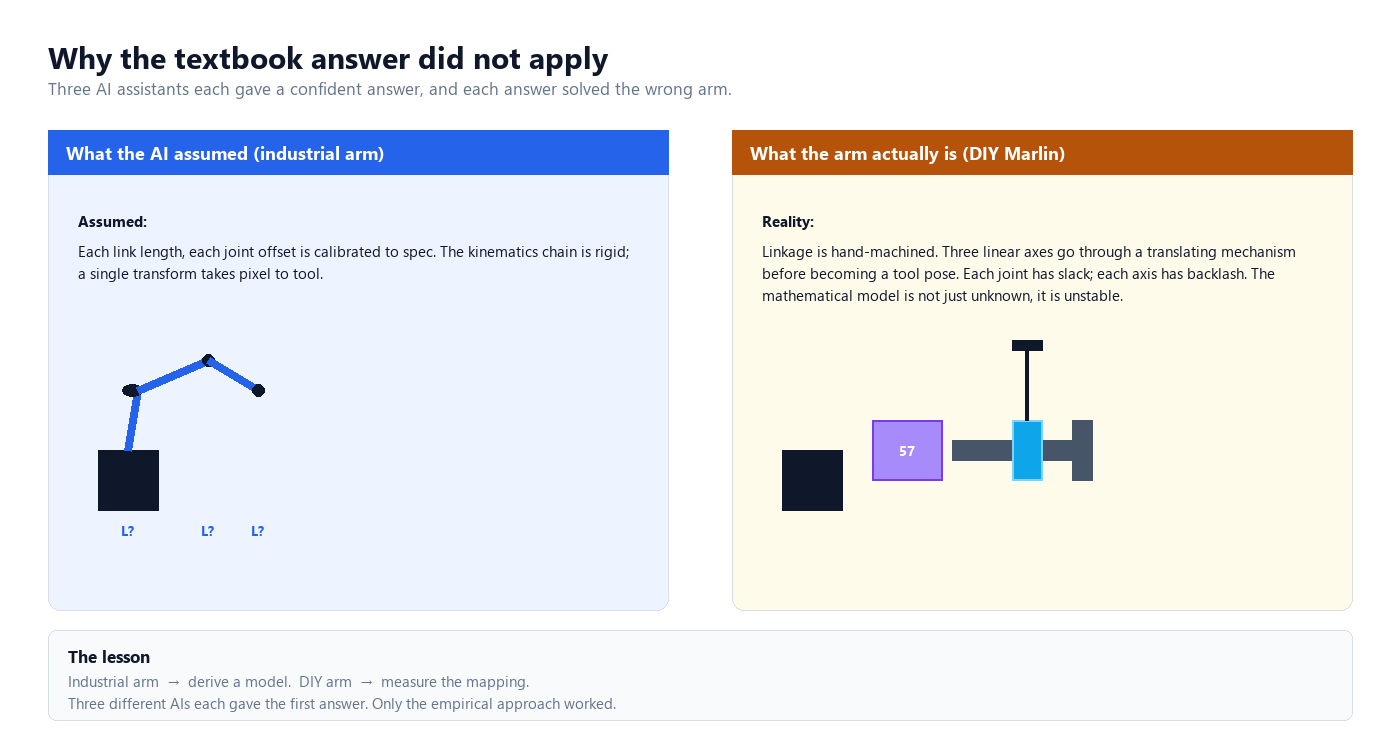
The assistant is, by default, talking to someone with a standard industrial arm. Each link length is on a spec sheet. Each joint offset has been measured. The whole kinematic chain is rigid, and a single closed-form transform takes a pixel to a tool pose.
My arm was not that. It was a Marlin-driven DIY machine I had built from a 3D-printer control board. The bottom layer was three linear axes, not six rotary joints. A translating mechanism turned those linear axes into something resembling a tool pose. The links were hand-machined, not catalogued. The control was nothing an industrial kinematics library was written to handle. The arm-to-arm coordinate transform was already complex; folding in the extra layer of straight-axis-to-rotation conversion made the math unstable.
The AI assistants' formulas were not wrong. They were formulas for a different arm.
The day the project turned around
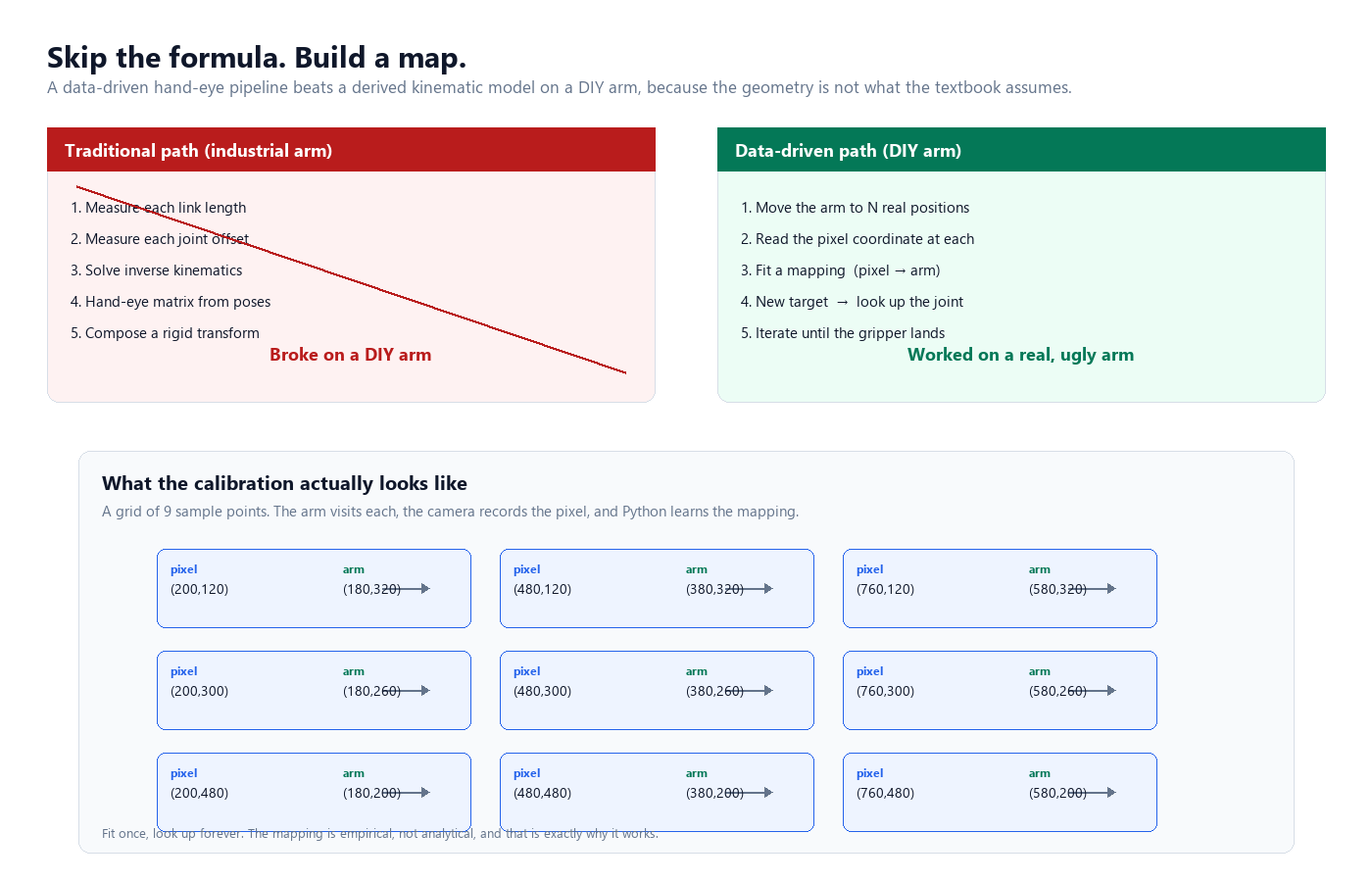
Once I framed the problem that way, the fix was almost obvious. If deriving the model was that hard, why derive a model at all? AI is, after all, exactly the kind of tool you reach for when the data relation is too tangled to write down by hand. So I stopped trying to derive the conversion. I started to collect data.
I moved the arm to a small number of real positions. At each, I recorded the arm's own coordinates and the pixel coordinate the camera saw. I let Python learn the mapping between the two. That is the whole trick: the model is not a kinematic chain, the model is a look-up table, and the look-up table is empirical, not analytical.
The project unblocked the same week. Suddenly the gripper landed on the target. The arm descended, closed, lifted, and dropped into a known bin. The full sequence was automatic.
The half-year view
If you only look at the final program, it is short. The hard part was the half-year of trial and error, the moment I realised the textbook problem was the wrong problem, and the day I switched the AI assistants from being instructors to being tools.
The most useful thing an AI assistant can do is turn a vague idea into runnable code. That is genuine leverage, and it is rare. But the leverage only works once the direction is set. The direction was mine to decide, and it took half a year of working with the assistant before I could set it cleanly.
The smaller, more stubborn problems filled the rest of the year. They were not about OpenCV, the arm, or the AI. They were about the developer workflow itself.
This article is a condensed summary of a public Chinese-language post. IOTTourChina covers open-source IoT hardware and the silicon behind it as part of its developer-insights series. This article is supplementary reading for that series.