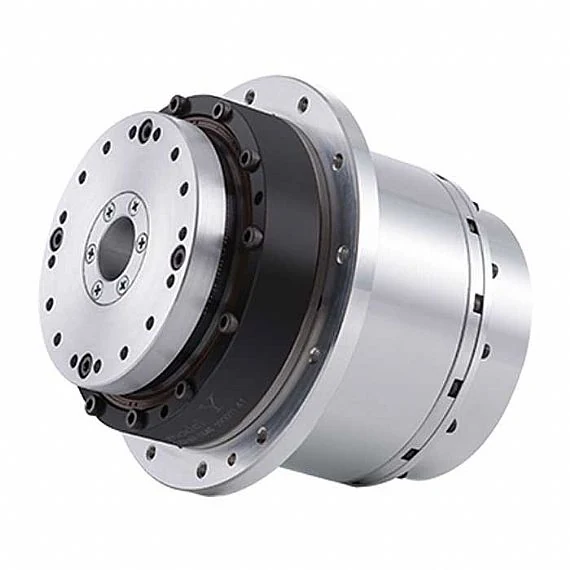
Robot Joints & Rotary Actuators
KAH Rotary Actuators
Sealed hollow-shaft rotary actuators that pair a strain wave reducer with an integrated stepper motor for self-contained rotating joints.
Capabilities below are vendor-documented. We have not tested this device or its integrations.
Sources checked:
Also known as: KAH hollow shaft rotary actuator, integrated rotary actuator, 绿的谐波 KAH
Suitable projects
- Robot and gantry axes that need a self-contained rotating joint.
- Semiconductor and medical imaging positioning stages.
- Fixtures that route cables, gas lines or an optical beam through the joint centre.
Before you buy
- Driven by a stepper motor, so closed-loop accuracy depends on the encoder and drive you add.
- IP67 is a custom option rather than a catalogue item.
- Check the bending moment and axial force limits before mounting a payload on the output flange.
Official resources
Related guides
- Frame sizes
- 14 / 17 / 20 / 25 / 32 / 40
- Reduction ratios
- 1:51 / 1:81 / 1:101 / 1:121 / 1:161
- Max torque at start/stop
- 23 to 800 N·m
- Motor
- Integrated magnetic stepper motor
- Shaft
- Hollow shaft for cables, gas lines or a laser beam
- Accuracy retention life
- 15000 h at 1:51, 20000 h at other ratios
- Protection
- IP65 default, IP67 on custom order
Choosing Leaderdrive KAH Rotary Actuators
This profile is based on official documentation, not our own device testing.
What this product is for
The KAH series is a sealed hollow-shaft rotary actuator. It is not a bare reducer: a magnetic stepper motor and a strain wave reducer are integrated into one housing, so the module turns electrical commands into joint rotation without a separate motor, coupling or bellows.
The output is a hollow shaft. Cables, gas lines or a laser beam can pass straight through the joint centre, which keeps the service inside the rotation axis instead of wrapped around it.
Typical use is a robot or gantry axis that needs a self-contained rotating joint, a positioning stage in semiconductor or medical imaging equipment, or a fixture that routes cable, gas or an optical beam through the joint centre.
How it differs from the standard cup series
The standard LCS cup series is a gearbox only. A joint built around it still needs a motor, a housing, a bearing set and an encoder before it works, and someone has to align and lubricate the stack.
The KAH removes that work. The motor, the reducer and the housing arrive as one sealed module, so the joint is defined by a part number rather than by an assembly drawing.
Choose the KAH when the joint has to be self-contained, sealed and quick to mount, and when the bore has to stay free for service. Choose a bare cup reducer when the motor has to be selected separately, or when a different drive architecture is already fixed.
Frame sizes and ratios
The series covers frames KAH-14, KAH-17, KAH-20, KAH-25, KAH-32 and KAH-40. Frame variants such as KAH-14A, KAH-14B and KAH-14C share the same frame and differ in build.
| Attribute | Value |
|---|---|
| Frames | KAH-14 / 17 / 20 / 25 / 32 / 40 |
| Ratios | 1:51 / 1:81 / 1:101 / 1:121 / 1:161 |
| Max torque at start/stop | 23 to 800 N·m |
| Motor | Integrated magnetic stepper motor |
| Shaft | Hollow, for cables, gas lines or a laser beam |
| Protection | IP65 default, IP67 on custom order |
| Accuracy retention life | 15000 h at 1:51, 20000 h at other ratios |
How frame size maps to torque
Each step up in frame size raises the torque capacity, and the series runs from 23 N·m to 800 N·m at start and stop.
Pick the smallest frame that carries the torque the axis needs, then check the bending moment and the axial force limits before a payload is mounted on the output flange. A payload that exceeds them loads the internal bearing rather than the reducer teeth.
Picking a ratio
Five ratios run from 1:51 to 1:161. The low ratios give more output speed and a shorter accuracy retention life: 15000 h at 1:51 against 20000 h at the other ratios.
Pick 1:51 when speed matters most and the duty is light. Pick a higher ratio when torque or resolution matters more, and use the 20000 h figure as the reference for the life plan.
What the module does not include
The module is complete as a mechanical joint, but the electrical side is not defined in the material we hold. There is no published connector, bus or command set for the series here, so the drive and the cabling have to be specified with the maker.
The protection class is not fixed either. IP65 is the default, and IP67 is a custom option rather than a catalogue item.
Closed-loop accuracy is also open. The module is driven by a stepper motor, so the final accuracy depends on the encoder and the drive that are added around it.
Check before ordering
Confirm the frame, variant and ratio. Write all three into the part number, and read the torque figure for that exact combination in the official parameter table.
Confirm the protection class. IP65 is the default and IP67 is a custom option. Confirm which one is being ordered, because the seal is not the same part.
Check the payload interface. The bending moment and axial force limits on the output flange decide the payload. Check both against the mounting drawing before the design is fixed.
Request the electrical and drive package. There is no published connector, bus or command set for the series here. Ask the maker for the electrical and drive documentation before wiring anything.
Next step
Open the official Leaderdrive KAH product page on leaderdrive.com, read the parameter table for the chosen frame and ratio, and ask the maker for the electrical and drive package before placing the order.
Quick Start — Leaderdrive KAH Rotary Actuators
Reference steps for commissioning the integrated actuator on the bench. The electrical side is defined by the maker rather than by the catalogue, so confirm every value before wiring anything.
1. Check what arrived
The module ships assembled and sealed, with the motor, the reducer and the hollow shaft in one unit. Confirm the frame, the variant letter and the ratio on the label against the order before opening anything else.
The series covers frames KAH-14 through KAH-40, at ratios of 1:51, 1:81, 1:101, 1:121 and 1:161. Confirm the protection class as ordered, because IP65 is the default and IP67 is a custom option.
Check the packing list and inspect the bore and the output flange for dents or shipping damage. A burr raised inside the bore is hard to remove once the joint is closed.
2. Mount the module
Clean the mounting face, then measure flatness and coaxiality against the official installation drawing.
Seat the module on its locating features before tightening. Tighten in a crosswise sequence, working around the bolt circle in stages rather than taking each bolt to full torque in one pass.
Use the torque figure from the official installation drawing and the bolt grade it specifies.
3. Fit the payload side
Check the bending moment and the axial force limits for the chosen frame before a payload is mounted. A payload that exceeds them loads the internal bearing.
Tighten the payload bolts in the same crosswise sequence, to the drawing torque.
4. Route the service through the bore
The hollow bore is there for cables, gas lines or a laser beam. Route the service through the centre with the bend radius and the strain relief the official drawing specifies.
Keep the service clear of the bore wall, and add a strain relief at both ends so it cannot pull on the module as the joint turns. Watch the cable for rub marks after the first moves.
5. What to obtain from the maker before wiring
The material we hold does not define a connector, a bus, a register map or a driver part number for this series. Do not infer any of them from another product. Ask the maker for the electrical and drive package in writing, and put these questions to them:
- Which supply voltage and current the motor needs.
- Which driver or controller they recommend for the frame.
- Which connector or terminal arrangement is fitted.
- Which cable is specified for a moving joint.
- Whether an encoder is fitted, and what its interface is.
- Which homing method the module supports.
- Which command set or software they supply.
6. Define homing and travel limits
Set a home position before the first motion, using the homing method the maker confirms.
Set soft travel limits in the controller so the joint cannot drive into a mechanical stop. Run the first moves at low speed, with the payload removed.
7. Service interval
Accuracy retention life is 15000 h at 1:51 and 20000 h at the other ratios. Use those figures for the service plan.
Check the seal at each service interval, and confirm the interval with the maker for the protection class in use.
Next step
Run the axis unloaded first, then add the payload and step the load up in stages. Record the first-run position, temperature and backlash, so the next service has a baseline.
FAQ — Leaderdrive KAH Rotary Actuators
What is the KAH series?
A sealed hollow-shaft rotary actuator. A magnetic stepper motor and a strain wave reducer are built into one housing, so the module is a complete rotating joint rather than a bare reducer.
How is it different from a cup reducer?
A cup reducer is one part of a joint and still needs a motor, a housing and a bearing set. The KAH contains the motor and the reducer together, which makes the joint self-contained and quick to mount.
Which frames and ratios are available?
Frames KAH-14, KAH-17, KAH-20, KAH-25, KAH-32 and KAH-40. Ratios are 1:51, 1:81, 1:101, 1:121 and 1:161. Variants such as KAH-14A and KAH-14B share the frame and differ in build.
How much torque does it deliver?
Max torque at start and stop runs from 23 to 800 N·m across the series. Match the figure to the frame and ratio on order rather than to the series envelope.
What is the hollow bore for?
Cables, gas lines or a laser beam can pass through the joint centre. That keeps the service inside the rotation axis instead of wrapped around it.
How long does accuracy hold?
Accuracy retention life is 15000 h at 1:51 and 20000 h at the other ratios, so the life plan follows the ratio. Use those figures for the service interval.
Is the module sealed?
Yes. Protection is IP65 by default, with IP67 available as a custom option. Confirm the class being ordered, because IP67 is not a catalogue item.
Can it run closed loop?
It is driven by a stepper motor, so closed-loop accuracy depends on the encoder and the drive added around it. Those parts have to be specified with the maker.
Where does the electrical documentation come from?
The maker. The material we hold does not define a connector, a bus or a command set for the series, so the electrical and drive package has to be requested before wiring.