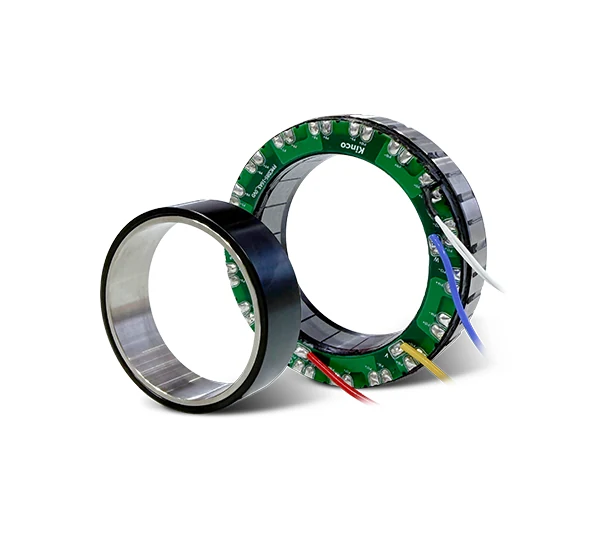
Frameless Torque Motors
FMK Frameless Torque Motors
Fourth-generation frameless torque motors in eight frame sizes, aimed at humanoid, collaborative and quadruped robot joints.
Capabilities below are vendor-documented. We have not tested this device or its integrations.
Sources checked:
Also known as: FMK frameless torque motor, Kinco FMK series, 步科 FMK 无框力矩电机
Suitable projects
- Humanoid and collaborative robot joints at the waist, shoulder, elbow and wrist.
- Quadruped robot locomotion joints running from a 48 V battery bus.
- Direct-drive axes that need a large bore for cable and tube routing.
Before you buy
- Supplied as stator and rotor rings only; housing, shaft, bearing and encoder are not included.
- The stator has to be bonded or clamped into a housing that the integrator designs.
- Torque figures are quoted at 48 V DC and at the rated speed listed in the parameter table.
- Kinco publishes FMK 2D and 3D drawings but no FMK selection manual; the only frameless-motor selection manual in its document center covers the FMC series, a different family.
- Document center files are handed out through temporary signed links, so the document center page is the stable entry point rather than any single file address.
Official resources
Related guides
- Frame sizes
- 25 / 38 / 43 / 50 / 60 / 70 / 85 / 115 mm
- Rated voltage
- 48 V DC
- Rated power
- 36 to 1173 W
- Rated torque
- 0.063 to 3.5 N·m
- Peak torque
- 0.204 to 11.5 N·m
- Rated speed
- 1600 to 5000 rpm
- Max speed
- 2530 to 7300 rpm
- Torque constant
- 0.065 to 0.2 N·m/A
- Mechanical time constant
- 0.068 to 1.947 ms
- Configuration
- Separate stator and rotor rings with a large hollow bore
Choosing Kinco FMK Frameless Torque Motors
This profile is based on official documentation, not our own device testing.
Kinco, or Shanghai Kinco Automation, has built frameless torque motors since 2016. The line started with STW1, moved to FMC and now reaches the fourth-generation FMK series, which launched in 2025. FMK is a medium and large frameless torque motor for robot joints. It is supplied as two separate rings, a stator and a permanent-magnet rotor.
What the series is for
FMK drives a robot joint directly. The stator and the rotor go into a joint that the integrator machines.
- Waist, shoulder, elbow and wrist joints of humanoid and collaborative robots.
- Locomotion joints of quadruped robots.
- Dual-arm robot joints from J1 to J6.
- Other precision motion systems.
The series brings no housing, no shaft and no bearing. The integrator supplies those parts.
What the FMK generation changes
Compared with the earlier FMC series, FMK claims lower temperature rise, a larger hollow bore, higher continuous torque, faster dynamic response and better running stability.
The design points behind those claims are listed as follows.
- A large split ratio and a large hollow bore let cables and tubes pass through the middle of the joint.
- The stator is vacuum potted for insulation and heat transfer.
- A segmented stator with a high slot fill factor raises power density and lowers torque ripple.
- Optimised stator welding and rotor manufacturing improve roundness and shorten the motor length.
How the frame sizes are organised
There are eight standard frame sizes, named by outer diameter: 25 / 38 / 43 / 50 / 60 / 70 / 85 / 115 mm. The frame number leads each model code, so an FMK050 model uses the 50 mm frame and an FMK085 model uses the 85 mm frame. Twelve catalogue models are listed across those eight frames.
The whole series sits inside this envelope.
- Rated power: 36 to 1173 W.
- Rated torque: 0.063 to 3.5 N·m.
- Peak torque: 0.204 to 11.5 N·m.
- Rated speed: 1600 to 5000 rpm.
- Maximum speed: 2530 to 7300 rpm.
- Torque constant: 0.065 to 0.2 N·m/A.
- Mechanical time constant: 0.068 to 1.947 ms.
How to pick a size and a model
Start from the continuous torque the joint must hold, then check the speed and the frame diameter. Every model in the following table is specified at 48 V DC.
Models on frames 25 to 60
| Model | Rated power (W) | Rated torque (N·m) | Peak torque (N·m) | Rated current (A) | Peak current (A) | Rated speed (rpm) | Max speed (rpm) | Torque constant (N·m/A) | Mechanical time constant (ms) |
|---|---|---|---|---|---|---|---|---|---|
| FMK02509-0004-5511N-7DP02 | 36 | 0.063 | 0.204 | 1.05 | 3.65 | 4500 | 7300 | 0.065 | 0.583 |
| FMK03807-0005-3518N-7DP02 | 50 | 0.135 | 0.405 | 1.7 | 5.491 | 3500 | 5500 | 0.089 | 0.95 |
| FMK04311-0008-3725N-7DP02 | 77 | 0.2 | 0.6 | 2.2 | 6.7 | 3700 | 5000 | 0.09924 | 0.068 |
| FMK05008-0016-5030N-10DP02 | 157 | 0.3 | 0.9 | 3.7 | 10.8 | 5000 | 6200 | 0.088 | 0.61 |
| FMK05015-0018-3530N-10DP22 | 183 | 0.5 | 1.5 | 5 | 15 | 3500 | 4800 | 0.11 | 1 |
| FMK06008-0007-1630H-10DP00 | 75 | 0.45 | 1.35 | 2.4 | 7.2 | 1600 | 2530 | 0.2 | 1.947 |
| FMK06018-0026-3628N-10DP02 | 264 | 0.7 | 1.4 | 8.35 | 9.18 | 3600 | 5300 | 0.103 | 0.91 |
Models on frames 70 to 115
| Model | Rated power (W) | Rated torque (N·m) | Peak torque (N·m) | Rated current (A) | Peak current (A) | Rated speed (rpm) | Max speed (rpm) | Torque constant (N·m/A) | Mechanical time constant (ms) |
|---|---|---|---|---|---|---|---|---|---|
| FMK07011-0025-3642N-10DP02 | 252 | 0.66 | 1.98 | 6.1 | 18.5 | 3650 | 4570 | 0.116 | 0.48 |
| FMK07019-0044-3042N-10DP22 | 440 | 1.4 | 5.4 | 12.7 | 55 | 3000 | 4000 | 0.11 | 0.78 |
| FMK08513-0037-2952N-10DP02 | 370 | 1.2 | 3.6 | 9 | 27 | 2950 | 3700 | 0.14 | 1.1 |
| FMK08523-0073-3542N-10DP02 | 732 | 2 | 6 | 16.5 | 49.5 | 3500 | 4000 | 0.134 | 1.02 |
| FMK11525-0117-3260N-10DP02 | 1173 | 3.5 | 11.5 | 30 | 102 | 3200 | 3900 | 0.127 | 1.15 |
A larger frame carries more torque. The smallest motor is the FMK025 at 0.063 N·m rated, and the largest is the FMK115 at 3.5 N·m rated. Rated speed runs from 1600 to 5000 rpm across the table, so confirm torque and speed together before choosing.
What the hollow bore buys you
The hollow bore runs through the middle of the stator and the rotor. It lets cables, tubes and air lines pass along the joint axis instead of looping around the outside.
- A through bore keeps the moving-joint envelope clean and reduces cable flexing.
- The large split ratio supports the wide bore without giving up torque density.
- A wide bore also suits direct drive, where the motor takes the place of a gearbox and a solid shaft.
- FMK claims a larger hollow bore than the earlier FMC series.
What to check before ordering
- Confirm the model code against the frame, the torque and the speed the joint needs.
- Note that only the stator and the rotor are supplied. Housing, shaft, bearing, encoder and driver come from the integrator.
- Decide how the stator will be bonded into the housing. The datasheet names anaerobic adhesives such as Loctite 638 or 648.
- Plan a cylindrical cup housing with a 0.5 mm to 1 mm shoulder at one end for axial location, and use a clearance fit between the stator outer diameter and the housing bore.
- Add adhesive grooves where torsional strength matters.
- Check the cure schedule, because adhesive cure temperature must not exceed 155 °C.
- Match the driver to the motor. Kinco pairs the series with its RD series hollow-shaft servo driver.
- Record the model, the driver and the joint it goes into on the order line.
Next step
Read the quick start tab before the parts reach the bench. The official parameter page for this series is listed under Official resources on the overview tab of this device page. A general selection guide is linked from this page.
Quick Start — Kinco FMK Frameless Torque Motors
This is an untested reference for first assembly. Confirm the model against the official Kinco page for this series.
1. Check what arrived
The motor ships as two separate rings, a stator and a permanent-magnet rotor. Housing, shaft, bearing, encoder and driver are not included. Confirm the model code on the label against the order.
2. Design the housing
The stator is normally bonded into a housing. Make the housing a cylindrical cup with a 0.5 mm to 1 mm shoulder at one end for axial location. Plan a clearance fit between the stator outer diameter and the housing bore. Additional adhesive grooves help torsional strength.
3. Prepare the bonding surfaces
Clean both surfaces first. Remove oil, dust and loose material from the stator outer diameter and the housing bore before any adhesive is applied.
4. Bond the stator
Use an anaerobic adhesive such as Loctite 638 or 648. Apply it to the cleaned surfaces and seat the stator against the shoulder. Adhesive cure temperature must not exceed 155 °C.
5. Fit the rotor
The rotor is the second ring and carries the permanent magnets. It is supplied on its own, so the shaft or hub it turns on comes from the integrator. Keep the rotor concentric with the stator and keep the running gap even.
6. Wire the phases and the sensors
Run the motor phases to the driver and keep the phase order consistent. The matched driver carries two-channel DI enable, dual encoders, torque-sensor inputs and temperature inputs for the motor and the reducer. Confirm the pinout for the exact model on the official page.
7. Pair a driver
Kinco pairs the FMK series with its RD series hollow-shaft servo driver. The driver supports RS485 and EtherCAT, with a CAN interface reserved. It carries overcurrent, short-circuit, IIT, overvoltage, undervoltage and overtemperature protection.
8. First run
Start at low speed with a light load and listen for uneven noise. Watch the temperature of the motor and the reducer. Stop and re-check the bonding and the alignment if noise or temperature rises quickly.
Mistakes that ruin a frameless motor
- Bonding a stator to a dirty or an oily surface.
- Skipping the shoulder that locates the stator axially.
- Forcing the stator into a bore instead of using a clearance fit.
- Letting the adhesive cure above 155 °C.
- Leaving out the adhesive grooves where torsional strength matters.
- Assuming a housing, shaft, bearing or encoder is included.
- Running the motor on a driver that was not matched to it.
- Pushing a high load at speed before the first low-speed run.
FAQ — Kinco FMK Frameless Torque Motors
What does frameless actually mean?
A frameless motor is supplied without the parts that usually wrap it. FMK ships as two separate rings, a stator and a permanent-magnet rotor. There is no housing, no shaft and no bearing, so the integrator builds those into the joint.
Which frame sizes exist?
There are eight standard frame sizes, named by outer diameter: 25 / 38 / 43 / 50 / 60 / 70 / 85 / 115 mm. Twelve catalogue models are listed across those eight frames. The frame number leads each model code.
What voltage do the motors run on?
Every model in the electrical table is specified at 48 V DC. The current, speed and torque figures are given at that voltage.
What is the torque range?
Rated torque runs from 0.063 to 3.5 N·m and peak torque runs from 0.204 to 11.5 N·m across the series. Read the table one model at a time: each row gives the rated torque and the higher peak torque for that model, all at 48 V DC.
Does the motor include a bearing or an encoder?
No. The stator and the rotor are sold on their own. Housing, shaft, bearing, encoder and driver are not included and come from the integrator.
How is the motor mounted?
The stator is normally bonded into a housing with an anaerobic adhesive such as Loctite 638 or 648. The housing should be a cylindrical cup with a 0.5 mm to 1 mm shoulder at one end for axial location. Use a clearance fit between the stator outer diameter and the housing bore, clean both surfaces first, and keep the adhesive cure temperature at or below 155 °C.
Which driver matches the FMK series?
Kinco pairs the series with its RD series hollow-shaft servo driver. The driver supports RS485 and EtherCAT, with a CAN interface reserved. It carries overcurrent, short-circuit, IIT, overvoltage, undervoltage and overtemperature protection.
What is the FMK series used for?
It suits robot joints that need direct drive. The intended joints are the waist, shoulder, elbow and wrist of humanoid and collaborative robots, the locomotion joints of quadruped robots, dual-arm robot joints from J1 to J6, and other precision motion systems.
Where are the official figures published?
The official parameter page for this series is listed under Official resources on the overview tab of this device page.