What a robot arm is: a five-by-three map of structure, drive and use
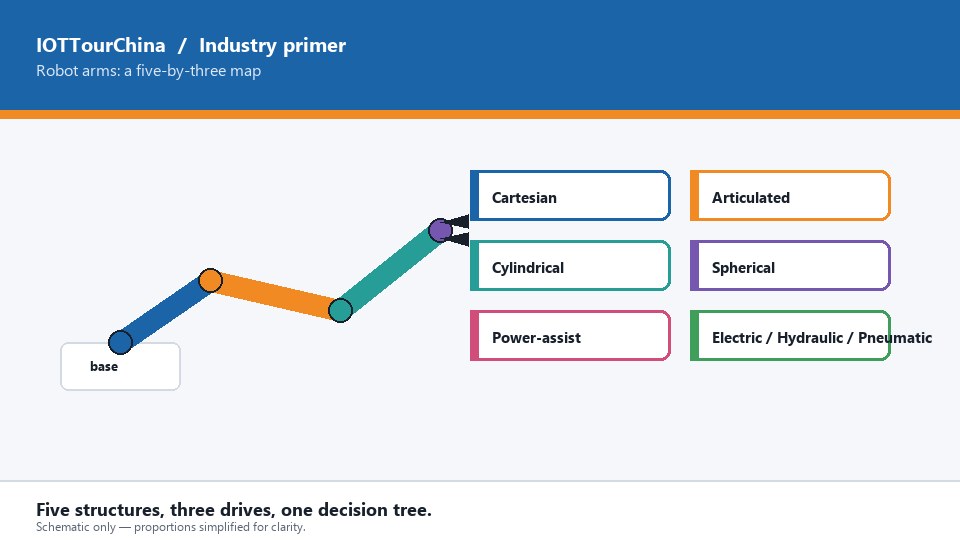
What a robot arm is
A robot arm is a programmable mechanical chain that mimics the way a human hand and forearm reach, grasp and place. It usually sits on a fixed base or a mobile platform, and ends in an end-effector that does the actual work — a gripper, a suction cup, a welding torch, a polishing head, a vision probe. Strip the end-effector off and the arm itself is just a kinematic skeleton. Pair it with a controller, a power source and a tool, and you have an automation cell.
The value of an arm is not its cleverness but its willingness to repeat the same motion a million times without getting tired, distracted or injured. That property is what makes it useful in three very different settings — factories, warehouses and places where sending a person is the worst possible option.
Five structures, three duty profiles
Robot arms are usually classified by their kinematic structure. The most common textbook list has five entries; each one trades reach for precision, or freedom for simplicity.
- Cartesian — three orthogonal slides. The workhorse of palletising, CNC loading and any cell where the motion is a clean XYZ box. High accuracy, low cost, and a footprint that scales linearly with the work envelope.
- Articulated — two or more rotary joints stacked on a shoulder, much like a human arm. The mainstream choice for welding, painting and general assembly, because the joints let the tool approach the workpiece from almost any angle.
- Cylindrical — a vertical column with a horizontal sliding arm. Compact, and a natural fit for machine tending on lathes and presses.
- Spherical — a polar-coordinate arm anchored on a hinge and a slider. Found mostly in older cells (foundry forging, die-cast extraction) where the kinematics were chosen before articulated arms became affordable.
- Power-assist — a wearable or co-manipulated arm. The operator wears it or steers it; the structure provides the lifting force, not the autonomy. Common in factories where heavy loads need to move but full automation is overkill.
These five are not competitors — they are answers to different questions. The right pick depends on the work envelope, the cycle time and how much you trust the cell to run unattended.

Three drives, three trade-offs
The other axis of classification is the drive. An arm with the perfect geometry but the wrong actuator is still a bad arm.
- Electric drives dominate the modern market. They are quiet, clean, easy to network, and accurate enough for sub-millimetre work. Almost every collaborative and desktop arm is electric.
- Hydraulic drives are the heavy lifter. Where the payload is measured in tonnes — forging presses, steel handling, large construction equipment — hydraulics still win. The trade-off is leakage, noise and a higher maintenance burden.
- Pneumatic drives are fast, simple and cheap. They are the right answer for high-cycle light assembly and small pick-and-place, and the wrong answer anywhere you need precise force control.
In practice, electric and hydraulic share the floor of a heavy-industry plant, while pneumatics show up wherever the parts are small, the cycle is short and the budget is tight.
Where robot arms actually work
The installed base breaks into three pillars, and they look very different on a P&L statement.

- Industrial manufacturing is the largest pillar by units. Automotive body shops, electronics assembly, machine tending and packaging are the classic cases. The win is throughput and quality; the cost is the integration work to feed the cell.
- Warehouse and logistics is the fastest-growing pillar. Sorting, palletising, de-palletising and parcel induction run twenty-four hours a day and replace shift-bound manual handling. The economics are driven by labour cost per pick, not by the arm's sticker price.
- High-stakes and specialty is the smallest pillar by units but the highest by unit price. Surgical assistance, hazardous-sample handling, space-station robotics, bomb disposal and fire response are all niche — but they are the niche that justifies the most expensive engineering in the field.
The common thread across all three is simple: the work is repetitive, the work is precision-bound, or the work is unsafe for a person. Anywhere those three describe the job, an arm is worth the integration cost.