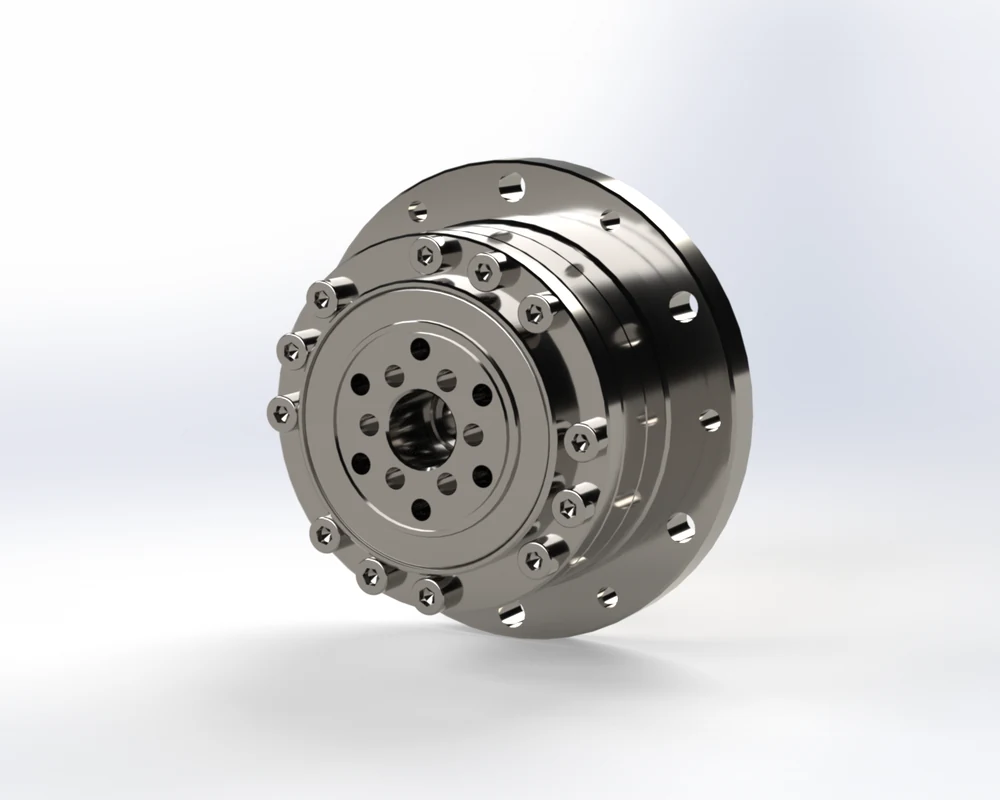
Harmonic Reducers
LCS / LCSG Strain Wave Gears
Standard cup-shaped strain wave gears with built-in cross roller bearings, offered in standard and high-torque versions.
Capabilities below are vendor-documented. We have not tested this device or its integrations.
Sources checked:
Also known as: LCS harmonic reducer, LCSG high-torque cup-shaped, 绿的谐波 LCS 系列
Suitable projects
- Robot arm joints where one stage has to deliver 50:1 or more.
- Servo axes that need low backlash in a short axial envelope.
- Humanoid and collaborative robot joints with a flange output.
Before you buy
- Sold as a component set or as a unit type; motor, encoder and brake are not included.
- Input and output must stay coaxial, and the housing carries the reaction load.
- Rated torque applies at the rated input speed listed in the parameter table.
Official resources
- LCS product introduction manual and drawings, ZIP
- LCSG product introduction manual and drawings, ZIP
- LCS 3D model, ZIP
- LCS product page
Related guides
- Frame sizes
- 14 / 17 / 20 / 25 / 32 / 40 / 45 / 50 / 58
- Reduction ratios
- 30:1 to 160:1
- Rated torque
- 4 to 745 N·m (LCS) / 7 to 969 N·m (LCSG)
- Peak torque at start/stop
- 9 to 1840 N·m (LCS) / 23 to 2392 N·m (LCSG)
- Max backlash
- ≤10 arcsec
- Max input speed
- 3000 to 8500 r/min
- Input coupling
- LCS-I flat key / LCS-II Oldham coupling
Choosing Leaderdrive LCS / LCSG Strain Wave Gears
This profile is based on official documentation, not our own device testing.
The LCS family is a cup-shaped strain wave gear with a built-in cross roller bearing. It is supplied as a component set or as a unit type. LCS is the standard version and LCSG is the high-torque version, and both share the same frame sizes.
What the series is for
A cup-shaped gear fits where a joint needs a high single-stage reduction in a short axial envelope.
- Robot arm joints where one stage has to deliver 50:1 or more.
- Servo axes that need low backlash in a short axial envelope.
- Humanoid and collaborative robot joints with a flange output.
The version choice, LCS or LCSG, is about torque. The frame choice is about size and mounting.
Standard and high-torque versions
LCS and LCSG share frames, bolt patterns and the cup-shaped body. They differ in the torque band they cover and in the lowest ratio they accept.
- LCS covers a rated torque of 4 to 745 N·m and starts at 30:1 on the smaller frames.
- LCSG covers a rated torque of 7 to 969 N·m and starts at 50:1.
- Peak torque at start/stop runs 9 to 1840 N·m for LCS and 23 to 2392 N·m for LCSG.
Both versions are listed with a maximum backlash of ≤10 arcsec.
How frame size maps to torque
Frame size is the main scaling axis. A larger frame carries more torque at the same ratio, and it often adds higher ratios to the list for that frame.
LCS frame sizes
| Frame | Ratios available | Rated torque (N·m) | Peak torque at start/stop (N·m) |
|---|---|---|---|
| 14 | 30:1, 50:1, 80:1, 100:1 | 4 – 7.8 | 9 – 28 |
| 17 | 30:1, 50:1, 80:1, 100:1, 120:1 | 8.8 – 24 | 16 – 54 |
| 20 | 30:1, 50:1, 80:1, 100:1, 120:1, 160:1 | 15 – 40 | 26 – 92 |
| 25 | 30:1, 50:1, 80:1, 100:1, 120:1, 160:1 | 27 – 67 | 50 – 176 |
| 32 | 30:1, 50:1, 80:1, 100:1, 120:1, 160:1 | 54 – 137 | 100 – 372 |
| 40 | 50:1, 80:1, 100:1, 120:1, 160:1 | 137 – 294 | 402 – 647 |
| 45 | 50:1, 80:1, 100:1, 120:1, 160:1 | 176 – 402 | 500 – 882 |
| 50 | 50:1, 80:1, 100:1, 120:1, 160:1 | 122 – 529 | 715 – 1180 |
| 58 | 50:1, 80:1, 100:1, 120:1, 160:1 | 176 – 745 | 1020 – 1840 |
LCSG frame sizes
| Frame | Ratios available | Rated torque (N·m) | Peak torque at start/stop (N·m) |
|---|---|---|---|
| 14 | 50:1, 80:1, 100:1 | 7 – 10 | 23 – 36 |
| 17 | 50:1, 80:1, 100:1, 120:1 | 21 – 31 | 44 – 70 |
| 20 | 50:1, 80:1, 100:1, 120:1, 160:1 | 33 – 52 | 73 – 120 |
| 25 | 50:1, 80:1, 100:1, 120:1, 160:1 | 51 – 87 | 127 – 229 |
| 32 | 50:1, 80:1, 100:1, 120:1, 160:1 | 99 – 178 | 281 – 484 |
| 40 | 50:1, 80:1, 100:1, 120:1, 160:1 | 178 – 382 | 523 – 841 |
| 45 | 50:1, 80:1, 100:1, 120:1, 160:1 | 229 – 523 | 650 – 1147 |
| 50 | 80:1, 100:1, 120:1, 160:1 | 484 – 688 | 1223 – 1534 |
| 58 | 80:1, 100:1, 120:1, 160:1 | 714 – 969 | 1924 – 2392 |
The rated figure applies at the rated input speed listed for the model, not at any speed. Read each row as the span across the ratios listed for that frame.
Choosing a reduction ratio
- A higher ratio multiplies input torque more and lowers output speed.
- Not every ratio is offered on every frame. Frame 14 stops at 100:1 and frame 17 stops at 120:1 on both versions.
- Frames 20 and above reach 160:1 on LCS and on LCSG.
- Confirm the ratio against the row for the chosen frame, not against the series envelope.
Backlash and speed limits
- Maximum backlash across the series is ≤10 arcsec.
- Maximum input speed is listed across the series as 3000 to 8500 r/min. Confirm the value for the exact model.
- Input and output must stay coaxial, and the housing carries the reaction load.
Check before ordering
- Decide between a component set and a unit type. The two are separate order lines.
- Note that a motor, encoder and brake are not included in either form.
- Choose the input coupling: LCS-I flat key or LCS-II Oldham coupling.
- Confirm rated torque at the rated input speed, not only the peak figure.
- Confirm the flange bolt pattern and the pilot diameter for the chosen frame.
- Record the frame, the ratio and the coupling option on the order line.
Next step
The official parameter page for this series is listed under Official resources on the overview tab of this device page.
Read the quick start tab before the part reaches the bench. A general selection guide for harmonic reducers is linked from this page.
Quick Start — Leaderdrive LCS / LCSG Strain Wave Gears
This is an untested reference for first assembly. Confirm the frame, ratio and coupling option against the official leaderdrive.com page for this series.
1. Check what arrived
The reducer ships as a component set or as a unit type, and the two are separate order lines. A motor, encoder and brake are not part of either. Confirm the frame and ratio on the label against the order.
2. Prepare the mounting surface
Both faces that carry the reducer seat on machined flats. Remove paint, burrs and swarf before fitting. Input and output must stay coaxial, and the housing carries the reaction load.
3. Lubricate the gear set
Strain wave gears run on a specified grease. The extracted parameter tables do not list the grade, so take it from the official page for the exact model and do not mix greases. Keep the tooth contact and the built-in cross roller bearing greased, and avoid overfilling.
4. Mount the output flange
Seat the output flange on its pilot before the bolts go in. Start every bolt by hand. Do not use the bolts to pull a cocked flange flat.
5. Tighten the bolts in a cross pattern
Tighten in stages, working across the bolt circle rather than around it. Bring the bolts to the grade and torque that the flange and bolt supplier specifies. The extracted tables do not list bolt torques.
6. Couple the input
LCS offers an LCS-I flat key input and an LCS-II Oldham coupling. Fit the servo or the stepper so its shaft runs concentric with the input. Keep runout low and do not force the coupling onto the shaft.
7. Check backlash after assembly
Lock the input, fix the housing, and measure rotation at the output flange. Maximum backlash is ≤10 arcsec. If the reading is larger, re-check the flange seating and the bolt torque before looking at the gear set.
8. First run
Run at low speed first and listen for uneven noise. Stay inside the listed 3000 to 8500 r/min input range. Stop and re-check if noise or temperature rises quickly.
Mistakes that ruin a reducer
- Pulling a flange flat with the bolts.
- Forcing a coupling onto the shaft.
- Pushing axial load through the output bearing.
- Running above the maximum input speed.
- Mixing greases.
- Mounting without coaxial input and output.
- Fitting the reducer to a painted or a burred face.
- Leaving the housing unbolted so it cannot carry the reaction load.
FAQ — Leaderdrive LCS / LCSG Strain Wave Gears
What is the difference between LCS and LCSG?
Both are cup-shaped strain wave gears on the same frame sizes. LCS is the standard version, rated 4 to 745 N·m, and LCSG is the high-torque version, rated 7 to 969 N·m. LCSG also starts at a higher ratio on the smallest frames. Peak torque at start/stop is 9 to 1840 N·m for LCS and 23 to 2392 N·m for LCSG.
Which frame sizes does the series cover?
The series runs from frame 14 to frame 58. The full list is 14, 17, 20, 25, 32, 40, 45, 50 and 58. Each frame accepts a different set of ratios.
Which reduction ratios can be ordered?
Ratios run from 30:1 to 160:1 across the series. The smallest ratio is limited to the smaller frames, and frame 14 stops at 100:1. The ratio list differs per frame, so read the row for the chosen frame before ordering.
How much torque can a single frame carry?
Rated torque runs 4 to 745 N·m for LCS and 7 to 969 N·m for LCSG across the series. The frame-size table on the Buying Guide tab gives the span for each frame. Peak torque at start and stop is higher than the rated figure.
What backlash should be expected?
Maximum backlash is ≤10 arcsec. Mounting quality affects the measured value at the output. Measure with the input locked and the housing fixed.
What is the maximum input speed?
The series is listed across 3000 to 8500 r/min. The ceiling differs by model. Confirm the value for the exact frame and ratio on the official page.
Does the reducer include a motor or an encoder?
No. The series is sold as a component set or as a unit type. A motor, encoder and brake are separate. Check which form is on the order line.
Which input couplings are available?
LCS offers an LCS-I flat key input and an LCS-II Oldham coupling. Confirm the option on the order line. The choice affects how the servo or stepper shaft is fitted.
Where are the official figures published?
The official parameter page is listed under Official resources on the overview tab of this device page.
It carries the frame table, the ratio lists and the torque figures reproduced here.