Open-source USTButterfly board packs an STM32 and coreless motors into a 48 g flapping robot
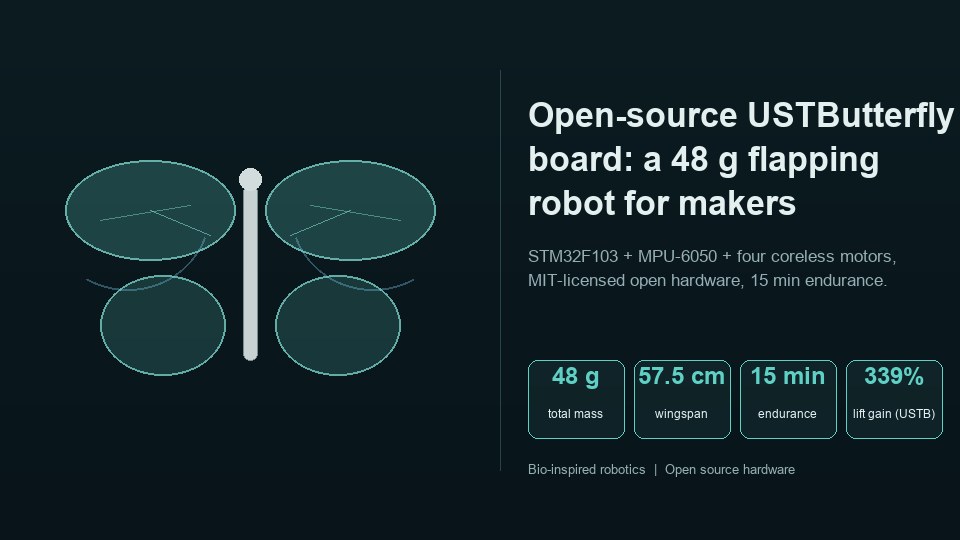
A Chinese maker release and a Beijing university study put a 48 gram flapping-wing robot within reach of developers, pairing open hardware with a deep-reinforcement-learning wing-optimization result.
What the open-source board delivers
The USTButterfly control board is an open-hardware design released under the MIT license. It targets the same class of bionic butterfly built by the University of Science and Technology Beijing, and it is small enough to embed in a lightweight airframe. The board measures 26 by 15.5 millimeters and carries the full avionics stack needed to drive four coreless motors, read attitude, and take remote commands.
The full flying robot weighs about 48 grams, spans 57.5 centimeters, and runs for up to 15 minutes on a lithium cell. It flaps at a rated 5 hertz with an 84 degree stroke, and a remote control steers it through climb, descent, forward and backward translation, and turns.
| Spec | Value |
|---|---|
| Total mass | 48 g |
| Wingspan | 57.5 cm |
| Flapping frequency | 5 Hz |
| Stroke amplitude | 84 degrees |
| Endurance | 15 min |
Hardware on the board
The design uses a dual-coreless-motor flapping drive with magnetic-encoder feedback rather than a single large actuator. Four coreless motors with gearboxes drive the wings, and four magnetic encoder channels close the loop on speed and position. The radio link runs on a 2.4 GHz module, and a low-dropout regulator feeds the 3.3 volt rail from a 3.5 to 6 volt supply.
| Module | Part |
|---|---|
| Microcontroller | STM32F103C8T6 |
| Attitude sensor | MPU-6050 |
| Motor driver | AT8833CQ x2 |
| Wireless | nRF24L01+ |
| Regulator | XC6206 3.3 V |
The published files include the schematic, PCB layouts in Altium and LCEDA formats, a bill of materials with procurement links, and a basic STM32 firmware demo covering closed-loop motor control, attitude estimation, and wireless communication.
How it flies
The robot generates lift and thrust by flapping flexible wings, and it borrows four well-known aerodynamic effects from biological flight. Delayed stall keeps a leading-edge vortex attached at angles far beyond the steady-flow stall limit. Rotational circulation adds an impulse as the wing flips at the turn of each stroke. Wake capture recovers energy when the wing meets its own vortex from the previous stroke. Clap-and-fling, where the wings meet at the top of the upstroke and separate again, produces the forward jet that drives thrust.
Steering comes from asymmetric flapping. Increasing the amplitude or frequency on both sides produces climb. Biasing one side stronger than the other creates a yaw moment that turns the body.
The research that inspired it
The platform descends from USTButterfly-II, a robot built by the University of Science and Technology Beijing and described in a 2026 npj Robotics paper. That team fitted 19 pairs of wings and flew 95 real test flights, then used a deep reinforcement learning loop to search the wing shape space. The optimized wing raised the reported lift performance parameter by 339 percent and thrust by 46 percent, with physical checks within about 7 percent of the model.
The study is notable because it trains on real flights rather than simulation alone, offering a concrete design loop for flapping robots that need either climb and payload or forward speed.
Where it fits
Flapping-wing robots remain hard on energy efficiency, endurance, wind resistance, and material durability. Even so, the format already earns stable revenue in weddings, cultural-tourism shows, and creative aerial photography because of its visual appeal and safe, low-noise flight. An open board at this weight class gives universities and makers a reproducible base for teaching and experimentation in embedded control and bio-inspired robotics.