Three open-source desktop robot dogs: ESP32-C3 voice, 12-servo bionics and a dual-S3 AI core
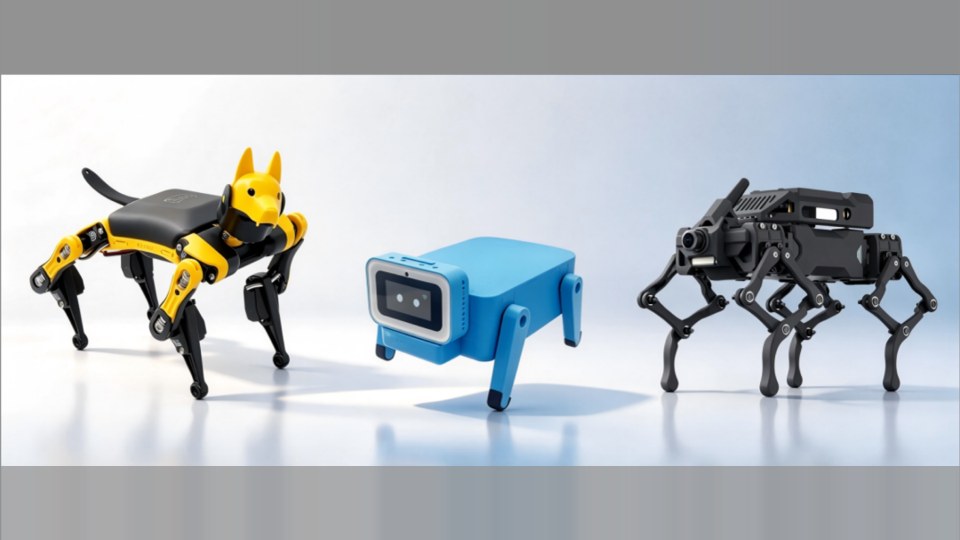
Legged robotics used to be the expensive end of the hobby: a platform with a dozen precision servos, a real-time controller and a control stack that took months to tune. That has changed. A generation of desktop quadrupeds now runs on the same Espressif chips and the same Arduino-era tooling as a smart switch, and the voice interface that once required a cloud appliance is a wake word and an API key away.
This roundup looks at three open-source desktop robot dogs that approach the problem from three different directions: a minimalist ESP32-C3 design built around a voice assistant, a mature twelve-servo kit with a proper desktop workbench, and a dual-chip machine that separates motion from AI and can be reprogrammed block by block. All three are programmable; none of them requires a robotics lab.
ESP-Hi: a voice-first dog on an ESP32-C3
The ESP-Hi is the most stripped-down of the three, and the most interesting for anyone who wants to understand how a talking robot is actually wired. It is built on an Espressif ESP32-C3 board and ships with the XiaoZhi voice assistant — the same open-source ESP32 voice stack that has become the default for Chinese DIY talking devices — driving a set of language models for conversation.
The design splits neatly into a brain and a body. The brain handles dialogue, voice and motion wake-up, voice commands, indicator lighting and the animated expressions on the screen. The body handles twelve preset movement routines, driven either by voice or from a web page. The vendor quotes a hardware cost of roughly ¥150 for the parts.
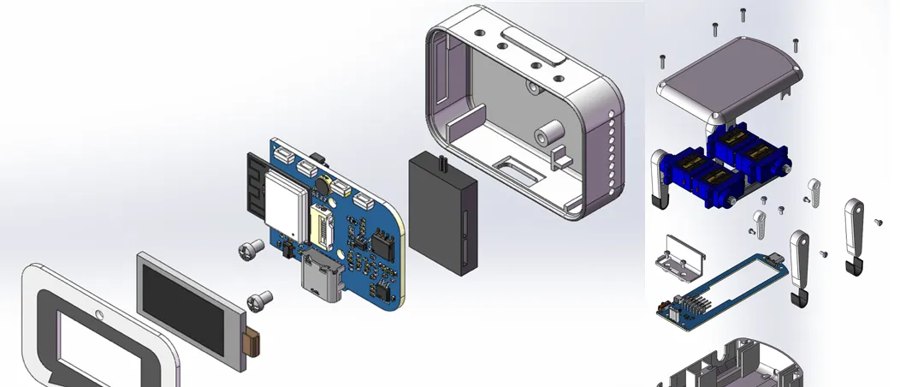
What lifts it above a novelty is the wake-up design. Instead of relying only on a wake word, the dog carries a mercury tilt switch that senses how fast it is being shaken, so picking it up, nudging it or shaking it can wake the assistant, interrupt a reply or fire an action. The rest of the electronics are deliberately ordinary: a 0.96-inch colour LCD, an 8 Ω 1 W speaker, a 4 × 1.5 mm microphone, a dedicated wake-up chip, a light-shielding baffle to keep the microphone from picking up its own servo noise, and an acrylic front panel over a PCB-shaped main board.
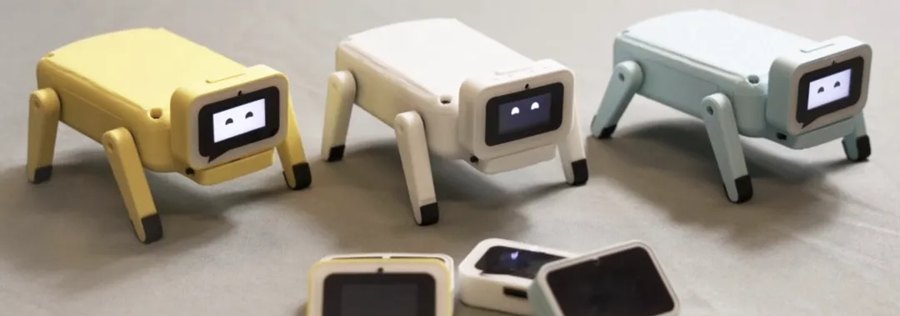
The mechanical side is a four-servo stack: four 180° SG92R servos under a servo board, with the frame made from four 3D-printed parts and a 500 mAh lithium cell tucked inside. From a browser you can drive it forward, back and side to side, trigger the twelve preset actions, and level the servos — a small but practical detail, because a quadruped that is even slightly out of calibration walks like it has had a long week.
Petoi Bittle: twelve servos and a Python workbench
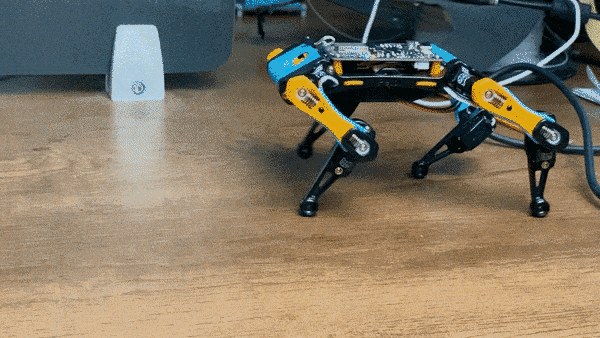
Where the ESP-Hi is minimal, Petoi Bittle is the established, well-documented option — an open-source, programmable, bionic quadruped small enough to sit on a desk. It measures about 20 × 11 × 11 cm, weighs under 280 g, and drives twelve servos through more than 60 canned action combinations, with enough torque to run, jump and climb a cardboard box, and enough of a back to carry around 450 g of payload.
The detail that matters for anyone who intends to program it is how the joints are organised. The twelve servo-driven joints are indexed by their distance from the torso: head pan and head tilt, tail pan and tail tilt, then per leg a shoulder (or hip) open/close, a shoulder pitch and an elbow (or knee). Getting that naming straight is the difference between a robot that walks and one that fights itself, and it is the first thing the documentation walks you through.
Petoi's desktop application is written in Python 3 with Tkinter, and gives you three things in one window: firmware upload, joint calibration and a skill composer for designing custom actions. For a kit aimed at education and hobby robotics, a maintainable desktop tool that covers all three is a genuine differentiator — it is the part most cheap quadrupeds skip.
Quaddle: one chip for motion, one for AI
Quaddle takes the opposite approach to the ESP-Hi: rather than one chip doing everything, it runs two ESP32-S3 microcontrollers, one dedicated to motion and one to AI interaction. The split is deliberate — keeping the servo control loop away from the audio and network workload is the difference between a robot that responds instantly and one that stutters whenever the language model has a thought.
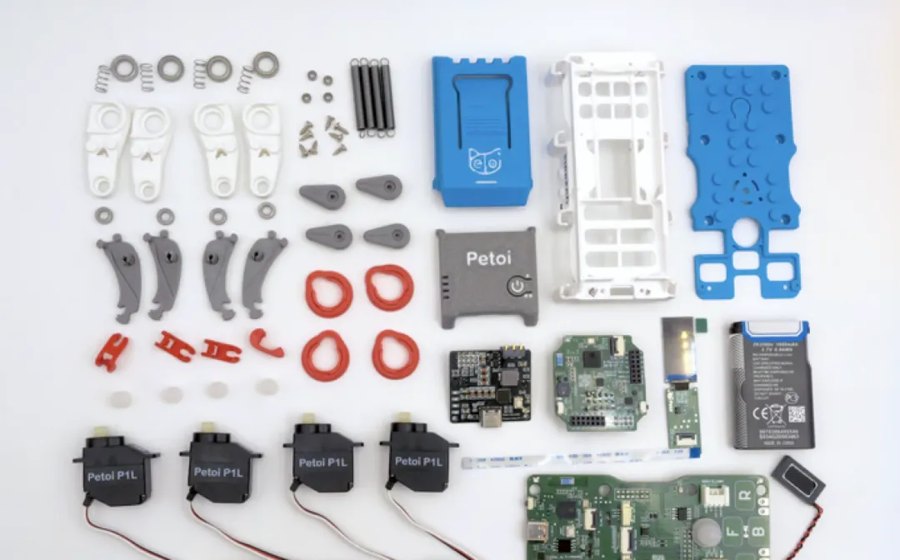
The mechanical design is where Quaddle is genuinely new. Petoi calls the trick MiniDoF: a linkage that lets one servo drive both the shoulder and the knee of a leg, so the robot walks, strafes, spins in place and self-balances on four servos where most hobby quadrupeds need eight or twelve. Fewer motors means less current draw, a smaller battery and a cheaper bill of materials, and it is the reason the kit can be sold as a desk toy at all. The body is deliberately boxy rather than animal-shaped — closer to a miniature industrial platform than a pet — and the legs fold flat against the chassis for storage and travel.
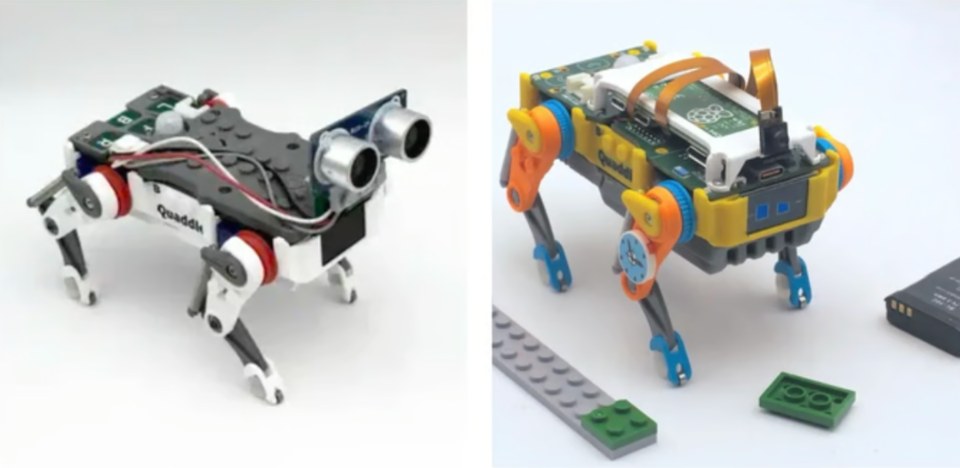
It is built on the open-source OpenCat system, a platform with a long lineage behind it: Nybble became Nybble Q, Bittle became Bittle X, and Bittle X grew into Bittle X+Arm. Around that core sit the sensors that turn a walker into something interactive: two ambient-light sensors, two infrared distance sensors, a gesture sensor, a passive-infrared sensor for human presence, four touch pads and a pair of microphones, plus four RGB LEDs, a colour TFT screen, a speaker, expansion Grove ports and a swappable lithium cell rated for roughly one to two hours of running.
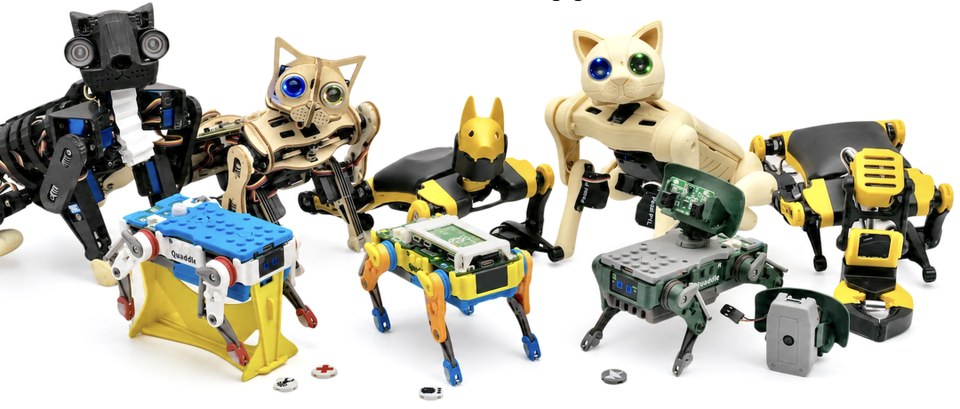
For privacy-conscious buyers there is a physical answer rather than a settings menu: a slide switch that disables the AI function entirely, and a mode switch that selects between onboard AI control and external control. Software support is unusually broad for a toy-grade robot — graphical block programming for beginners, then MicroPython, Python, C++ and ROS for people who want to go further, with an optional backend language-model API. A Raspberry Pi Zero can also be mounted in place of the AI core and take over as the brain, and the shell carries LEGO-compatible studs and 3D-printable mounting points, so it doubles as a chassis for whatever sensor or bracket you want to bolt on next.
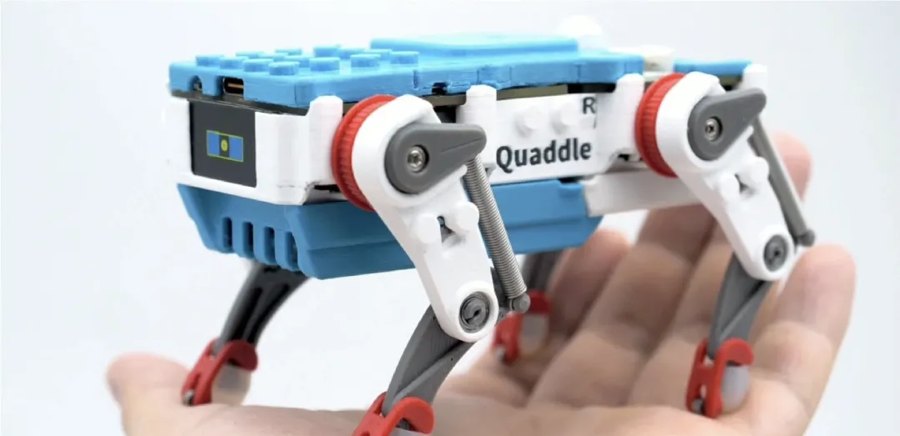
The kit was funded through a crowdfunding campaign that met its target within days, and it ships in three tiers built on the same hardware:
- Builder — the base kit, from $99 for early backers, already walking with more than ninety movements and carrying the Raspberry Pi Zero socket for anyone who wants to add a full Linux brain later.
- Buddy — everything in Builder plus the second ESP32-S3 AI core and position-feedback servos, which enable the feature that stands out most in the documentation: puppet the robot through a movement by hand and the firmware saves it as a macro for playback, with no inverse kinematics and no code.
- Scout — everything in Buddy plus the sensing package and a micro servo that sweeps the infrared distance sensor like a radar head, with an optional AI vision module for richer perception.
$99 buys the base model, and the AI core plus the feedback servos are what push the higher tiers up, so the tier you pick comes down to whether you want a coding toy or a sensing platform.
How they compare
| ESP-Hi | Petoi Bittle | Quaddle | |
|---|---|---|---|
| Main chip | ESP32-C3 | OpenCat controller board | ESP32-S3 motion core plus an optional ESP32-S3 AI core |
| Servos | 4 × SG92R | 12 | 4, with a MiniDoF linkage driving two joints each |
| Voice AI | XiaoZhi assistant, LLM conversation | Optional, via connected services | Dual-chip AI interaction, optional LLM API |
| Programming | Web remote, preset actions | Desktop workbench, skill composer | Block, MicroPython, Python, C++, ROS |
| Sensors | Mercury tilt switch, mic, LCD | Gyro, touch, and expansion | Light, IR distance, gesture, PIR, touch, mic |
| Teaching mode | No hand-taught recording | Skill composer on the desktop | Hand-guided recording on the higher tiers |
| Cost signal | ~¥150 in parts (DIY) | Commercial kit | From $99 for the base kit |
| Best for | Learning how voice robots work | Serious programmable bionics | Sensors, hand-taught tricks and privacy controls |
Practical notes
- The voice features are only as good as your network and API key. On-device wake-word detection is local, but the conversation itself normally calls a hosted model, so plan for connectivity, latency and a per-token bill.
- Servos are the failure point. Cheap 180° servos brown out under a stall, and a quadruped stalls constantly while it learns to walk. Budget for a proper battery, a common ground and, ideally, a servo that can take the load.
- Audio needs memory. An ESP32-S3 build that captures and streams audio really wants PSRAM; check the module variant before you buy a bare chip.
- Calibrate before you judge. All three rely on joint calibration, and a badly levelled quadruped looks broken when it is merely misconfigured.
- Check the licence and the support model. Open firmware is a promise about today; verify that the board you want is still in stock and that the project is still receiving commits before you commit to a build.
- Prices and payload figures are quoted from the projects and move with component costs and exchange rates; treat them as a starting point, not a quote.
IOTTourChina covers open-source IoT and robotics projects from the China-made hardware ecosystem as part of its developer resource. This is editorial coverage, not an endorsement or an advertisement; specifications, availability and pricing should be confirmed with each project before you build.