One board, one arm: an open-source robotic arm on RT-Thread's Titan RA8P1
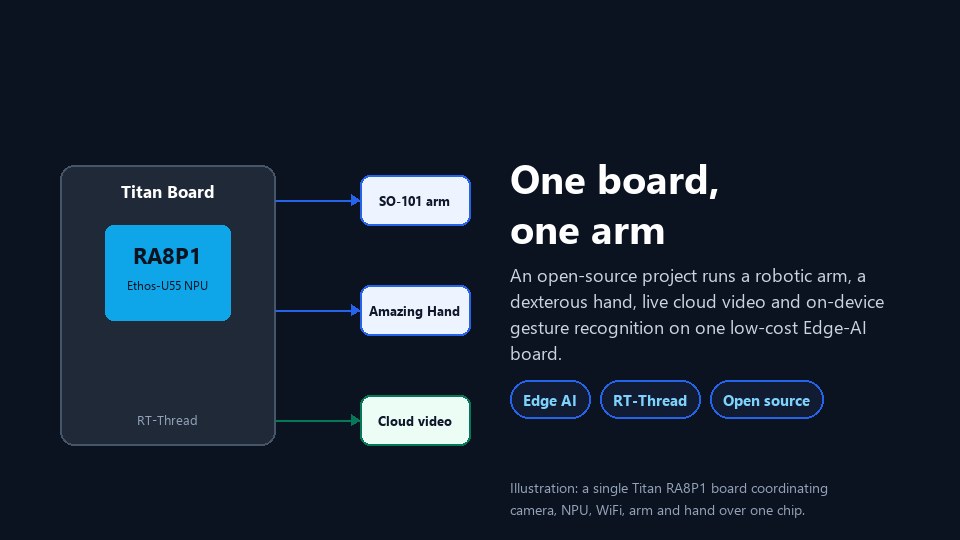
The arm wobbles, and its author says so in the first screens of the write-up. The base servo eventually chews its own metal gears. That honesty is what makes this project worth studying: everything around the wobbly arm — a seventeen-pose gesture model running on a microcontroller NPU, a live video link to a browser, and a game controller driving the joints — actually works, and every integration trap on the way is documented.
A competition build with a practical goal
The project took an honorable mention in the 2026 RT-Thread AIoT competition, and the author published the full code and build notes. The hardware host is the Titan Board RA8P1, the development board RT-Thread built around Renesas' RA8P1 microcontroller — a chip that pairs a 1 GHz Arm Cortex-M85 with a 250 MHz Cortex-M33 and an Ethos-U55 NPU rated at 256 GOPS.
The goal is practical rather than demonstrative: a desktop assistive arm for people with limited use of one upper limb, where a robotic arm and a dexterous hand share grasping, carrying and two-handed tasks. The author's own framing of the novelty is architectural — keep the control of arm and hand off the PC entirely, and see how much one board can absorb: camera, display, WiFi, inference and motion control on a single chip. The inspiration came from a Bilibili video of a Joy-Con teleoperating a LeRobot SO-101, which struck the author as more elegant than the usual leader-and-follower arm pair.
The hardware stack
| Part | What it is |
|---|---|
| Titan Board RA8P1 | RT-Thread's board around the Renesas RA8P1: 1 GHz Cortex-M85 plus 250 MHz Cortex-M33, Ethos-U55 NPU at 256 GOPS, 32 MB HyperRAM, 64 MB HyperFlash, WiFi 4 on a CYW43438 module |
| LeRobot SO-101 arm | The open-source, 3D-printed six-degree-of-freedom arm built on Feetech STS3215 bus servos |
| Amazing Hand | An eight-servo dexterous hand that replaces the SO-101's gripper |
| Joy-Con (right) | Teleoperation input, bridged by an ESP32 running Bluepad32 |
| Camera and RGB LCD | 640×480 capture for the vision model, plus a local live view |
The servos are the honest weak point. At a little over ¥100 each, the STS3215 units strain to carry an arm whose gripper has been upgraded into a dexterous hand: the base servo deforms gear teeth under load, and the whole arm shakes as it moves. The author is upfront that the mechanical result feels like a toy. The software result does not.
One chip, three jobs
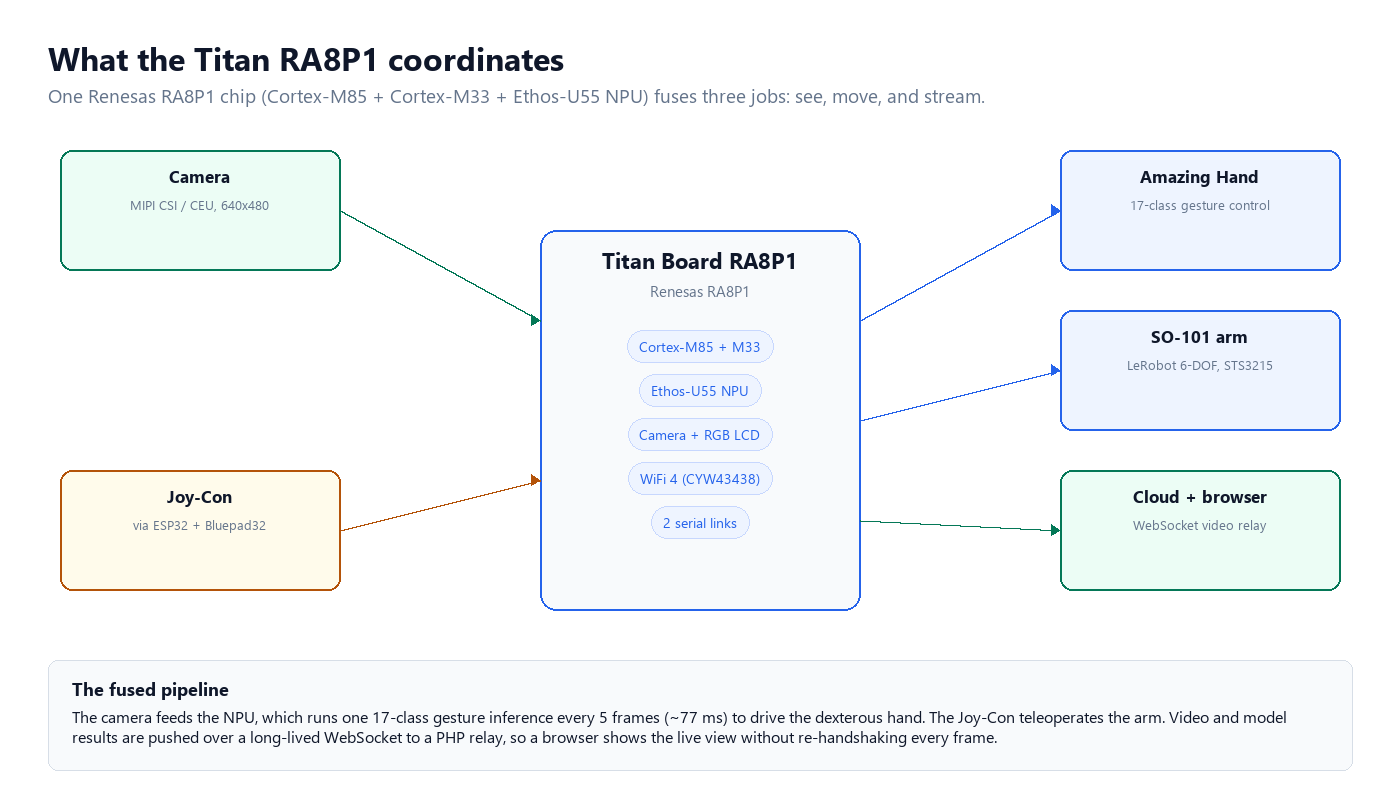
The RA8P1 runs three loops at once, and each has its own serial link:
| Link | Baud rate | Job |
|---|---|---|
| UART9 | 115200 | Joy-Con data arriving from the ESP32 |
| UART5 | 1000000 | The SO-101's STS3215 servo bus |
| UART6 | 1000000 | The Amazing Hand, send-only |
The gesture loop sends camera frames to the Ethos-U55, which classifies one of seventeen hand poses roughly every five frames at about 77 ms per inference, and drives the dexterous hand over UART6. The teleoperation loop turns Joy-Con sticks and motion into end-effector increments, solves inverse kinematics on the Cortex-M85, and writes joint targets to the arm's servo bus. The streaming loop pushes compressed video and model metadata to a browser.
Problem 1: teaching the WiFi stack to live with the NPU
WiFi on this board is a CYW43438 module driven by the WHD host driver, and the project keeps the driver's firmware and CLM data in external OSPI Flash through FAL partitions rather than in the MCU's internal flash. Porting that configuration from the standalone WiFi example into the NPU project surfaced three distinct failures: the FSP configurator generating invalid C code when an OSPI command table was left empty, a firmware download that verified correctly in Flash but failed on its way to the WiFi chip, and a WHD package update that began expecting a whd_nvram partition in external storage where the project used a built-in NVRAM.
Each failure had a separate root cause, and the author's debugging notes read like a checklist for anyone merging radio and AI workloads on this class of board.
Problem 2: the cache and the clock have to be staged
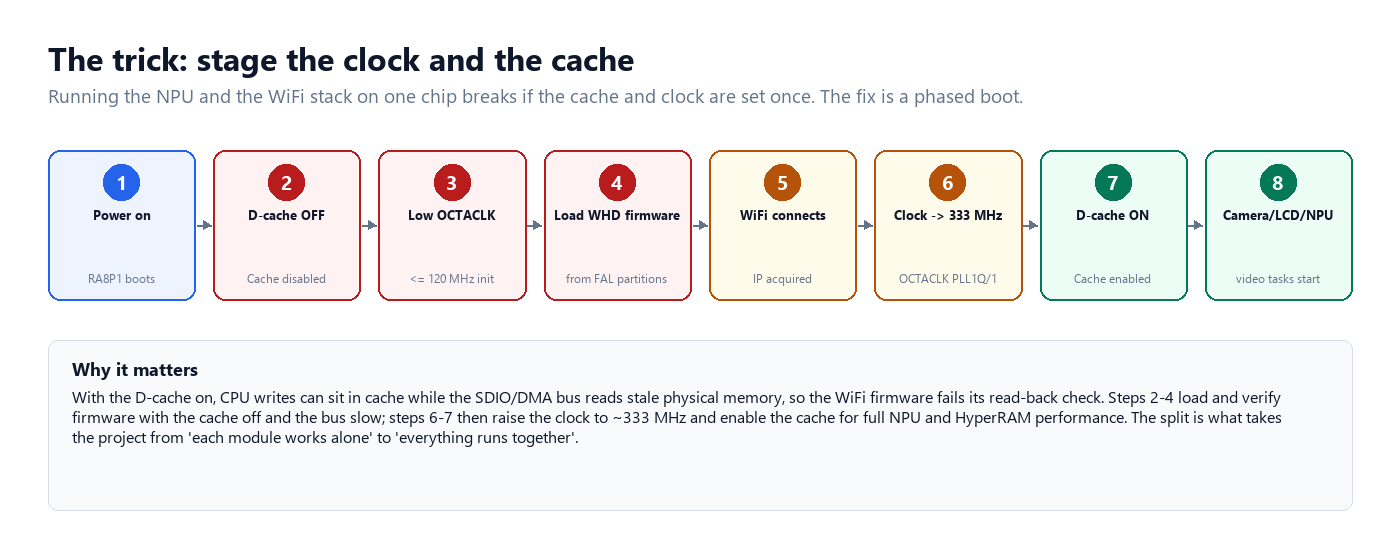
The second problem was the subtle one. In the standalone WiFi project, firmware downloads verified cleanly; in the merged NPU project, the same firmware failed its read-back check. The difference was the D-cache. With caching on, CPU writes can sit in cache while the SDIO and DMA engines read physical memory, so the WiFi driver compares stale bytes against fresh ones and fails.
Turning the cache off fixed the download and gutted performance — inference slowed, and LCD and HyperRAM access suffered with it. The working compromise is a phased boot: start with the D-cache off and the OSPI bus at its conservative clock of no more than about 120 MHz, load and verify the WiFi firmware, connect, then raise the bus clock to roughly 333 MHz and only then enable the cache and start the camera, LCD, NPU and video tasks. The author credits this split with taking the project from each module working alone to everything running together.
Problem 3: a video link that does not choke
The first streaming design posted every camera frame to a PHP script over HTTP, and it stuttered. Each frame carried TCP setup, HTTP headers, script startup and file writes — hundreds of milliseconds of overhead even for small images. The replacement is a long-lived WebSocket: the board connects once to a push endpoint on a PHP relay, the browser connects once to a view endpoint, and the relay forwards the latest frame to every viewer.
Before encoding, the 640×480 RGB565 frames are downsampled to 160×120 and compressed with TinyJPEG. At modest JPEG quality a frame is about 3 to 6 KB and encodes in 9 to 10 ms, enough for roughly 15 to 20 FPS in the browser; raising quality to 12 to 17 KB per frame drops throughput to 4 to 7 FPS, so the project keeps the leaner setting. The local LCD runs its own path at 17 to 22 FPS while the NPU takes every fifth frame. The author reports the pipeline ran overnight without a failure.
Problem 4: a gesture model that compiles to pure NPU code
The vision model recognizes seventeen poses — fist, palm, peace, OK, pointing, grabbing and more — and the training pipeline is as instructive as the deployment. It starts from the HaGRIDv2 gesture dataset, auto-annotated with MediaPipe hand keypoints, then applies augmentation tuned to what the board's camera actually produces: low light, focus and motion blur, sensor noise, RGB565 color quantization and uneven illumination. That last step mattered most; a model trained on clean dataset images fell apart on the board's darker, noisier feed until the augmentation closed the gap.
Training runs a PyTorch version of YOLO-Fastest at 192×192 input, chosen after Darknet's toolchain clashed with a recent laptop GPU, and the model is exported through ONNX with both detection heads preserved. The conversion trick worth remembering: hand the RUHMI toolchain a floating-point ONNX file and it wraps the NPU section with CPU subgraphs for quantization and post-processing; convert to a fully integer INT8 TFLite model first, and the entire graph compiles onto the NPU — the build log shows zero CPU operators and 107 NPU operators in a single subgraph.
The final model reaches a precision of 0.90, a recall of 0.82 and an mAP at 0.5 of 0.91. Precision is the metric that matters here: a false positive triggers a wrong hand motion, while a missed gesture can simply be repeated.
Problem 5: motion you can trust near people
Raw model output would make the hand twitch, so the control layer adds a majority vote over the last five inferences, with at least three agreeing before a pose is accepted, a minimum hold of about 1.5 seconds per gesture, and a timeout that returns the hand to its default pose after roughly 3.5 seconds without a detection. A long press on the Joy-Con's A button freezes the current hand pose — useful once the hand has closed on an object the camera can no longer see — and the X button releases it.
The arm gets the same discipline. Joint homes are computed as the midpoint of each joint's calibrated range rather than copied from calibration positions, software limits and power-on homing guard the mechanism, and per-cycle step caps keep position commands from producing jerky, snapped movements.
What builders can take from this
- Cache and clock policy is system design. On a single chip running AI and radio workloads together, when you enable the cache and when you switch clocks decide whether the system boots at all; the phased startup in this project is a reusable pattern.
- Convert to INT8 before the NPU compiler. Feeding a floating-point ONNX model straight into the toolchain leaves CPU subgraphs around the accelerator; an integer TFLite intermediate produced a pure NPU build with no CPU operators at all.
- A long-lived WebSocket beats HTTP per frame. One connection for the device and one for each viewer removed hundreds of milliseconds of per-frame overhead and stayed stable overnight.
- Train on the sensor, not the dataset. Augmenting training images to match the camera's darkness, blur and color quantization did more for on-device accuracy than any architecture change would have.
IOTTourChina covers open-source IoT hardware and the silicon behind it as part of its developer resource. This is editorial coverage, not an endorsement or an advertisement; the mechanical result is described as rough by its own author, and specifications and behaviour should be confirmed against the project repository before you build.