The accelerator's port is eight bytes wide and the array wants 512
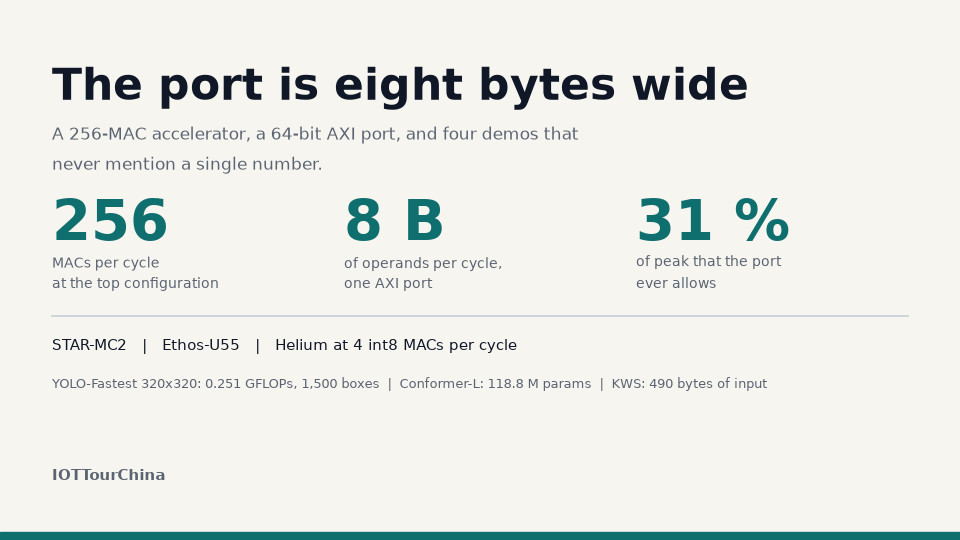
A vendor announces a platform, lists four workloads that ran on it, and publishes no numbers. Not a clock, not a multiplier count, not a memory mode, not a latency. The omission is not unusual for a promotional post, but in this particular case the missing items are the same four variables that decide whether the thing can be designed into a product, so the post describes a demonstration without describing its own result.
The platform is Arm China's Xingchen 300, an AIoT prototype built around three pieces of licensed IP: a STAR-MC2 application core, which the post equates with the Cortex-M52, an Ethos-U55 microNPU, and the vector extension that Arm calls Helium. The four demonstrations, spread across a series of videos, are face detection with YOLO-Fastest, speech recognition with wav2letter and with Conformer, keyword spotting with a MicroNet, and image super-resolution with a model the post calls ESR. All of them ran on an FPGA prototype.
That last sentence is the honest part and the unhelpful part at once. An FPGA proves the toolchain emits working command streams for four graphs. It says nothing about area, nothing about power, and, because the post withholds the configuration, nothing about speed that transfers to silicon. What follows reconstructs the missing variables from the IP's own compiler, then applies them to the four named models. Every figure can be reproduced from published files.
Four demos and not one number
The Ethos-U55 is not one accelerator. It is a family of four, and the family spans an eight-to-one range in arithmetic throughput. The compiler that targets it, Vela, names them by the number that matters: ethos-u55-32, -64, -128 and -256, where the suffix is the number of multiply-accumulate operations the array can retire per cycle. A post that says an NPU ran a model, without saying which of the four, has said something true and almost weightless.
The same applies to the clock, which in the compiler's own configuration file is a free parameter with two shipped values, 200 and 500 MHz, and to the memory mode, of which three are defined. Multiply the choices together and the same IP ranges over a factor of twenty in peak arithmetic before anyone argues about utilisation: the smallest part at 200 MHz retires 6.4 billion MACs per second, the largest at 500 MHz retires 128 billion.
What the post does pin down, indirectly, are the CPU-side numbers, because Arm publishes those on the product page for the core it names. The Cortex-M52 executes up to four 8-bit MACs per cycle under Helium, up to two 16-bit, one 32-bit, and it scores 4.3 CoreMark per MHz. Those are the numbers that give the accelerator something to be compared against, and they will matter later.
The four models, by contrast, are mostly well documented, and the two that are not are the interesting ones.
| Demo | Model | Published size |
|---|---|---|
| Face detection | YOLO-Fastest-1.1 | 0.252 GFLOPs, 0.35 M parameters, 320 x 320 |
| Speech recognition | wav2letter, then Conformer | 10.3 M to 118.8 M parameters, depending on variant |
| Keyword spotting | MicroNet-KWS | 16.4 M operations for the small variant, 53 kB of working memory |
| Super-resolution | ESR | not stated by the post |
The super-resolution model is named and not sized. That is the one case where the arithmetic below has to work from the output side, from the frame the demo has to produce rather than from the network that produces it, which turns out to be enough to make the point.
One port, eight bytes
The most consequential number in this whole story is not the TOPS figure. It is in the compiler's architecture description, in a single assignment that applies to all four configurations: the accelerator's AXI port moves eight bytes per cycle. One 64-bit port per memory area, one outstanding DMA transaction in the compiler's model, a 32-bit address space. Eight bytes.
At 200 MHz that is 1.6 gigabytes per second. At 500 MHz, four. Those two numbers appear verbatim in the comments of the configuration file that ships with the compiler, which is a useful kind of self-check: the file says SRAM at 1.6 GB/s for the low-end system, and eight bytes times 200 MHz is exactly that.
Now compare the two sides. A 256-MAC array consuming 8-bit operands wants one byte of weight and one byte of activation per MAC, which is 512 bytes per cycle if nothing is reused. It gets eight. Even with perfect reuse inside the array, keeping 256 MACs fed requires 32 MACs of work per byte that crosses the port. The smallest configuration, at 32 MACs per cycle, requires four. That ratio, not the multiplier count, is the design constraint.
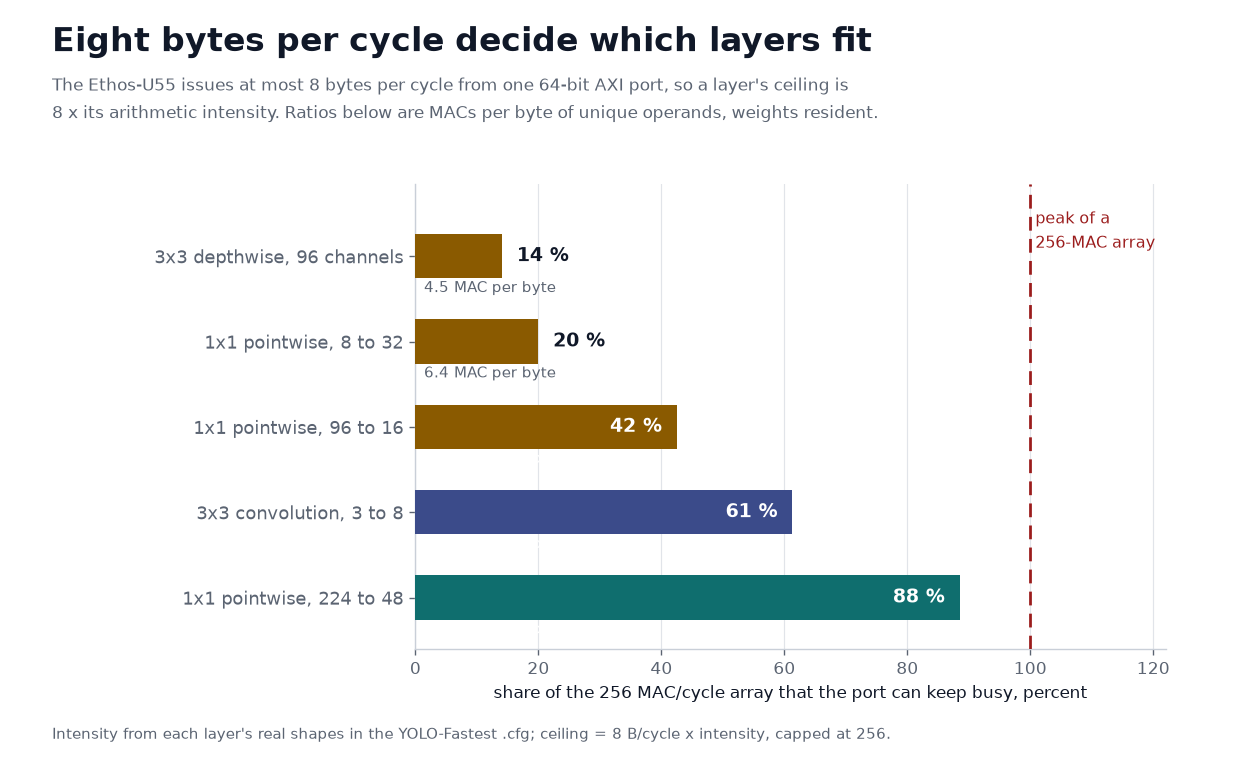
The figure above applies that ceiling to the layer shapes that actually occur in the face detector. A three-by-three depthwise convolution with 96 channels reads one activation byte and writes one per output, and performs nine MACs per output, so its arithmetic intensity is about 4.5 MACs per byte. Multiply by eight bytes per cycle and the best that layer can do on a 256-MAC array is 36 MACs per cycle: 14 percent of the array, with the remaining 86 percent waiting.
A pointwise convolution with 96 input channels reaches 13.6 MACs per byte and 42 percent. One with 224 inputs reaches 28.3 and 88 percent. The whole network, summed over all its layers, comes to 125.4 million MACs against 12.5 megabytes of unique traffic, which is 10 MACs per byte, or roughly a third of what the largest array needs.
None of this is a flaw in the IP. It is what a microNPU is: a small array with a narrow port, designed so that the compiler blocks the work into pieces that fit. The point is that the ratio determines the achievable fraction of peak, and that fraction is not a detail. It is the number that turns a badge into a schedule.
| Configuration | MACs per cycle | GMAC/s at 200 MHz | GOPS at 200 MHz | MACs per byte needed |
|---|---|---|---|---|
| ethos-u55-32 | 32 | 6.40 | 12.8 | 4 |
| ethos-u55-64 | 64 | 12.80 | 25.6 | 8 |
| ethos-u55-128 | 128 | 25.60 | 51.2 | 16 |
| ethos-u55-256 | 256 | 51.20 | 102.4 | 32 |
Doubling the array doubles the arithmetic and leaves the port where it was, so the required intensity doubles with it. The cost of a bigger array is not paid in silicon area alone.
Where the weights live
The port is shared between two memories with very different speeds, and the compiler's memory modes decide which gets what. Three modes are defined. In Sram Only everything sits in one SRAM and only one port is used. In Dedicated Sram the private SRAM is demoted to a cache and both the weights and the activations are placed in the wider read-write memory outside it. The default for the U55 is the middle one, Shared Sram, and it is the one that describes a real microcontroller: the weights are constant, so they are placed in the AXI1 address space marked read-only, which is where the flash sits; the activations are scratch, so they go in AXI0, which is SRAM.
The speeds in that file are worth reading carefully, because they show how lopsided the arrangement is.
| System configuration | Core clock | SRAM | Flash | Ratio |
|---|---|---|---|---|
| U55 Deep Embedded | 200 MHz | 1.6 GB/s | 0.1 GB/s | 16 to 1 |
| U55 High End Embedded | 500 MHz | 4.0 GB/s | 0.5 GB/s | 8 to 1 |
The flash path is the port scaled by 0.0625 or 0.125, so a weight byte costs eight to sixteen times as much time as an activation byte. For a layer whose weights are read once per inference that is the right trade, and for a model whose weights exceed the on-chip memory it is unavoidable. It also means that the useful mental model is not a single bandwidth but two, and the compiler chooses which one a tensor sits in.
The last piece of the memory picture is capacity. Three fixed sizes are published for that private SRAM, 256, 384 and 512 kilobytes, alongside an unconstrained variant for chips with memory to spare. Half a megabyte is the largest figure in the list, and it is the line the next three sections are measured against. It is not a hardware limit; it is the largest budget for which the compiler ships a configuration, which makes it the right reference for asking whether a model fits at all.
Rebuilding the face detector from its own config
The face detector is the one demonstration whose arithmetic can be rebuilt end to end, because the model's repository ships the Darknet configuration file the model was trained with. Parsing it gives 131 blocks, 84 of them convolutions, and adding up the multiply-accumulates layer by layer gives 125.4 million MACs, which is 0.251 GFLOPs. The published figure for the same model is 0.252 GFLOPs. The two agree to four tenths of a percent, which is the check that makes the rest of the numbers in this piece trustworthy.
The parameter count does not agree as well: 0.319 million by my count against 0.35 million published, a nine percent gap, because the count above includes convolution weights only and the published figure appears to fold in normalisation terms. For the bandwidth argument the difference does not matter, because the weight stream is dominated by the same layers either way.
The layer mix is the surprising part, at least to anyone who assumes these compact detectors are mostly depthwise work.
| Layer type | Count | MACs | Share of total |
|---|---|---|---|
| 1 x 1 pointwise | 55 | 96.7 M | 77 percent |
| 3 x 3 depthwise | 28 | 23.1 M | 18 percent |
| 3 x 3 stem, 3 to 8 channels | 1 | 5.5 M | 4 percent |
The pointwise layers carry three quarters of the arithmetic and the depthwise layers less than a fifth, which is the opposite of what the parameter count suggests: depthwise layers hold only 10.6 percent of the weights. The depthwise layers are what keep the model small. The pointwise layers are what the accelerator actually spends its time on, and there are 55 of them against 28.
The two detection heads sit on grids of 10 by 10 and 20 by 20, three anchors each, so a single frame produces 1,500 candidate boxes and 127,500 output values. Those numbers will matter when the CPU's post-processing is accounted for.
The weight file for this model is 1.4 megabytes in the floating-point form the repository publishes, which is 0.319 megabytes once quantised to eight bits. The largest single activation tensor is the second layer's output at 160 by 160 by 24, which is 614,400 bytes, or 600 kilobytes. That is larger than the largest SRAM the compiler offers, before any weights are loaded, which is why no deployment of this model is ever single-tile.
What the port costs at each configuration
With the layer list in hand, a floor can be computed. For each layer, count the bytes that must cross the port at least once: the input plane, the output plane and the weights, with the weights assumed resident for the duration of the layer. Divide by eight bytes per cycle to get a port-limited time, divide the MACs by the array width to get an arithmetic time, and take the larger of the two. Sum over the network and the result is a lower bound on inference time, generous in every direction: perfect reuse, no tiling overhead, no reload of activations between blocks.
| Configuration at 200 MHz | Arithmetic | Port | Floor | Share of peak |
|---|---|---|---|---|
| ethos-u55-32 | 19.6 ms | 7.8 ms | 19.8 ms | 99 percent |
| ethos-u55-64 | 9.8 ms | 7.8 ms | 12.0 ms | 81 percent |
| ethos-u55-128 | 4.9 ms | 7.8 ms | 8.9 ms | 55 percent |
| ethos-u55-256 | 2.5 ms | 7.8 ms | 8.0 ms | 31 percent |
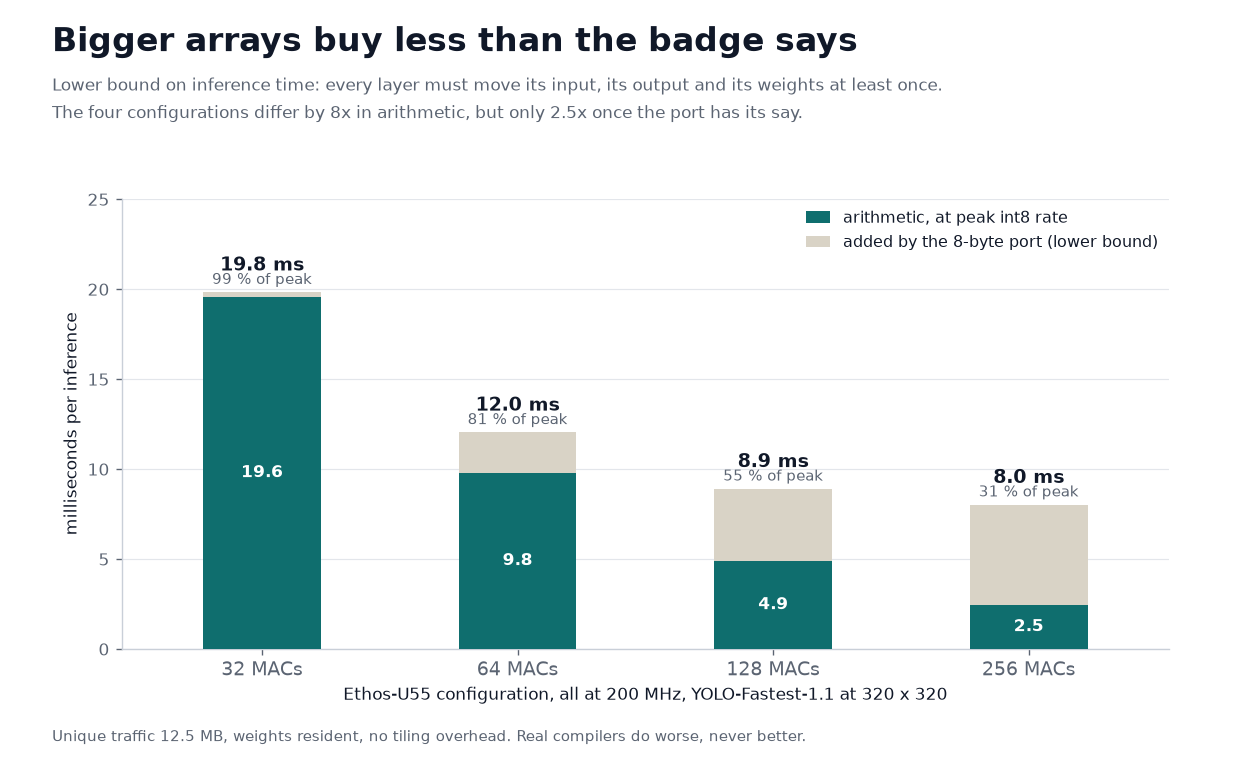
The column to stare at is the last one. Quadrupling the array from 64 to 256 MACs multiplies the arithmetic rate by four and moves the achievable time by a factor of 1.5, because the port's 7.8 milliseconds do not care how wide the array is. The eight-to-one spread across the family becomes a 2.5-to-one spread in time. Above 128 MACs the accelerator is no longer an arithmetic device for this model; it is a memory device that happens to multiply.
Two practical consequences follow. First, a vendor quoting one number for a family that spans 32 to 256 MACs is quoting the best case, and the best case is the one where the port is the whole story. Second, the way to make this model faster is not a wider array. It is a larger mesh: more channels per layer, so that each byte fetched serves more multiplies. That is a decision made at training time, months before the silicon arrives.
Two of the four cannot fit
Super-resolution and the Conformer share a problem that the face detector only brushes against: their working sets are measured in megabytes, and the on-chip budget is measured in hundreds of kilobytes.
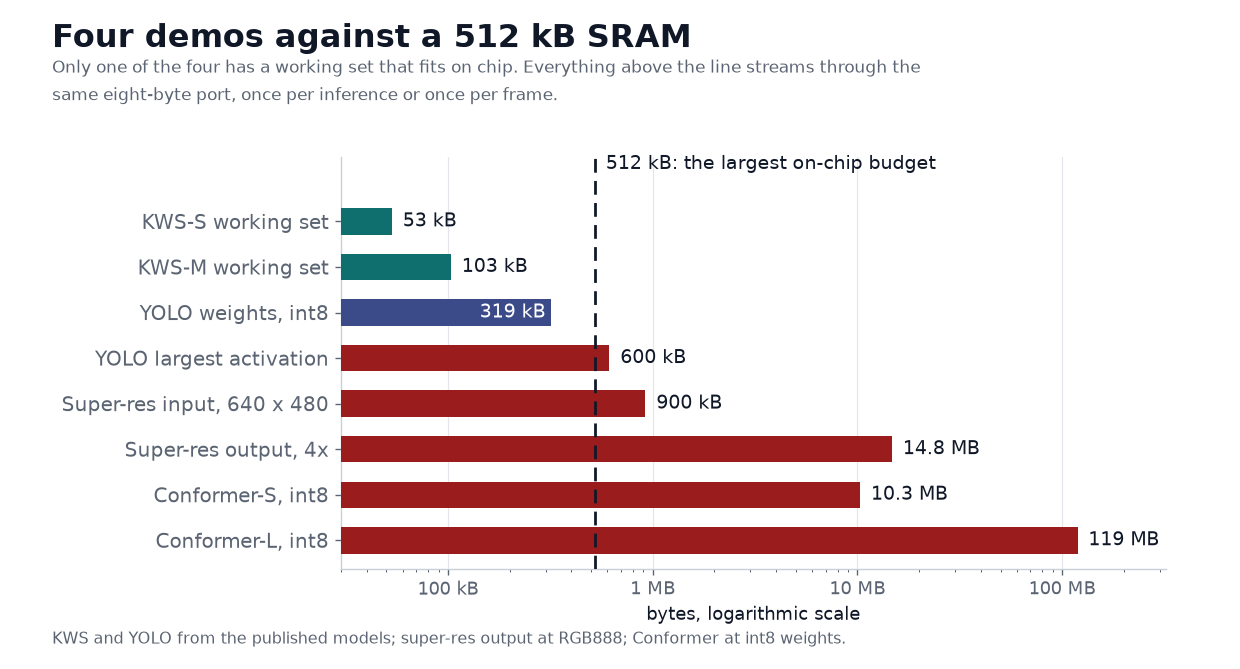
Take the super-resolution demo at a plausible surveillance resolution. A 640 by 480 frame at four times scale becomes 2560 by 1920, which is 4.9 megapixels. Written as RGB888 that is 14.75 megabytes for one frame. At the port's four gigabytes per second, writing it once takes 3.69 milliseconds, before anything is read and before any arithmetic happens. At 30 frames per second the output stream alone is 442 megabytes per second, which is 11 percent of the entire port budget spent on the last step of the pipeline.
Tiling does not make the requirement go away; it makes it fit. Fourteen and three-quarter megabytes over a 512-kilobyte window is at least 29 tiles, and each tile boundary forces the halo to be read again. The input side is no better: a single 640 by 480 RGB888 frame is 921,600 bytes, which is 1.76 times the largest SRAM the compiler offers. Even the frame being upscaled does not fit.
The Conformer has the same shape of problem with a different constant. Its published variants carry 10.3, 30.7 and 118.8 million parameters, which is 10.3, 30.7 and 118.8 megabytes at eight bits per weight, and 20, 59 and 227 times the 512-kilobyte ceiling. The acoustic front end, by contrast, is kilobytes: a mel spectrogram at 80 bands and 100 frames per second is 8,000 bytes. The ratio between the input and the model is about 1,300 to 1.
| Workload | Bytes that must move or reside | Against 512 kB | Stream time at 0.5 GB/s |
|---|---|---|---|
| Super-resolution output, 4x, RGB888 | 14.75 MB per frame | 28 x | 29.5 ms per frame |
| Super-resolution input frame | 0.92 MB | 1.8 x | 1.8 ms |
| Conformer-S | 10.3 MB | 20 x | 20.6 ms per second of audio |
| Conformer-M | 30.7 MB | 59 x | 61.4 ms |
| Conformer-L | 118.8 MB | 227 x | 238 ms |
Read the last column as the price of hearing one second of speech, assuming the weights have to be re-read from flash and nothing is cached. On the high-end system that is a quarter of the budget for the largest variant, and on the low-end 200 MHz system the same model needs 1,188 milliseconds of streaming to process one second of audio, which is not a latency problem but a real-time impossibility. A Conformer of that size cannot run on a microcontroller whose weights live in flash, whatever the NPU's TOPS.
This is the distinction the promotional post blurs. Four demonstrations ran on one FPGA board, and the four working sets span more than five orders of magnitude, from 490 bytes to 118.8 megabytes. A board that runs all four is a board with external memory on it. That is a perfectly reasonable thing for a prototype platform to be, and it is not a microcontroller.
The keyword spotter is the one that fits
The keyword spotter is the demonstration that survives every check, and the published numbers for it are unusually complete because the model comes from a benchmark suite with a memory budget attached.
The task is one second of audio from a 35-word vocabulary, classified into twelve classes at 16 kHz. The feature extractor turns that second into 49 frames of 10 mel coefficients, so the input tensor is 490 bytes. The small variant of the model needs 53.2 kilobytes of working memory and 102 kilobytes of flash, and performs 16.4 million operations. On a 128-kilobyte STM32F446 it completes in 250 milliseconds. On the larger boards the same model takes 109 and 108 milliseconds.
| Variant | Working set | Flash | Operations | Latency, small board |
|---|---|---|---|---|
| KWS-S | 53.2 kB | 102 kB | 16.4 M | 250 ms |
| KWS-M | 103.3 kB | 163 kB | 30.6 M | 426 ms |
| KWS-L | 208.8 kB | 612 kB | 129 M | not deployable |
The working set of the small variant is 42 percent of the smallest board's SRAM, which is why it fits with room for the rest of the firmware. The large variant needs 209 kilobytes, which is 163 percent of that board and the reason the benchmark table leaves its latency blank.
Those 250 milliseconds are the most useful number in this whole comparison, because they are a measurement rather than a peak. 16.4 million operations in a quarter of a second is 65.6 million operations per second, or 32.8 million MACs per second, on a core whose Helium extension can retire four 8-bit MACs per cycle. That is what a real integer inference kernel on a real M-class core achieves: a small fraction of the hardware's own ceiling, spent mostly on data movement and loop overhead.
Put the same graph on the accelerator and the arithmetic becomes trivial. 8.2 million MACs at 51.2 GMACs per second is 160 microseconds at 200 MHz with the largest array, or 320 microseconds with the 128-MAC part. Whether the real number lands anywhere near that depends entirely on the two things the post does not say.
Checking the 480-times claim
Arm's own product page for the accelerator makes a larger claim than the WeChat post does: an Ethos-U55 combined with a Cortex-M55 delivers a 480-fold uplift in machine learning performance over existing Cortex-M based systems. The reference platform named there is the M55, while the Xingchen 300 pairs the same accelerator with the smaller M52-class core, which is worth noting but is not the interesting part.
The interesting part is that the claim can be bounded. Two numbers are pinned down by the vendor itself. Helium on the M52 retires four 8-bit MACs per cycle. The accelerator retires between 32 and 256. At the same clock, and on pure int8 arithmetic, the accelerator is therefore between 8 and 64 times the CPU. A factor of 480 cannot come from the accelerator alone at equal frequency; it has to include a clock difference, a utilisation difference, or a baseline older than the M52.
The measured keyword-spotter number lets the claim be tested the other way round. Take the 65.6 million operations per second that an M4 actually delivered on that model and apply the 480 factor: the accelerator would need to sustain 31.5 billion operations per second. Compare that with what each configuration can do at peak.
| Configuration | Peak at 200 MHz | Utilisation needed for 480x |
|---|---|---|
| ethos-u55-64 | 25.6 GOPS | 123 percent, impossible |
| ethos-u55-128 | 51.2 GOPS | 62 percent |
| ethos-u55-256 | 102.4 GOPS | 31 percent |
At 200 MHz the smallest array cannot produce the number at all, which rules it out as the configuration behind the demonstration. The largest needs 31 percent of its int8 peak, and that is the same 31 percent that the port floor produced for the face detector in the table earlier. Two entirely independent routes, one from measured CPU latency and a marketing ratio, the other from per-layer byte counts, land on the same utilisation figure.
That agreement is the most useful thing in this piece. It says the 480-times number is not inflated. It also says what it is: a statement about a specific configuration, at a specific clock, on a model small enough that the port's penalty is partly hidden by fixed overheads. None of those three qualifiers appear in the post, and all three are needed before the number can be compared with anything.
What the CPU still has to do
The last piece of the budget is the part that runs on the core, and at this scale it is not a rounding error.
The resize from a 640 by 480 camera frame to the detector's 320 by 320 input touches 307,200 samples, three channels of 102,400 pixels, and a bilinear interpolation needs four multiplies per sample. That is 1.23 million MACs. On Helium at four 8-bit MACs per cycle and 200 MHz, ignoring memory, it takes 1.54 milliseconds. The accelerator's share of the same frame is 2.45 milliseconds at the largest configuration. Pre-processing is 63 percent of the inference it feeds.
Decoding the two detection heads is smaller but not free: 127,500 output values, each needing a sigmoid or an exponential and a scale, is 0.64 milliseconds at one value per cycle. Then there is suppression.
| Stage | Work | Time at 200 MHz |
|---|---|---|
| Bilinear resize to 320 x 320 | 1.23 M MAC | 1.54 ms |
| Head decode, 1,500 boxes | 127,500 values | 0.64 ms |
| NMS, 50 survivors | 1,225 pairs | 0.06 ms |
| NMS, 200 survivors | 19,900 pairs | 0.99 ms |
| NMS, all 1,500 candidates | 1,124,250 pairs | 56.2 ms |
Non-maximum suppression is quadratic, and the whole difference between a rounding error and the largest cost in the pipeline is the confidence threshold. At the default settings of this model most candidates are discarded before suppression runs, which is why nobody notices. Raised to keep more small objects, the same code becomes five times the cost of the inference it is filtering. This is the sort of thing that a four-demo prototype never exposes, because the demo is tuned until it looks good.
A published deployment of the same accelerator on a different chip makes the point from the other direction. In a gesture-recognition arm built around a Renesas RA8P1, with the same 256-MAC NPU rated at 256 GOPS, a seventeen-class pose model runs every fifth frame at about 77 milliseconds per inference. The model at that input size is a tenth of a gigaflop. Arithmetic at 256 GOPS would finish it in under a millisecond. The other 76 are the camera path, the pre-processing, the handoff and the post-processing, which is where the time actually goes in a working system.
What an FPGA demo does not settle
Four graphs running on a prototype is evidence that a compiler works. It is not evidence about a product, and the gap between the two is exactly the four numbers the post leaves out.
The first is the accelerator configuration, because the family spans eight to one in arithmetic. The second is the clock, because the same part at 200 and 500 MHz differs by a factor of 2.5 in the numbers computed here. The third is the memory mode, because the choice between all-in-SRAM and weights-in-flash changes the available bandwidth by 8 to 16 times. The fourth is the latency per model, which is the only number that cannot be derived, because it depends on the graph, the compiler's blocking choices and the memory system together.
Ask for those four and most of the ambiguity disappears. Ask for TOPS and the answer will be true, unhelpful, and impossible to check.
The number that deserves to be on the front of the datasheet is the one in the compiler's architecture file: bytes per cycle at the port. Eight, in this case, against an array that can consume 512. Everything else in this piece follows from that ratio, and none of it is visible in a video of four demos running.