reBot-DevArm: an open 6+1 DoF arm that closes a sim-to-real loop
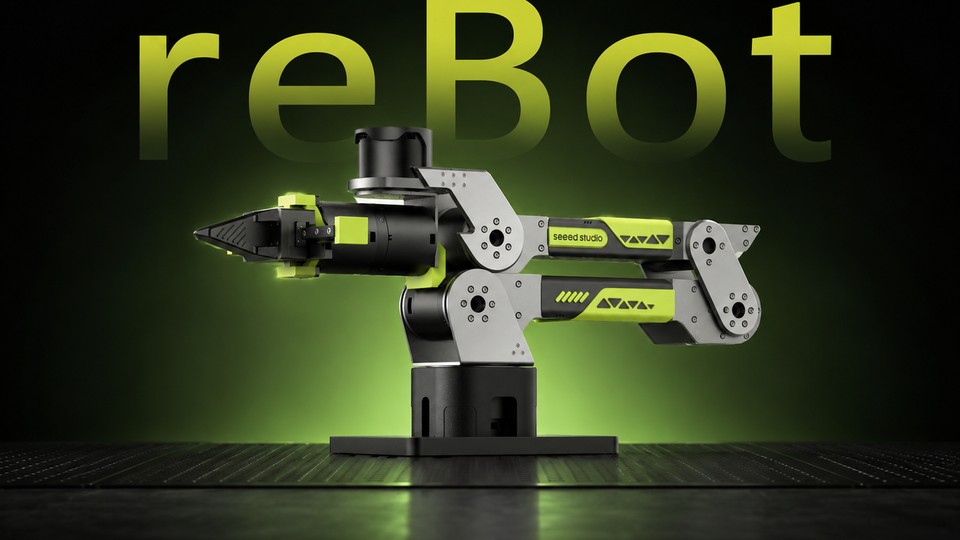
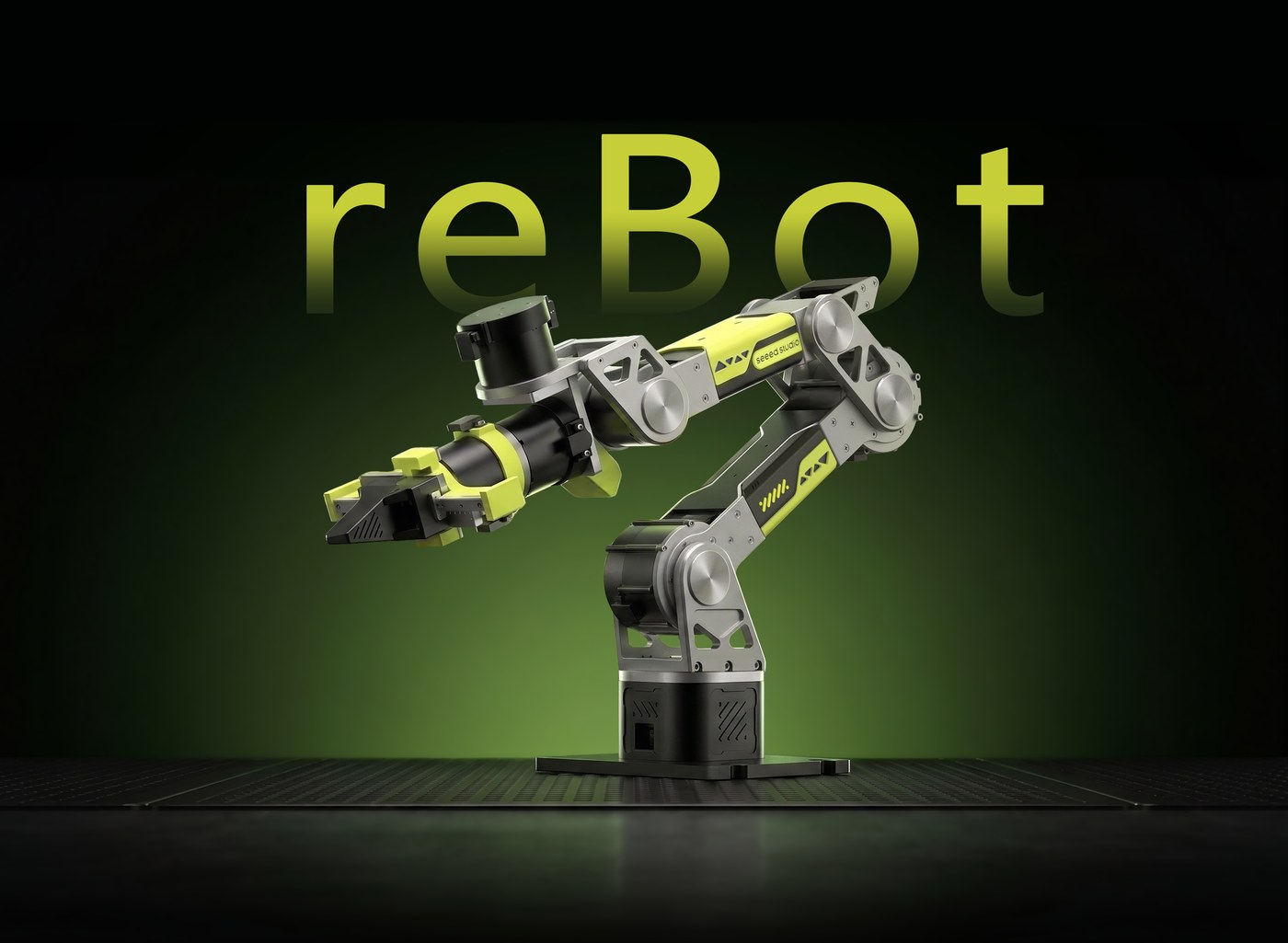
A robotic arm is the cheapest way to get a real end effector in front of a computer-vision model, and an expensive way to find out that your hardware cannot be reproduced by the person reading your paper. reBot-DevArm is Seeed Studio's answer to the second problem: a desktop six-axis arm whose mechanical drawings, bill of materials and control stack are all published, in two actuator variants that share a shell.
What makes it worth reading about now is not the arm. It is that in July 2026 the arm became one of the first physical platforms to adopt the stack NVIDIA and Hugging Face had just released together, and the whole round trip from recorded demonstrations to a working policy was documented by the people who built the model.
Two arms in one shell
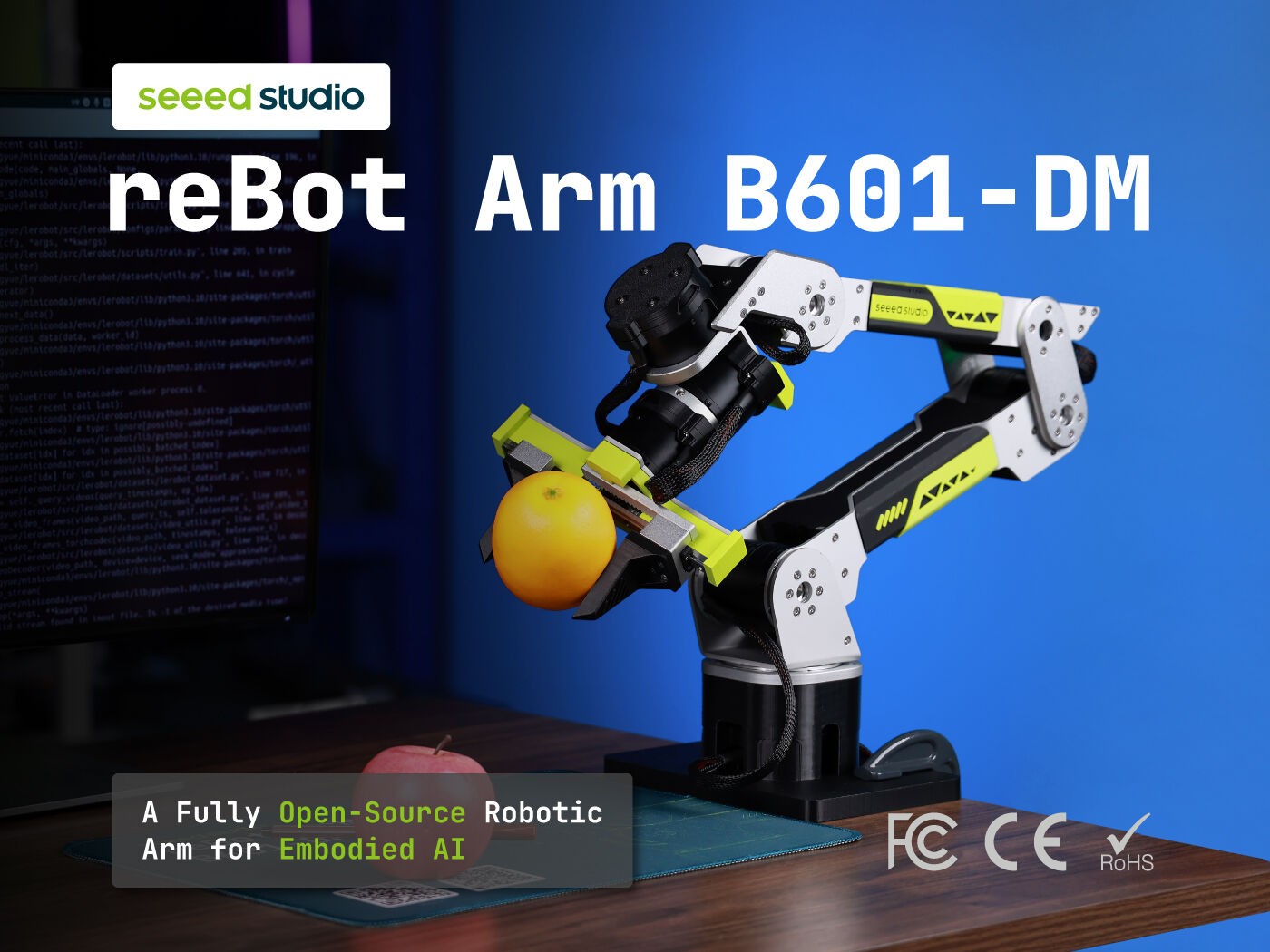
Both variants are 6 DoF plus a seventh actuator in the jaw, so the ecosystem documentation calls them 7-DOF arms. They look the same and differ underneath in the motors you have to buy.
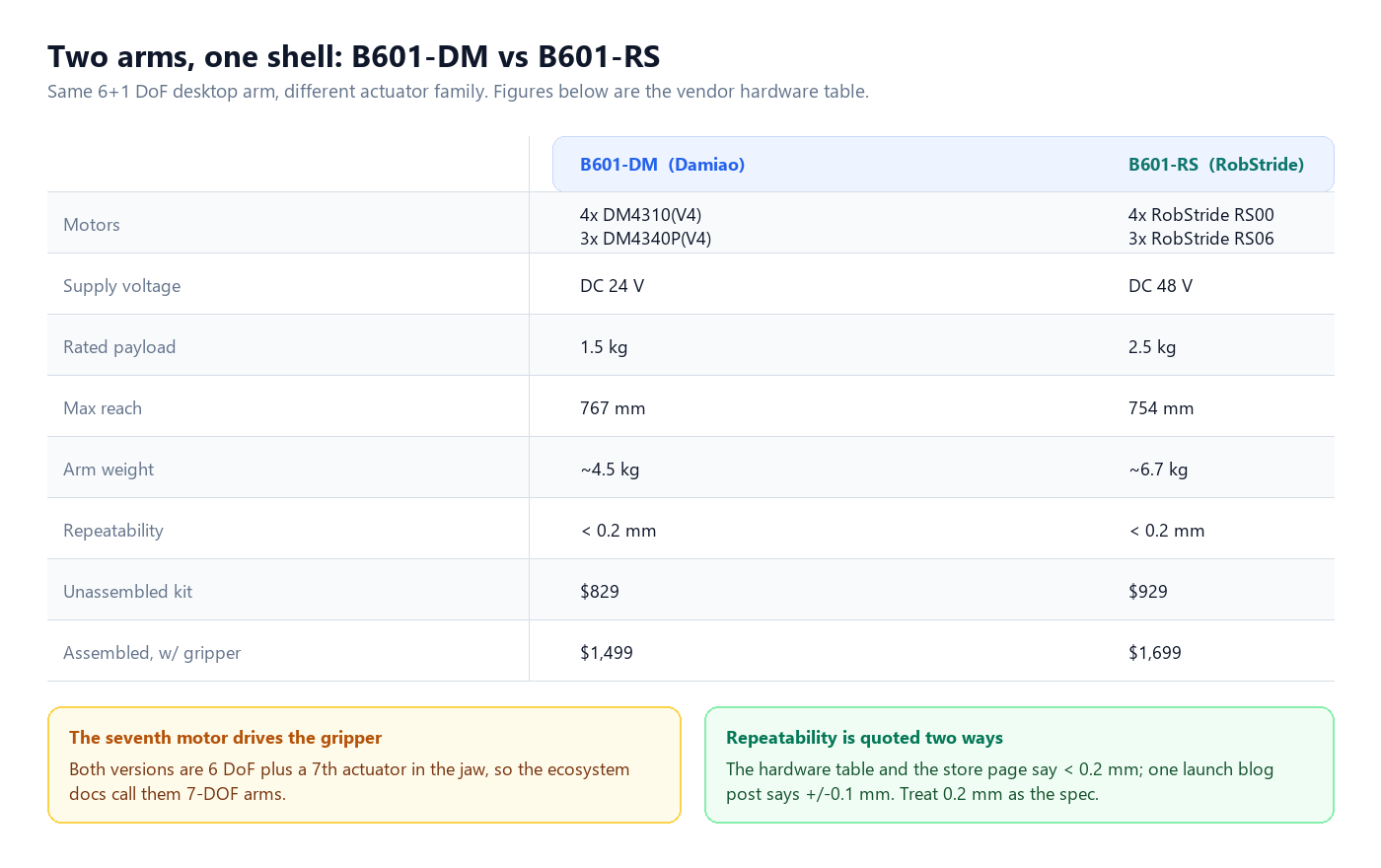
| Parameter | B601-DM | B601-RS |
|---|---|---|
| Actuators | 4x DM4310(V4) and 3x DM4340P(V4) | 4x RobStride RS00 and 3x RobStride RS06 |
| Degrees of freedom | 6 plus a gripper actuator | 6 plus a gripper actuator |
| Supply voltage | DC 24 V | DC 48 V |
| Rated payload | 1.5 kg | 2.5 kg |
| Maximum reach | 767 mm | 754 mm |
| Arm weight | about 4.5 kg | about 6.7 kg |
| Repeatability | under 0.2 mm | under 0.2 mm |
| Recommended workspace | 70 percent of reach | 70 percent of reach |
The Damiao build wins on reach and weight, the RobStride build wins on payload and supply headroom. Seven hundred grams of extra arm weight buys you a kilogram of rated load, which is the trade the two variants are actually offering.
Two details are worth flagging early.
- Repeatability is quoted two different ways. The hardware table in the repository and the store product page both say under 0.2 mm. One Seeed launch blog post for the RS version says plus or minus 0.1 mm. Treat 0.2 mm as the specification you can hold the vendor to, and expect community measurements to be worse than that on a desk that is not bolted down.
- The seventh motor is not a spare axis. It drives the parallel jaw, so payload figures assume the gripper is carrying the load.
What the open-source claim actually covers
Plenty of projects publish firmware and call themselves open. Here the repository publishes the parts you would otherwise have to reverse-engineer.
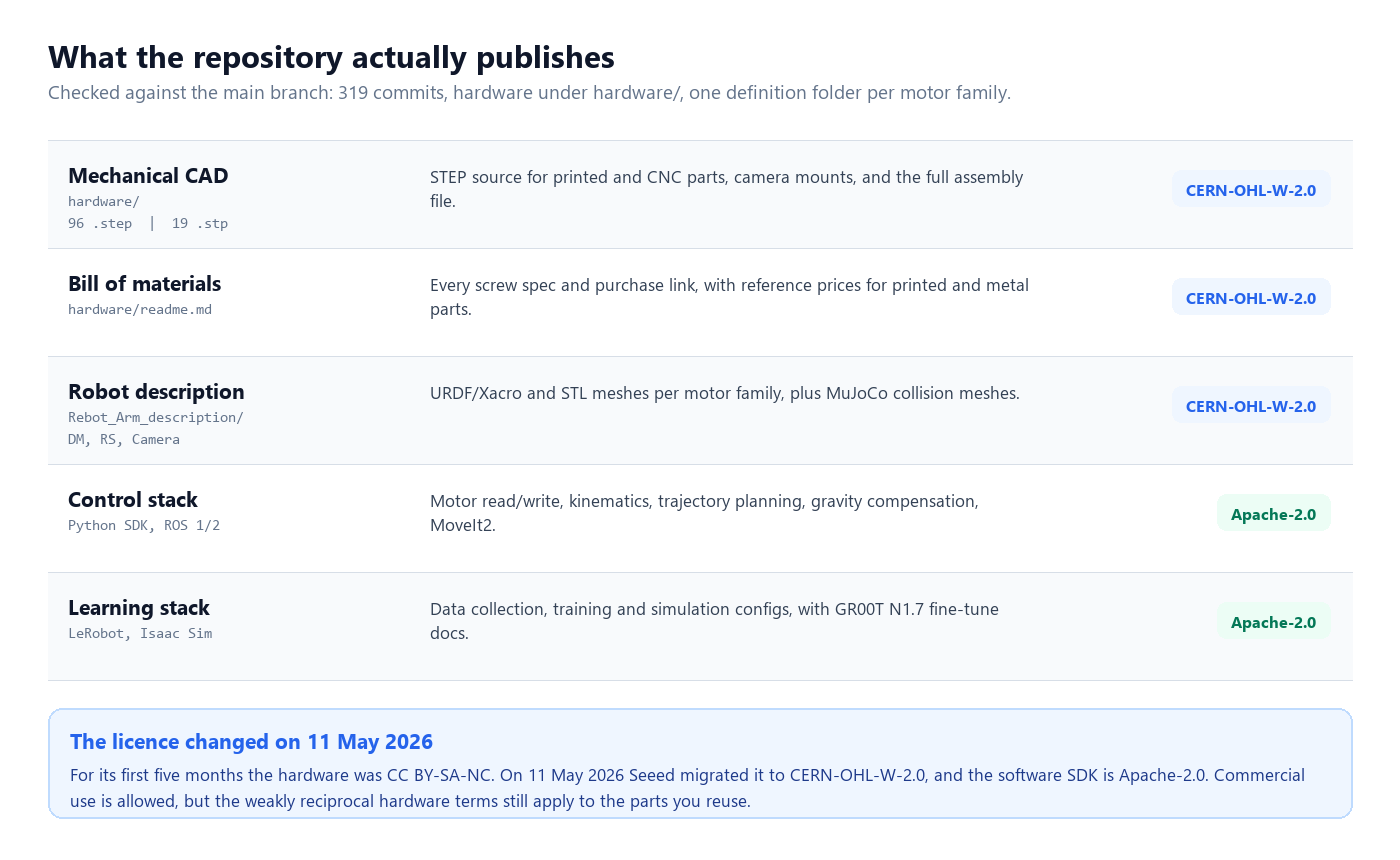
The mechanical source is the part that matters most for reproduction. The hardware tree carries STEP source for both motor families, split into 3D-printed parts, CNC-machined metal parts and purchased parts, plus a full assembly file and a set of wrist camera mounts. At the time of writing that tree holds 312 files, of which 96 are STEP and 19 are STP. Separate definition folders hold URDF and Xacro, STL meshes and reduced collision meshes for MuJoCo, one folder per motor family.
The bill of materials is unusually granular for a hardware project: every screw is listed with its specification and a purchase link, and both the printed and the machined parts carry a reference price. It also carries an explicit disclaimer that the published BOM is not the shipping configuration, because Seeed's production version adds laser-engraved foolproofing, replaces some printed parts with metal, tightens tolerances and adds braided-sleeve wiring. The mechanical structure is the same; the details are not.
The one piece of evidence that the published files track the real hardware is the revision history. The DM hardware went from v1.0 in March 2026 to v1.1 in April 2026, and the v1.1 changelog lists three changes that could only have come from assembling arms: a cable restraint for the three end-joint motors, a correction of joint 1 from a 4310 to a 4340P, and an added base reinforcement part. Those are field fixes, not marketing.
On licensing, hardware and software are separated. The hardware designs moved from a non-commercial Creative Commons licence to CERN-OHL-W-2.0 with a single commit on 11 May 2026, after five months of the more restrictive terms. The software SDK is Apache-2.0. Commercial use is allowed either way, but the weakly reciprocal hardware terms still apply to whatever you reuse, so read them before you build a product on the drawings. The project also holds OSHWA open-hardware certification CN000024.
The repository itself is active rather than parked: created in November 2025, 319 commits, around 4,371 stars and 436 forks at the time of writing, with pushes on the day this was checked, and READMEs maintained in English, Chinese, Japanese, French and Spanish.
Why NVIDIA used it
This is the part that separates reBot-DevArm from the pile of open arms on GitHub.
In July 2026, NVIDIA and Hugging Face announced that Isaac Teleop, NVIDIA's teleoperation data-collection framework, and GR00T N1.7, its vision-language-action foundation model, were native to LeRobot. LeRobot 0.6.0 replaced its earlier N1.5 port with a native N1.7 policy. The significance is not the model alone but the absence of format conversion between collecting data and training on it.
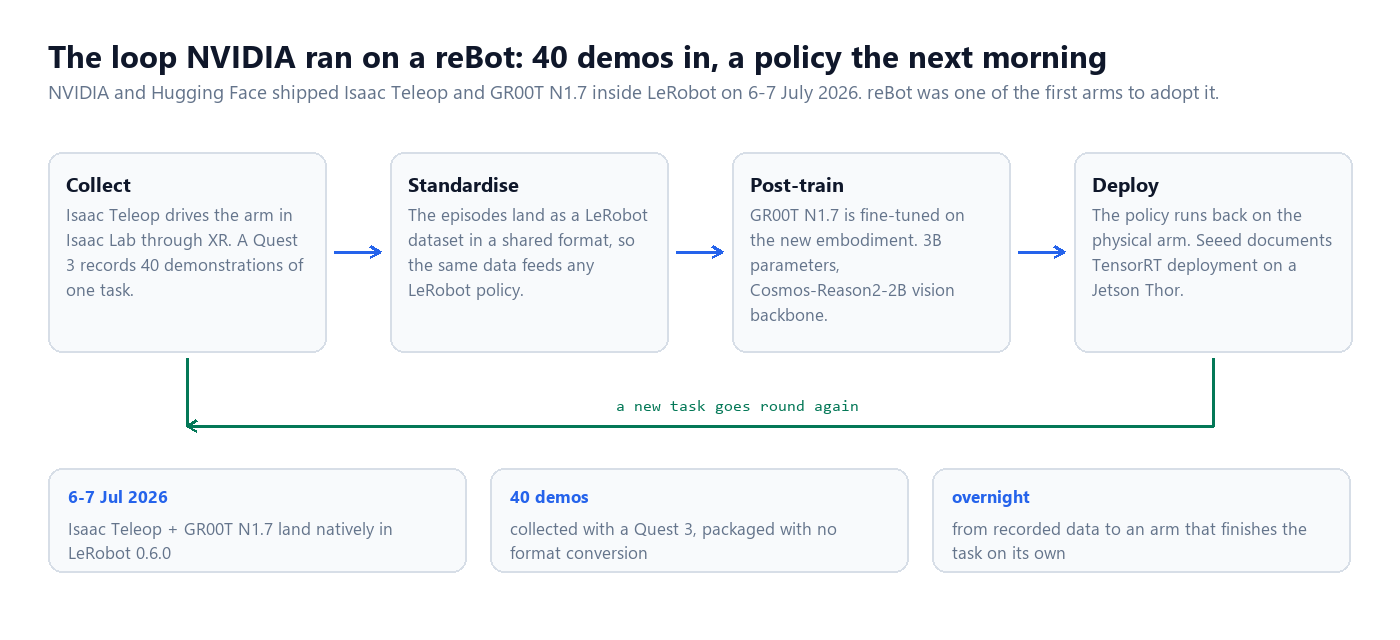
GR00T N1.7 is a 3-billion-parameter model built from a Cosmos-Reason2-2B vision-language backbone and a diffusion transformer action head, with the dexterity training recipe drawing on roughly 20,854 hours of human first-person video. What makes it usable on a desktop arm is that it is cross-embodiment: you post-train it against your own hardware instead of reimplementing it.
NVIDIA's senior developer advocate for robotics and physical AI, Asier Arranz, documented the round trip on a reBot. The stack was ported from the SO-ARM101 to the reBot DevArm, the arm was teleoperated in Isaac Lab through XR using a Quest 3, and forty demonstrations of a single task were recorded and packaged as a standard LeRobot dataset. After fine-tuning GR00T N1.7 as a new embodiment, the arm completed the task on its own the next morning. The whole learning loop ran in simulation.
Two practical notes for anyone following that path. The dataset travelling through LeRobot is in v3 format while the GR00T repository expects v2, so an official conversion step sits between collection and training. And GR00T N1.7 weights ship under terms that are not as simple as the headline suggests: NVIDIA's launch material describes commercial use, while a licence file bundled with the checkpoint restricts use to research and evaluation. Check the terms attached to the exact download before you plan a product.
The rest of the stack
A published arm with no control software is a sculpture, so the ecosystem coverage matters as much as the CAD.
| Layer | What is published |
|---|---|
| Motor SDK | A Python SDK and a browser tool covering Damiao, Robstride, Hightorque, Myactuator and Hexfellow actuators, with one-click zero-point setting |
| ROS | ROS 1 and ROS 2 workspaces with RViz visualisation and MoveIt2 for planning |
| Kinematics | Pinocchio forward and inverse kinematics with gravity compensation |
| Simulation | Isaac Sim models and simulated teleoperation, plus an in-browser MuJoCo digital twin of the RS arm |
| Learning | LeRobot configurations for both single-arm and dual-arm setups, and a GR00T N1.7 fine-tune and Jetson Thor deployment guide |
| Perception | A YOLO and RGB-D grasping demo with hand-eye calibration supporting the Orbbec Gemini 2 and Intel RealSense D435i and D405 |
| Voice | A reSpeaker microphone-array demo that drives the arm by spoken command |
| No-code | A guided workflow on Seeed's SenseCraft Robotics platform with cloud training, so the whole loop can run without a local GPU |
The reference environment for the ROS 2 workspace is Ubuntu 24.04 with ROS 2 Jazzy, and the tutorials note that Humble on Ubuntu 22.04 follows the same workflow with a matching distribution.
Data collection is where the accessories start to matter. A wrist camera mount decides whether your recorded episodes contain useful pixels, and the repository publishes mounts for a small UVC board, the D435i, the D405 and the Gemini 2 and Gemini 305, with the meshes and URDFs included so they appear correctly in simulation.
The thermal ceiling nobody advertises
This is the most useful page in the whole repository, and it is the one a marketing article would leave out.
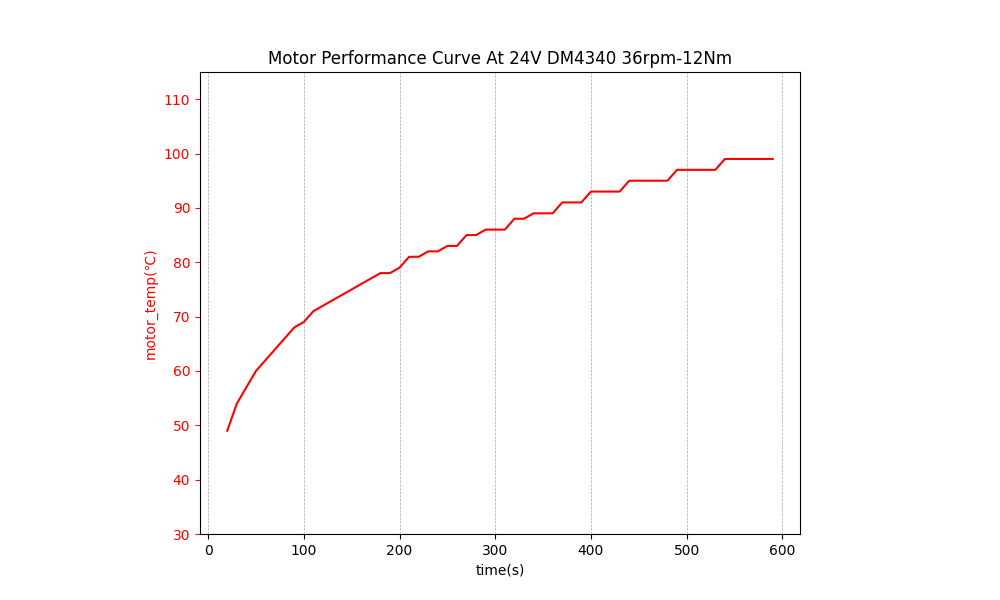
The arm has no active cooling, so duty cycle is set by whichever motor heats up first. Seeed ran the DM version until it tripped, published the results and named the culprit: motor 2, the 4340P in the shoulder.
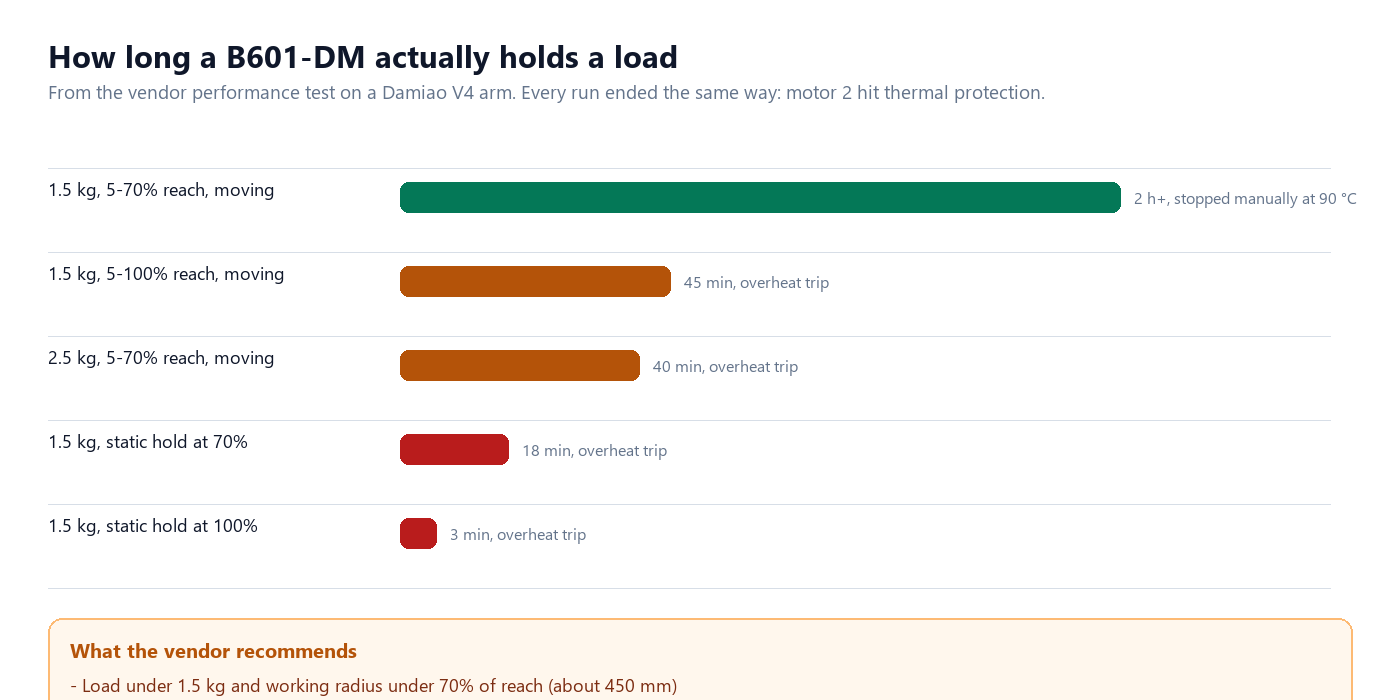
Read the patterns rather than the individual numbers. Moving is far cheaper thermally than holding, because a static pose keeps dumping current into one joint. Extending the arm doubles the moment arm and roughly halves the runtime. And holding 1.5 kg at full extension for three minutes before thermal protection is the number to design around if your application involves waiting.
The vendor's own advice follows from that: keep the load under 1.5 kg and the working radius under 70 percent of reach, stay under 70 percent of rated speed, keep the room between 15 and 35 degrees Celsius, add active cooling for long high-load runs, and rest the arm for ten to fifteen minutes every two hours.
None of that is a defect. It is what happens when you put a rated 2.5 kg payload on a desktop arm without a fan, and it is the difference between a demo that works for five minutes and a system that works all afternoon.
What it costs, and why self-sourcing loses
Prices checked at the time of writing, for the DM version unless noted.
| What you get | Price |
|---|---|
| B601-DM, unassembled kit | $829 |
| B601-DM, assembled with gripper | $1,499 |
| B601-RS, unassembled kit | $929 |
| B601-RS, assembled with gripper | $1,699 |
The counter-intuitive part is what happens if you try to buy the parts yourself. The published BOM lists the DM motors at $120 for each 4310 and $175 for each 4340P, which is $1,005 for the seven actuators before you buy a single machined link. Add the metal parts at a reference average of $250, the printed parts at $50, bearings, rail, gear and a CAN adapter, and the reference total lands somewhere around $1,480. The RS figures are worse: four RS00 at $125 and three RS06 at $210 is $1,130 in motors alone, against a $929 kit.
So ordering the unassembled kit is the cheap way to reproduce the arm, and printing and machining it yourself is the expensive way. That inversion is worth knowing before you plan a build to save money.
Two costs sit outside every kit. No power supply is included, and neither are the clamps that hold the base down. The DM version wants a 24 V 14.6 A supply and the RS version a 48 V 12.5 A unit, with a 48 V 25 A supply recommended for full RS performance. Voltage is switchable on the supply itself, which matters if your mains is 110 V rather than 220 V. A separate leader arm, the Star Arm 102, is what pairs with the arm for master-slave teleoperation teaching.
From a box of parts to an arm that moves
The published assembly guidance is written for someone who will make mistakes, which is why it is worth reading before the box arrives.
- Torque is the number people get wrong. The kit contains many similar-looking screws and structural parts, and the shipped screws already carry thread-lock. Seeed asks for an electric screwdriver with the torque set between 3 and 6 kgf·cm, and says to stop immediately if a screw strips rather than forcing it.
- Every joint needs an identifier written to it. Motor 1 through 3 are set to CAN identifiers 0x01 to 0x03 and motors 4 through 7 to 0x04 to 0x07, each with a matching master identifier, over a 921600 baud link from the vendor's tool. Getting this wrong produces an arm that fights itself.
- Zero calibration happens twice. Once after the identifiers, and again before you first command the arm from software.
- A virtual machine will not do. The official guidance states that virtual machine performance was verified to be insufficient for running the demos and that configuration problems exist, and recommends a physical Ubuntu machine, with 24.04 LTS as the suggested install.
- Two failure modes have published fixes. Loud abnormal noise on startup usually means parameter calibration was triggered accidentally during identifier setup and overwrote factory values including motor inertia, which is recoverable by exporting parameters from an intact motor of the same model. And all motors ending up with the same CAN identifier is caused by pressing the set button next to the identifier field in the debug tool, which broadcasts to every motor on the bus.
Buying the assembled version skips the identifiers and the calibration entirely, which is a reasonable thing to pay for if your interest is the software rather than the build.
Before you buy
- Check the duty cycle against your use case. Twenty minutes of continuous holding is a very different requirement from two hours of slow movement, and the arm is only honest about the difference because the vendor published the test.
- Do not count on holding a load through a power cut. No holding brake appears anywhere in the published specifications, and the vendor's own static-hold test is the shortest run in the table: three minutes at full extension. If a dropped object is unacceptable, that is a mechanical problem to solve separately.
- The price gap between kit and assembled is not only labour. The assembled arm includes manufacturing details that the open files deliberately simplify, so a self-built arm is not a like-for-like copy of the product.
- Add the power supply and mounting clamps to the budget. They are not in the kit, and without clamps the arm will move its base before it moves its payload.
- Expect the software to be the easy part and the assembly to be the hard part. The tutorials are thorough precisely because the physical build has sharp edges.
- Both prices and payload ratings move. Confirm the current specification and the shipping configuration with the vendor before ordering, because the kit lineup has already changed once since launch.
IOTTourChina covers open-source IoT and robotics projects and the hardware and silicon behind them as part of its developer resource. This is editorial coverage, not an endorsement or an advertisement; specifications, availability and pricing should be confirmed with the vendor or the project before you buy.
- reBot-DevArm repository
- B601-DM hardware source and bill of materials
- B601-RS hardware source and bill of materials
- B601-DM real-machine performance test
- Seeed wiki: B601-DM quick start
- Seeed wiki: reBot Arm in LeRobot
- Seeed wiki: fine-tune GR00T N1.7 and deploy on Jetson Thor
- Seeed robotics tutorial index