A Radar at 111 RMB: Who Is Still Winning Orders in Chinese mmWave
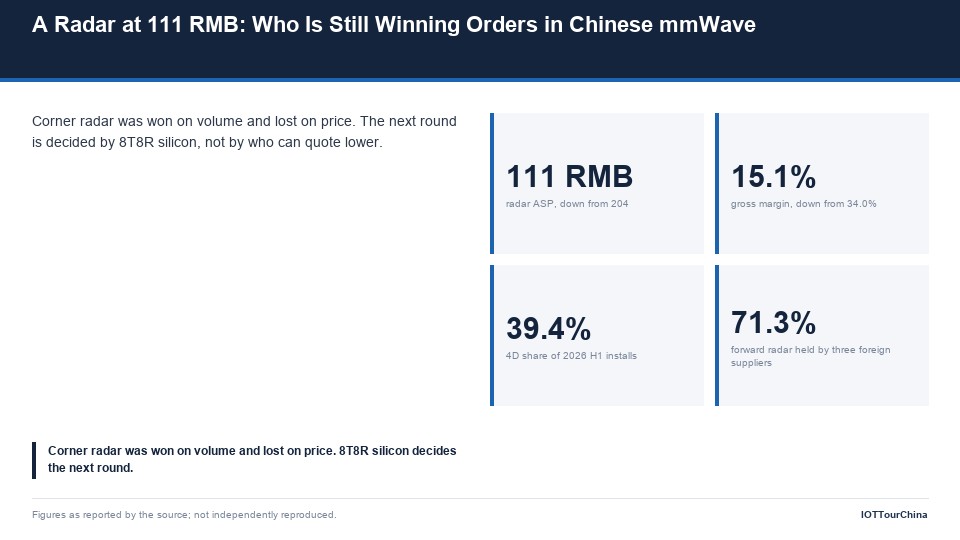
Hella announced in mid-November 2026 that it had won 77 GHz radar production orders from three Chinese carmakers, on the cost-oriented ForWave7e platform, for China and Europe, with production starting in the first half of 2027. A foreign Tier 1 taking three orders out of Chinese OEMs is the headline. The number that explains the market is different: one domestic supplier's average radar selling price fell from 204 RMB to 111 RMB in two years, and its radar gross margin from 34.0% to 15.1%.
The volume picture
Chinese passenger-car radar installations went from 17.216 million units in 2022 to 22.142 million in 2023 and 26.732 million in 2024 — 55% cumulative growth, driven first by AEB, ACC and blind-spot monitoring becoming standard and then by more radars per car in mid- and low-priced models.
In the first half of 2026 the picture splits:
| Metric | 2026 H1 | Year on year |
|---|---|---|
| Total radar installations | 16.79 million | −1.93% |
| 4D radar installations | 6.6152 million | +45.83% |
| 4D share of installations | 39.4% | — |
Total units are flat to slightly down while 4D units grow by nearly half. That is not a shrinking market; it is a market where the mix is moving up and the old volume is being replaced unit for unit.
On value, Zoss estimated the 2023 domestic market at 5.82 billion RMB, with forward radar contributing about 60% of the money and rear corner radar more than 30%. Forward radars are fewer and more expensive, which is the whole reason the competitive structure differs between the two.
Forward radar: 71.3% still foreign, and why
Gasgoo's data for the first quarter of 2025 puts Continental at 31.6%, Bosch at 28.4% and Denso at 11.3% — 71.3% combined. Chengtech held 5.6%, Huawei 4.5% and Aptiv 3.9%. Over a longer window, the foreign top three's combined share fell from 84.1% in 2022 to 82.1% in 2023 and 74.6% in January–July 2024: still dominant, clearly eroding.
The reason forward radar resists substitution is not detection range. It is that a forward radar is wired into the vehicle's automatic braking, and is therefore in the path of global safety regulation. Beyond seeing far, it has to handle stationary vehicles, metal guardrails, crossing targets, curves and bad weather without false positives or missed detections; OEMs then validate target-level output, false-alarm rate, detection probability, time synchronisation, diagnostics and unit-to-unit consistency. Bosch, Continental and Denso accumulated platform customers and functional-safety experience across exactly that work, and that is a harder asset to displace than a BOM.
Domestic challengers have split into two strategies. The product-first group is led by Chengtech, the largest domestic supplier of forward radar by shipments, and Sensortech, which delivered more than 7.5 million automotive radar units in China in 2025 with cross-model qualification capability. The system-first group sells radar as part of something larger: Huawei shipped more than 3 million units into Chinese passenger cars in 2025, bundling sensors with domain controllers, software and vehicle development; Desay SV covers corner, forward and 4D imaging radar and is pushing an 8T8R satellite-architecture programme in 2026; Freetech packages radar with driving ADAS so the OEM buys architecture fit, not a part number.
Corner radar: won on volume, lost on price
The corner radar market localised years ago. In 2023 the Chinese passenger-car front-installation shares were Sensortech 43.2%, Freetech 15.4%, Desay SV 8.3%, Chengtech 6.1% and Elead 4.8%.
The mechanism was straightforward. Once 77 GHz CMOS became mature, board-level component count fell and production automated, so domestic suppliers could take orders quickly; the content per car went from two rear units to four front and rear; a single model programme could multiply shipments overnight.
Chengtech's numbers show what winning that way costs. Average selling price fell from 204 RMB in 2023 to 111 RMB in 2025 — a 45.6% decline. Radar gross margin fell from 34.0% in 2024 to 15.1% in 2025, down 18.9 points in a year. And revenue concentration rose: the largest customer accounted for 91.3% of revenue in 2023, 93.6% in 2024 and 96.4% in 2025.
Scale achieved through one large OEM, at a price that wins more trim levels, while absorbing single-customer negotiating power, annual price-downs, R&D and receivables. That is the corner radar business, stated plainly.
4D is where the next reshuffle happens
Adding elevation to range and velocity is what lets a radar separate a bridge from a truck, or a road surface from an obstacle. It also raises channel count, antenna complexity and signal-processing load, and produces a point cloud that can be used for dense targets and stationary obstacles.
The tiers are roughly:
- 4T4R and 5T4R highly integrated SoCs — mainstream 4D, basic height measurement for volume models.
- 6T6R and 8T8R — the mid-to-high band, balancing cost, point-cloud density and forward performance. This is where the next share shift is most likely.
- Higher effective channel counts, cascading and more complex antenna processing — high-resolution imaging for advanced perception. Still a small segment.
Domestic routes diverge: Sensortech is evolving from scale radar into 4D; Seyond-type imaging specialists have entered high-end programmes; Huawei is pushing distributed 4D radar matrices tied to central compute; Desay SV, Freetech and ChuHang continue to win 8T8R and satellite-architecture nominations. On the other side, Continental, Bosch, Hella and Aptiv retain global customers and platform engineering.
The silicon layer is being redrawn underneath
This is the part that changes the cost structure rather than the market share table. The 2026 generation moves multi-chip high-channel designs into single packages:
| Vendor | Part | Positioning |
|---|---|---|
| TI | AWR2188 | Single-chip 8T8R transceiver |
| Infineon | CTRX8188F | 8T8R, in production |
| NXP | TEF8388 | 8T8R, scalable to 32T32R with S32R processors |
| Calterah | Andes-Pro | 6T6R SoC, 12T12R cascade |
Collapsing a high-channel array into one die removes supply rails, calibration steps and board complexity, which is exactly where the domestic cost advantage came from in the first place.
Calterah is the domestic proof point: more than 30 million automotive radar chips shipped cumulatively by the end of Q1 2026, 30-plus OEMs and 300-plus models, with company-cited figures of roughly one third of China's 2025 automotive radar chip share and about 66% of the 4T4R 4D SoC segment. Zhiyan Consulting's ranking of the wider 2025 Chinese radar chip market reads TI 32.7%, Calterah 25.7%, Infineon 16.5%, NXP 7.5% — a domestic supplier in the first tier, with the incumbents still strong on RF performance, platforms and high-channel parts.
Consolidation is following: in November 2026, Novosense moved to acquire 78.152% of Geekene for 487 million RMB to add radar SoC capability.
Hella's order is a supply-chain story, not just a win
ForWave7e is positioned on cost with 2027 production; ForWave7HD, using NXP technology for 2028 high-resolution programmes, is the same family aimed higher.
The more instructive disclosure is Hella's Chery Europe project from May 2026. The radar is developed by the Chinese engineering team, supplied from a plant in Lithuania with a planned April 2027 start, and fitted to European-market vehicles built at Chery's plant in Spain. Chinese development speed, European production and quality support, used together.
That is what a global platform order now looks like, and it explains why "domestic vs foreign" is becoming a poor description of the competition.
Four markets, four different fights
The structure that emerges by 2027:
| Segment | Who competes on | Representative players |
|---|---|---|
| Basic corner radar | Cost, yield, supply, annual price-downs | Sensortech, Chengtech, Freetech |
| Mainstream 4D forward | 4T4R→8T8R, algorithm and single-chip cost | Huawei, Desay SV, ChuHang |
| High-resolution imaging | High-channel point clouds, stationary targets, central compute | Imaging specialists, global Tier 1 |
| Global vehicle platforms | Cross-region capacity, engineering validation, quality traceability | Hella, Bosch, Continental, Chinese Tier 1 |
The three readings to watch next year are unglamorous and specific: domestic share in forward radar, actual shipped volume of high-channel 4D, and the ASP and gross margin of the scale players. Everything else in this market is a press release.
For anyone sourcing radar hardware rather than following the market, the practical consequence is that the 111 RMB corner unit and the 8T8R imaging unit are no longer variations of one product line. They have different suppliers, different qualification burdens and different margins, and the price pressure in the first says nothing about availability in the second.
This article is part of the mmWave Radar channel.