Desay SV's 8T8R 4D radar moves signal processing out of the sensor, and that changes who owns the algorithm
A conventional automotive radar is a small computer that happens to emit microwaves. It transmits, receives, runs the FFT, detects targets, classifies them, tracks them, and puts a short list of objects on the CAN bus. The downstream system never sees the spectrum those objects came from.
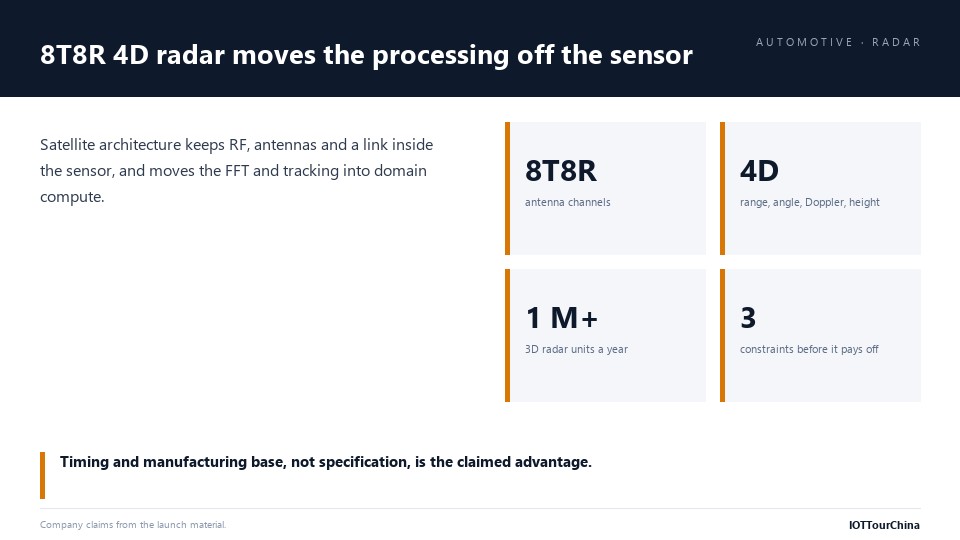
Desay SV's 8T8R 4D radar, launched in February 2026 and slated for what the company describes as the first mass production of this specification globally, does something else. The sensor keeps the RF front end, the waveguide antenna array and at most a single 1D FFT stage. Everything after that — Doppler processing, angle estimation, point cloud generation, detection — moves to the central domain controller, which receives raw high-fidelity ADC data over a high-speed SerDes link.
That is what "satellite architecture" means in this context. The radar is not a sensor with compute attached; it is an antenna with a serialiser.
Why the old arrangement existed
In a distributed electrical architecture, putting compute at the sensor makes sense. Bus traffic stays low because only conclusions cross the bus, and each sensor can be developed and validated independently. The cost is permanent information loss during compression. A central processor that receives "obstacle at 50 m ahead" from one radar and "pedestrian at 30 m left" from another cannot ask either of them what the raw return looked like.
There is a second cost, less technical. For most of the last decade the radar signal chain lived inside Tier-1 firmware — Bosch, Continental, Aptiv — delivered as a black box. An OEM knew which targets came out. It did not know how those targets were extracted from the spectrum, and had no way to change the extraction to suit its own perception stack.
That arrangement collides with what end-to-end driving models want. Occupancy networks need the outline and volume of an obstacle, not a coordinate. BEV perception wants pixel-level fusion of multiple sensors at the raw level, not late fusion of finished object lists. A radar that only emits object lists cannot participate in either.
The three gains
Hardware. Without a dedicated processing chip and its memory, the radar node shrinks, draws less, and costs less. The BOM saving is the most easily quantified part of the argument.
Compute. Five radars no longer each carry a full signal-processing budget that sits idle most of the time. They share the domain controller's DSP resources, which are already provisioned for cameras and lidar.
Fusion. This is the part that matters. In the old arrangement each radar produced its own object list in its own coordinate frame at its own timestamp, and the fusion stage reconciled disagreements. In the new one, all raw point clouds land in one place, get aligned in space and time first, and are then fused into a single map of the vehicle's surroundings.
The rain-and-fog case shows why that ordering matters. Lidar returns get scattered by water droplets and long-range targets fade; millimetre-wave reflection is largely unaffected. Under late fusion you get a contradiction — radar says clear, lidar says obscured — and the stack has to pick a winner. Under raw-level fusion both datasets sit in one coordinate frame and the algorithm can use the radar's strong returns to fill in where the lidar is sparse. Not "which sensor do we trust" but "what do they say together".
What 8T8R buys, and what it costs
The mainstream 4D configuration is 6T8R. Going to eight transmit channels is not a matter of two more outputs: transmit count sets the MIMO virtual aperture, and virtual aperture sets angular resolution. Desay SV quotes more than 30% better angle accuracy than 6T8R, point cloud density at 150% of the 6T8R baseline, and 50% more weak-target range.
Concretely: detection past 300 m, stable identification of a traffic cone at 120 m and a stationary vehicle at 280 m. Those numbers map onto the long-range requirements in China's updated AEB standard. The weak-target figure is the one that affects false-alarm rate — cones and pedestrians are low-RCS objects that used to disappear into noise, and waveguide antennas plus the extra aperture give the return enough gain to survive.
The chip side is what makes a single-board 8T8R possible at all. Desay SV secured access to a single-chip 8T8R automotive transceiver, avoiding cascaded multi-chip designs and their cost and complexity. Through 2026, TI, NXP and Infineon have all brought single-chip 8T8R transceivers into production, so the industry is moving from cascade to single-die at the same time.
The field is crowding
Desay SV is early, not alone.
- Quectel showed a full satellite-architecture system at the Beijing auto show: an 8T8R single MMIC plus a 4T4R MMIC, deployed as one forward 4D imaging radar and four corner radars for 360° coverage. The pitch is "subtract on hardware, add on fusion, multiply on upgrades", with white-box delivery.
- Chuhang Technology first published a 4D satellite-architecture solution in October 2025, positioned on domestic sourcing and cost, and announced in September 2026 a production nomination from a top-tier Chinese EV maker covering hardware and software.
- BYD Semiconductor began mass production in September 2026 of a satellite-architecture 4D radar chip centred on its Xuanji A3 compute, built on a 28 nm automotive process, integrating 8T8R on one die, claiming detection beyond 400 m, 0.8° horizontal separation, 0.05 m range resolution, and a -40 to 150 °C junction range the company calls the widest in the industry.
- Aptiv exhibited a satellite-architecture 4D radar at the same show, developed full-stack by its China team.
Desay SV's advantage is timing rather than specification: nominations secured, and a 3D radar business that has been shipping over a million units a year, which is the manufacturing and quality base a 4D ramp needs.
The fight that is actually happening
Once signal processing leaves the sensor, the sensor vendor's algorithm is no longer the product. An OEM can run its own radar processing on the domain controller, tune point cloud generation and detection to its own stack, and fuse radar with camera and lidar at the raw level. For any OEM pursuing full-stack autonomy, that is the attraction.
It also shifts value toward whoever owns the domain SoC. That controller now has to ingest multiple radar ADC streams, multiple camera RAW streams and multiple lidar point clouds simultaneously. Without the compute, the satellite architecture's advantage never materialises — which is why its adoption tracks domain-controller capability rather than radar capability.
The other movement is chip vendors entering the radar business directly. BYD Semiconductor designing and producing its own 8T8R MMIC means an OEM moving from buying radars to building radar silicon. NXP ships dedicated radar bridge chips that package the MMIC-to-SerDes link, and has begun integrating radar signal-processing IP into ADAS SoCs. Both compress the traditional Tier-1's position in the value chain.
Four things that can still slow it down
- Data bandwidth. Raw ADC from an 8T8R radar is orders of magnitude larger than an object list. Per-radar rates plausibly reach the Gbps range; five radars at once is a serious SerDes requirement, and whether current automotive SerDes can carry it with automotive reliability is a production question, not a datasheet one.
- Domain compute allocation. Raw-level fusion of camera, lidar and radar costs far more compute than late fusion. On a fixed compute budget the satellite architecture's benefit can be diluted to the point of disappearing.
- OEM capability. The architecture assumes the OEM can write radar signal processing, or license IP from the chip vendor. For manufacturers with small algorithm teams, that is a multi-year transition.
- Cost balance. The radar node gets cheaper; the domain controller gets more expensive. On mid- and low-end vehicles those can cancel out. The expectation in the article is that 4D radar reaches the RMB 150,000 segment within three years, but that satellite architecture lags behind 4D radar itself.
The pattern is familiar
Front cameras stopped processing their own images long ago: RAW goes over GMSL to the domain controller, and ISP plus perception run on the SoC. Lidar is moving from point-cloud output to raw output for the same reasons. Millimetre-wave radar is walking the same road a few years later.
If every sensor arrives at the central controller as raw data, the ceiling on fusion accuracy rises — not 1+1=2 but possibly 1+1=5. Whether that happens on schedule depends on two variables: how fast domain-controller compute grows, and how well OEMs learn to process radar signals themselves. The production nomination is a start. The next twelve months of actual shipping performance will decide whether the architecture holds up on cost, performance and reliability at once.
This article is part of the mmWave Radar channel.