Antennas set the ceiling for 4D radar; where the model runs sets the score
Four dimensions, thirty-six virtual channels, two hundred metres. The 4D imaging radar datasheets that arrived in 2026 are readable in a way radar datasheets were not five years ago: transmit and receive counts, virtual channel arithmetic, angular resolution in two planes, and a detection range quoted against a stated radar cross-section.
The numbers are real, and they are also the least interesting part of what changed. A radar front end is a sampling device. What a system can report about a scene is decided downstream of it, in a chain that begins with a threshold detector and, in the newest designs, ends with a neural network that runs somewhere other than where the antenna is.
Where that somewhere is has quietly become a product decision, and the suppliers with the most to say about 4D radar have made three different ones.
What four dimensions actually buy
A 2D automotive radar measures range, radial velocity and azimuth. It cannot separate a car on an overpass from a car in the lane ahead, because it has no elevation measurement, which is the root of the bridge false-brake problem. It also struggles to report stationary objects at all, because Doppler processing keys on motion and a parked car or a traffic cone looks like background clutter.
4D imaging adds elevation, and it does so by multiplying antenna elements. A 12-transmit, 16-receive array produces 192 virtual channels. A 6-transmit, 6-receive array produces 36. Virtual channel count is what buys angular resolution and point density, and it is pure arithmetic: no algorithm changes the number.
What algorithms change is how much of that information survives the trip from the spectrum to an object list.
The first loss happens before any model runs
Almost every shipping automotive radar converts its range-Doppler-azimuth-elevation spectrum into a sparse point cloud using a constant false alarm rate detector. CFAR is a threshold rule. It estimates the local noise floor and reports the detections that rise above it, and nothing else. It is cheap, deterministic, and it was the correct answer when the downstream consumer was a Kalman filter fed a dozen target reports per frame.
It is also lossy in a specific and now measurable way. A 2026 doctoral dissertation at Delft University of Technology on radar perception states the problem directly: conventional CFAR-based pipelines convert radar spectra into sparse point clouds, and in doing so discard the localised spectral information that distinguishes an extended object. A pedestrian in a 4D point cloud is often three to five detections. Five points do not carry enough shape to say which way a person faces, or whether they are standing or crouching.
The dissertation's answer is not to throw the pipeline away but to feed information back into it. Regions of interest are lifted out of the radar spectrum, passed through a convolutional network, and the resulting features are attached to the point-level representation before detection. Measured outcomes:
| Change | Reported effect |
|---|---|
| Spectrum-augmented detection, simulated dataset | mAP up 21.07% |
| Spectrum-augmented detection, K-Radar dataset | mAP up 8.18% |
| Learned instantaneous velocity estimation | mean absolute error down as much as 59% |
| Same velocity estimate used inside a tracker | velocity RMSE down as much as 41% |
| Hybrid tracking, class-agnostic with learned association | MOTA up 5.67% for cars, 5.55% for pedestrians, 12.77% for cyclists |
No chip was replaced to obtain any of those figures. That is the strongest available evidence for the argument that radar performance is now limited by what happens after sampling rather than by how many elements do the sampling.
There is a second finding in the same work that matters more to anyone building a pipeline, and it is the one nobody quotes. When motion information was integrated by filtering points out of the cloud first, accuracy got worse, because the filter removed structural information along with the noise. When the same information was integrated as a feature augmentation that left the cloud intact, mAP rose 3.63% over the baseline detector. How an extra signal is merged matters more than whether it exists.
Three places to put the model
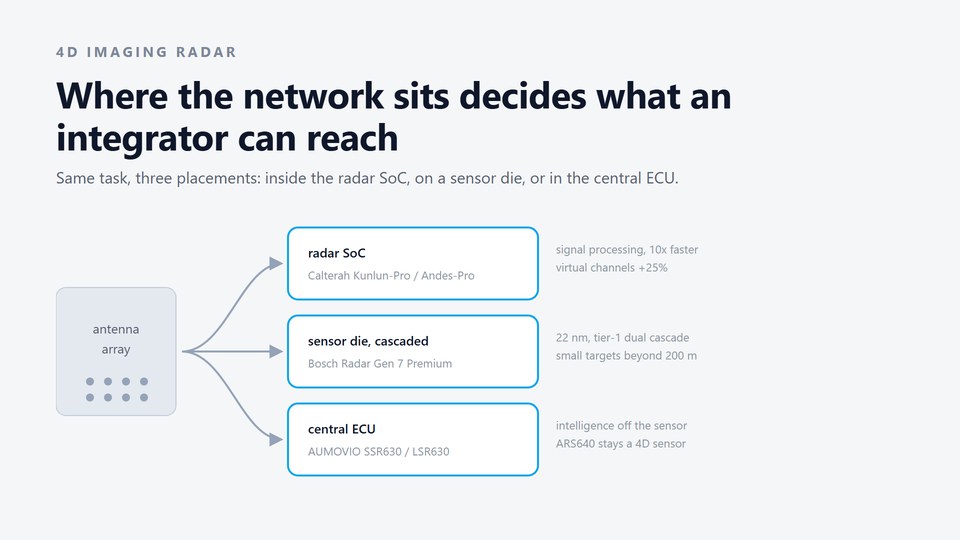
If the post-sampling chain is where the gains are, the engineering question becomes where to run it. Three current answers:
| Supplier | Product | Where inference runs | Channel configuration |
|---|---|---|---|
| Calterah | Kunlun-Pro, Andes-Pro | On the radar SoC, in a dedicated signal processor | 5T4R and 6T6R |
| Bosch | Radar Gen 7 Premium | On two cascaded in-house SoCs, inside the sensor | not published |
| Aumovio | SSR630, LSR630 | In a central control unit, outside the sensor | not published |
On the radar die
Calterah's two 2026 ADAS parts put the processing chain on the same die as the front end. Kunlun-Pro is a 5T4R chip built around a second-generation radar signal processor with two operator-engine combos, which the company rates at ten times the signal processing throughput of the previous generation, alongside a 2.5 dB signal-to-noise improvement and 25% more virtual channels than a 4T4R device. In field demonstrations it tracked a row of traffic cones laid at an angle beside the car to over 70 metres, roughly 1.5 times further than the earlier part, and a pedestrian next to a guardrail to over 160 metres, about 50% further.
Andes-Pro is the more interesting device: a 6T6R ADAS radar SoC, which the company describes as the first of its kind. Thirty-six virtual channels, a radar cross-section floor of minus 5 dBsm at 200 metres, and 1 degree of angular resolution in azimuth against 3 degrees in elevation. Its Flex-Cascading feature pairs two chips into a 12T12R imaging radar, positioned as a cheaper route to imaging performance than 8T8R silicon.
The placement argument here is physical. Thirty-six virtual channels generate samples faster than the resulting point cloud suggests, and keeping the range and Doppler processing on-die avoids moving raw data across a board. That is where interface power and thermal budget go.
In the sensor's own cascaded SoC
Bosch took the other end of the same idea with Radar Gen 7 Premium, shown at CES 2026. It uses an in-house 22 nm SoC and what the company calls the first Tier-1 in-house two-cascaded SoC design, detects small objects such as pallets or car tyres beyond 200 metres, and is explicitly described as having AI-ready compute. All key components are developed and manufactured in house.
A caution on this one: numbers circulating for Bosch's seventh-generation radar, including a 16T24R array, a gallium nitride front end and detection ranges of 400, 500 or 700 metres depending on which page you read, do not appear in Bosch's own material for Gen 7 Premium. The company's published claim for small-object detection is beyond 200 metres. Until a datasheet exists, the larger figures should be treated as unconfirmed.
Out of the sensor entirely
The third answer removes the model from the sensor altogether. Continental's automotive group sector became an independent listed company called Aumovio in September 2025, and its current radar catalogue splits along exactly this line. ARS640 remains a complete 4D imaging sensor: 300 metres of range, a field of view of plus or minus 60 degrees, angular accuracy of plus or minus 0.1 degrees in azimuth and elevation, a 60 millisecond frame period, and about 23 watts of dissipation at 76 to 77 GHz.
SSR630 and LSR630 are the opposite architecture. Aumovio describes them as satellite radars built for use with a central control unit, designed so that intelligence shifts from the individual sensor to centralised radar processing.
What placement decides for an integrator
Three consequences follow, and they are the reason this is worth tracking rather than filing under vendor strategy.
What the device will hand you. A post-CFAR point cloud, a pre-CFAR spectrum or RAD tensor, or raw ADC samples. Each step earlier in the chain carries more information and costs more bandwidth. A point cloud is kilobytes per frame. Raw samples are megabytes. Anything that wants the earlier representation has to run where the samples are produced, which is the whole argument for inference on the radar die.
Whether you can change the model. Inference inside the sensor gives a fixed output interface. It is certifiable and it is closed, and a third-party integrator gets whatever target list the vendor's firmware produces. Inference in a domain controller lets a team retrain and redeploy without touching the radar's type approval, at the cost of inheriting the front end and the link between them.
What the supply chain looks like. The satellite architecture turns radar back into an antenna plus an RF front end and moves the value into the domain controller. That reverses fifteen years of the smart-sensor division of labour, and it changes who owns the perception software in a vehicle programme.
What this does not settle
End-to-end models that skip CFAR, direction-of-arrival estimation and clustering, and learn directly from ADC samples, remain prototypes. The compute required sits well above a current automotive SoC, and no supplier ships one in a production sensor.
Every accuracy figure above comes from a different dataset and a different baseline. They are not comparable across rows, and no supplier publishes a common benchmark. A range claim against a small stated radar cross-section and a longer range claim against an unspecified one are not the same measurement.
The question to ask
When a 4D radar module is evaluated for a design, the antenna count will be on the first page of the datasheet, and the placement of the model usually will not be there at all. The useful sequence is: what does the output stage emit, where does the inference run, and what is the number of analysed channels as opposed to the physical one. Antennas set the ceiling. Where the model runs decides how much of that ceiling a system actually reaches.
This article is part of the mmWave Radar channel.