mmWave Radar Modules
Hi-Link HLK-LD2450
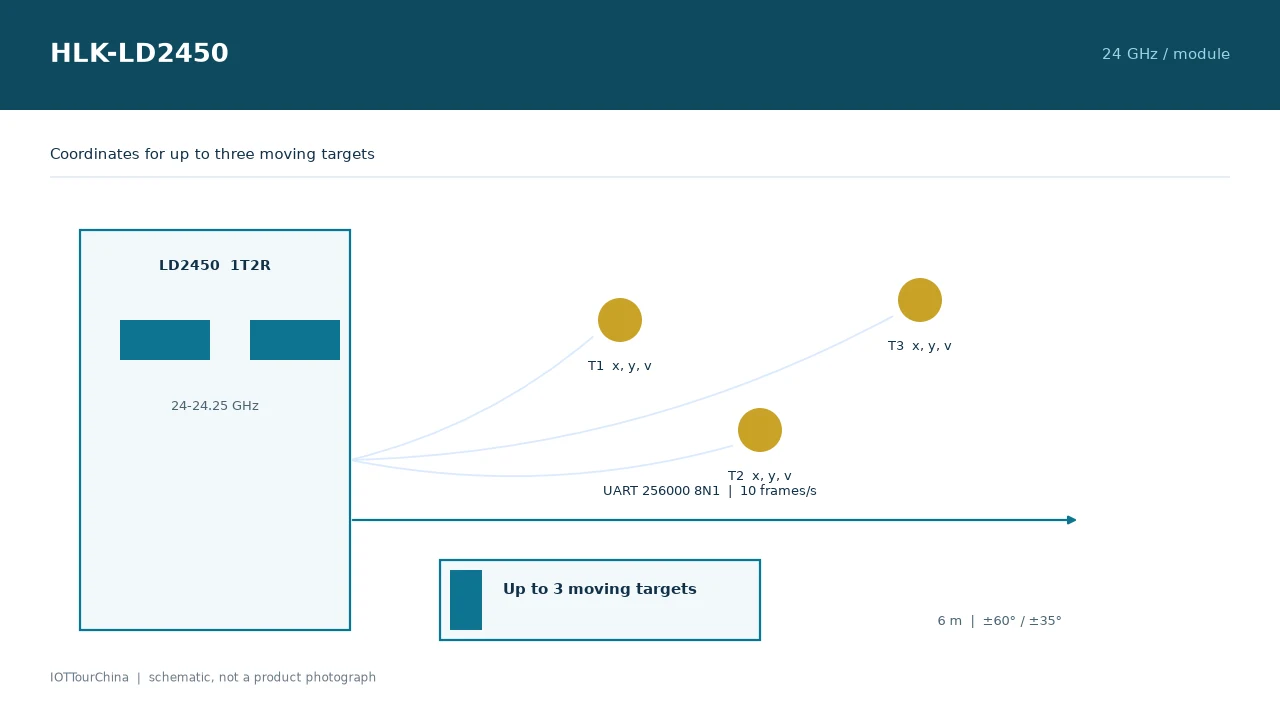
24 GHz 1T2R radar reporting x/y coordinates and speed for up to three moving targets over a fast serial link.
Capabilities below are vendor-documented. We have not tested this device or its integrations.
Sources checked:
Also known as: LD2450
Suitable projects
- Tracking where a moving person is inside a room rather than only whether somebody is present.
- Direction-aware lighting or a following platform that needs x/y coordinates.
Before you buy
- It tracks moving targets; a stationary occupant is not its documented output.
- The 256000 baud default differs from the 115200 default published for the LD2410 variants.
- Hi-Link publishes no grant number for this module on the product page.
Official resources
Related guides
- Multi-target tracking radar: LD2450 and Rd-03D
- From radar UART frames to Home Assistant entities
- Tuning distance gates to remove radar false triggers
- 24 GHz or 60 GHz radar: what the band actually changes
- Power and UART bring-up for mmWave radar modules
- Serial frames and configuration commands on radar modules
- PIR plus radar triggering: wake fast, clear slowly
- Radar boundary bleed: capping range at the room edge
- LD2450 zones in ESPHome: what the three rectangles actually count
- Reading a mmWave radar datasheet: what each number actually allows
- Test a radar UART parser without the radar
- From radar presence to a room occupancy state machine
- Band
- 24-24.25 GHz
- Sweep bandwidth
- 250 MHz
- Antenna
- 1T2R
- Distance resolution
- 0.75 m
- Max targets
- 3
- Report rate
- 10 frames/s
- UART default
- 256000 8N1
- Supply
- 5 V, above 200 mA
- Average current
- 120 mA
- Size
- 15 x 44 mm
- Max range (vendor claim)
- 6 m
Choosing the HLK-LD2450 Tracking Radar
This profile is based on official documentation, not our own device testing.
The LD2450 is a 24 GHz module with one transmit and two receive antennas. It reports the x/y coordinates, distance, angle and speed of up to three moving targets at ten frames per second. It is a different tool from the LD2410, even though both come from the same vendor and use the same band.
Published figures
| Item | Value |
|---|---|
| Band | 24-24.25 GHz |
| Sweep bandwidth | 250 MHz |
| Antenna | 1T2R |
| Maximum range (vendor claim) | 6 m |
| Azimuth and elevation | ±60° and ±35° |
| Distance resolution | 0.75 m |
| Tracked targets | 3 |
| Report rate | 10 frames/s |
| UART default | 256000 8N1 |
| Supply | 5 V, above 200 mA |
| Average current | 120 mA |
| Size | 15 x 44 mm |
The trade against a presence module
A presence module answers whether a room is occupied, including by somebody sitting still. A tracking module answers where a moving target is. The LD2450 documentation describes moving-target tracking and does not claim stationary-presence output, so a lighting automation that must hold while somebody reads a book needs the LD2410 or a second sensor.
Choosing it
- The host needs coordinates for direction-aware logic or a following platform.
- The installation is wall mounted at roughly 1.5-2 m, which is the height Hi-Link recommends.
- The host can sustain 256000 baud and a 5 V rail above 200 mA.
What the page does not settle
Hi-Link publishes no grant number for this module. It also publishes a BLE and OTA configuration path and a PC tool, but does not state that the tracking algorithm is open source.
Quick Start — HLK-LD2450
This profile is based on official documentation, not our own device testing.
This brings the module to a stream of target coordinates on a host with a 3.3 V UART.
1. Check the supply budget
The module needs 5 V with a supply capable of more than 200 mA and draws 120 mA on average. Serial logic is TTL 3.3 V, so do not feed 5 V into the host RX pin.
2. Wire and set the port
Cross TX and RX and join grounds. Set 256000 baud, one stop bit and no parity. This is four times the rate the LD2410 variants publish, and it is the default the ESPHome LD2450 component also documents.
3. Mount before tuning
Hi-Link recommends wall mounting at 1.5-2 m. The published field is ±60° in azimuth and ±35° in elevation, so a ceiling mount points most of that field at the floor.
4. Watch the frames with the PC tool
Use the vendor tool to confirm that a single walking person produces one target with stable x/y values. Add a second and third person to see the three-target limit. The module reports moving targets; do not use a seated person as the acceptance test.
5. Connect the host component
The ESPHome LD2450 component requires a recent module firmware and exposes target count plus per-target X and Y sensors. Check the firmware version before writing configuration, because the component page warns about older releases.
6. Fix the coordinate frame
The coordinates are relative to the module, not to the room. Record the mounting height and orientation in the host so a later re-mount does not silently rotate every reading.
FAQ — HLK-LD2450
This profile is based on official documentation, not our own device testing.
Does it detect a stationary person?
Not as a documented output. The vendor describes moving-target tracking. Use a presence module such as the LD2410 when the automation must hold during stillness.
Are the coordinates a room map?
No. They are x/y values in the module's own frame. Mounting height and rotation decide what those values mean, and a change of position invalidates any calibration done earlier.
Can it see through a wall?
Hi-Link says the module works behind a plastic enclosure without an opening. That is not a claim about walls, and thin partitions are a common source of targets that appear to be inside the room. Cap the range in configuration instead of relying on the wall.
Why is the baud rate different from the LD2410?
The two product lines publish different defaults: 115200 for the LD2410 variants and 256000 for the LD2450. Both figures are on Hi-Link pages. Check the exact model rather than reusing a configuration from another board.