mmWave Radar Modules
Ai-Thinker Rd-03D
24 GHz radar built on a published S5KM312CL SoC, reporting multi-target ranges and motion trajectories over a serial protocol.
Capabilities below are vendor-documented. We have not tested this device or its integrations.
Sources checked:
Also known as: RD-03D, Rd-03D V1
Suitable projects
- Multi-person trajectory tracking where the radar front end must be named in the design.
- Reading a documented serial protocol from a host MCU.
Before you buy
- The official parameter comparison loads dynamically, so supply and current values are not quoted here.
- Firmware images and protocol documents are published; the vendor does not state that the algorithm is open source.
- The page offers a fixed-frequency test guide but lists no certification number.
Official resources
Related guides
- Multi-target tracking radar: LD2450 and Rd-03D
- From radar UART frames to Home Assistant entities
- 24 GHz or 60 GHz radar: what the band actually changes
- Serial frames and configuration commands on radar modules
- Power and UART bring-up for mmWave radar modules
- Reading a mmWave radar datasheet: what each number actually allows
- Test a radar UART parser without the radar
- Band
- 24 GHz K band
- Max sweep bandwidth
- 0.25 GHz
- Radar SoC
- S5KM312CL
- Modulation
- FMCW
- Documented firmware
- 2307, V1.0.0
Choosing the Ai-Thinker Rd-03D
This profile is based on official documentation, not our own device testing.
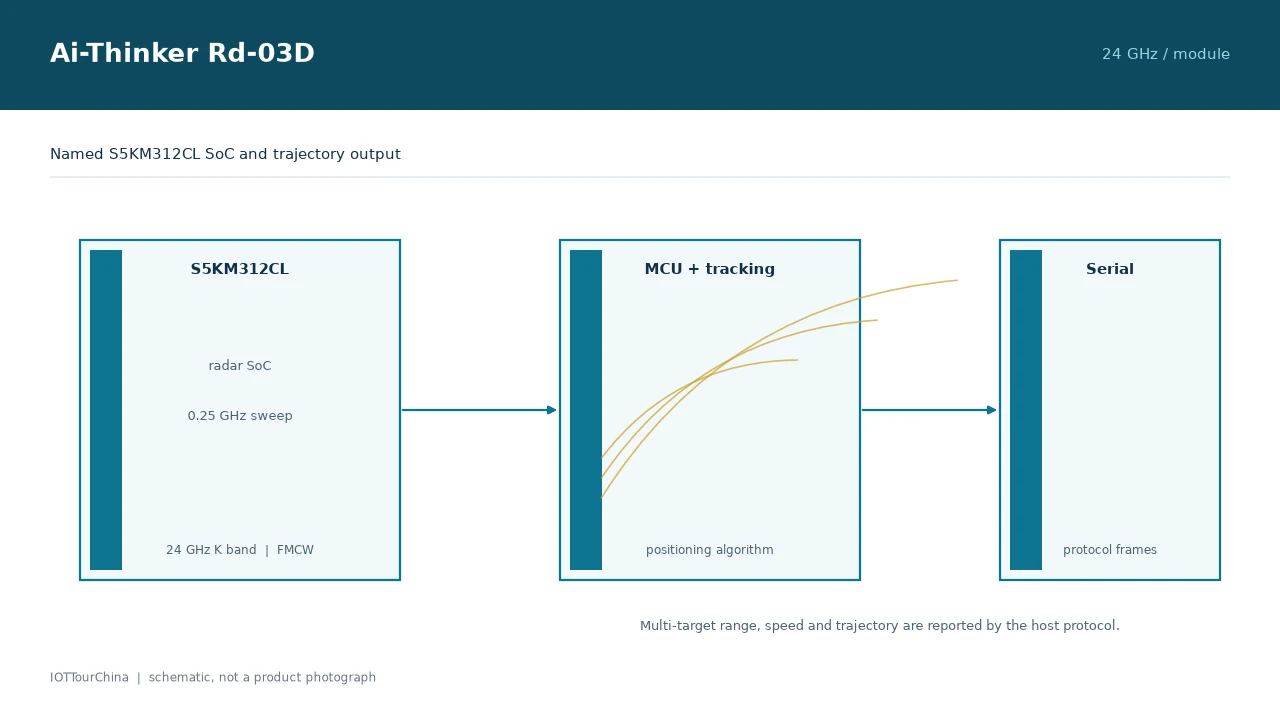
The Rd-03D is a 24 GHz radar module whose front end is named in the official documentation: the S5KM312CL millimetre-wave sensor SoC. That makes it unusual among low-cost modules, where the chip is often left unstated.
What the official page states
| Item | Value |
|---|---|
| Band | 24 GHz K band |
| Maximum sweep bandwidth | 0.25 GHz |
| Radar SoC | S5KM312CL |
| Modulation | FMCW |
| Documented firmware | 2307, V1.0.0 |
| Output | multi-target range, speed, trajectory |
The vendor describes FMCW processing on the S5 series, an MCU running positioning and tracking algorithms, and real-time reporting of multiple targets. The documentation set includes an English user manual, a serial protocol, a PC tool, power and reliability reports and a fixed-frequency test guide.
What we could not verify
The parameter comparison on the product page loads dynamically and returned no static rows when we read it. Supply voltage, current, dimensions and detection angles are therefore not quoted here; take them from the datasheet for the exact hardware revision. The same page lists a fixed-frequency test guide but no certification number.
When to shortlist it
- The design needs a named radar SoC in the bill of materials.
- The host will parse a documented serial protocol rather than a vendor cloud API.
- Multiple moving targets and their trajectories matter more than stationary presence.
Before committing
Confirm which hardware revision and firmware the supplier ships. The V1 documentation page and the V2 comparison page describe different firmware numbers, so ordering by the short model name alone is not enough.
Quick Start — Ai-Thinker Rd-03D
This profile is based on official documentation, not our own device testing.
This sequence takes the module from the packet to a parsed serial frame. Electrical values are deliberately absent because the official comparison table did not publish static rows.
1. Identify the revision
Match the part marking against the V1 documentation page or the V2 comparison page. The firmware number differs between them, and the serial protocol is revision bound.
2. Read the datasheet before powering
Take the supply voltage, current and pinout from the datasheet for your revision. Do not reuse figures from another 24 GHz module: the official comparison table did not expose those values as static text.
3. Bring up the UART
Cross TX and RX, join grounds and match the logic level stated in the datasheet. Use the baud rate and frame settings from the serial protocol document rather than the defaults of a similar module.
4. Confirm frames with the PC tool
Open the vendor upper-computer tool and walk one person through the field. Confirm that the reported target count and trajectory follow the subject before writing host code.
5. Parse only the documented fields
Decode target count, range, angle and speed from the protocol. Do not infer a person count from energy peaks, and do not treat a track as a stationary-presence signal.
6. Keep the firmware image
Archive the exact firmware that shipped with the board together with the protocol revision. The vendor publishes a standard tracking firmware image, so a reflash changes the frame behaviour you validated.
FAQ — Ai-Thinker Rd-03D
This profile is based on official documentation, not our own device testing.
Which chip is inside?
The official documentation names the S5KM312CL millimetre-wave sensor SoC. That is the radar front end, not the host MCU.
Is the algorithm open source?
The vendor publishes firmware images, a serial protocol, manuals and test reports. It does not state that the radar algorithm is open source, so plan around the documented frames rather than around modifying the signal processing.
What certifications does it have?
The product page offers a fixed-frequency test guide but lists no certificate or grant number. Treat certification as unconfirmed for the exact revision you order.
Why are there no voltage or current figures here?
The official parameter comparison is generated at page load and returned no static rows when we read it. We do not copy electrical figures from reseller listings. Consult the datasheet for your revision.