Twelve radar channels, one breathing rate: the paper that stops adding waveforms together
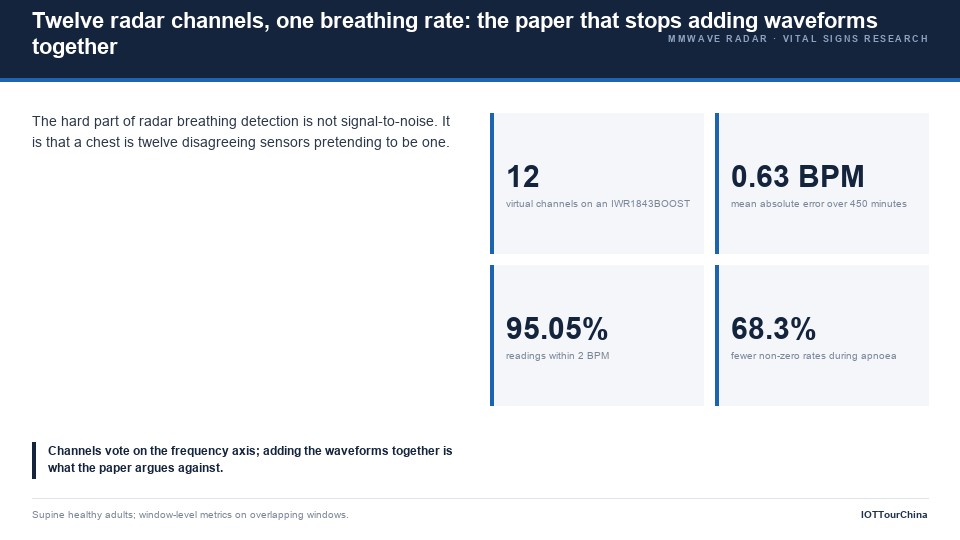
A 3T4R radar looking at a sleeping chest produces twelve virtual channels. Every one of them contains a breathing signal, and every one of them contains it slightly differently: different amplitude, different phase, different amount of interference from the ribs, the arms, the bedding, the wall behind. The system still has to output one number.
The usual shortcuts are to pick whichever channel looks strongest and run an FFT on it, or to add all twelve waveforms together and run an FFT on the sum. A 2026 paper in IEEE Internet of Things Journal from Yuxin Miao, Xiaolu Zeng and Xiaopeng Yang at Beijing Institute of Technology argues that both shortcuts rest on the same two assumptions, and that neither survives contact with a real chest: that the breathing component always dominates in the chosen channel, and that the channels are in phase and of comparable quality. Once a person shifts position, channel quality drifts, and summing waveforms bakes the resulting peak misalignment straight into the fused signal.
Their alternative is to stop fusing waveforms and start fusing candidate frequencies. It is worth reading closely, not because the accuracy numbers are spectacular, but because the whole method is rule-based, interpretable, and small enough to run on a radar board.
Channel scoring: rank on the spectrum, keep more than one peak
The preprocessing is conventional — phase difference per virtual channel, mean removal, smoothing, fourth-order low-pass at 0.6 Hz to strip static offset and slow drift, leaving the respiratory band.
Scoring is where the design starts. Each channel gets a quality weight from two terms in the same window: the main peak's magnitude, and the ratio between the main peak and the second peak, which is a proxy for whether the breathing peak is actually winning. Both are normalised across channels inside the window so that a channel sitting closer to the radar does not automatically outrank a distant one because of path loss. The two terms are averaged with equal weight.
The top six channels enter fusion, and — this is the part that matters — each of them contributes its top three candidate frequencies, not just its strongest. A channel whose true respiratory peak is second or third still gets a vote, and each candidate inherits the channel's quality weight.
Consensus: votes on the frequency axis, not on the waveform
Candidates are then clustered on frequency. A cluster is built by taking each candidate as an anchor and absorbing everything within 0.03 Hz, roughly 1.8 BPM. A channel may cast at most one vote per cluster, and a cluster needs support from at least two channels or it is discarded outright.
Cluster score is a weighted vote minus a dispersion penalty:
- the first term grows with the number of supporting channels, weighted by channel quality;
- the second term penalises how spread out the cluster is in frequency, scaled by β = 0.25, deliberately mild.
The consequence is the behaviour the authors want: several channels each offering a slightly-off frequency will beat one channel offering several strong peaks, because the multi-channel cluster accumulates support while the single-channel peaks cannot vote twice.
A temporal gate sits on top. The state evolves as a first-order random walk, and an observation more than 5 BPM away from the current state is not used to update it. That suppresses isolated jumps without smoothing away genuine transitions.
Pausing: three conditions, one frozen reference, one state machine
Respiratory rate and apnoea detection are usually produced independently, which allows the self-contradictory output everyone in this field has seen: the system declares a pause and keeps printing a breathing rate.
The pause detector works on non-overlapping 3 s blocks. Each block yields an amplitude range and an interquartile range — the first for overall excursion, the second for the bulk of the motion, insensitive to a single spike. Whether the amplitude is "too low" requires a reference, and the reference is where the design earns its keep: it is taken from the 10 s before the current block, falling back to the median of historical normal blocks, and frozen the moment a low-amplitude candidate appears. It stays frozen through candidacy, confirmation and recovery, and only resumes adapting once normal state returns.
That freeze is not a detail. If the reference keeps adapting, a long apnoea drags the denominator down with it and the pause normalises itself into apparent normal breathing. Blocks whose amplitude ratio stays at or below 0.5 become candidates; a candidate must persist for at least 10 s to be confirmed, and confirmation also requires the waveform to be flat and to have lost respiratory periodicity. Three thresholds, all three required: amplitude ratio 0.30, IQR ratio 0.20, and a periodicity measure (respiratory-band energy over a baseline low-frequency band) of 0.55.
An N/L/A/R state machine — normal, low-amplitude candidate, confirmed apnoea, recovery candidate — then backdates the confirmed onset to where the candidate began, and reports at the end of the first block that satisfies confirmation. Recovery uses the same 0.5 amplitude boundary.
Finally the two outputs are coupled. If the start of a respiratory-rate window falls inside a confirmed pause, the output is masked to zero; otherwise it passes through. The result is one self-consistent state sequence instead of two disagreeing estimators.
Results, and what they cost
The hardware is a TI IWR1843BOOST at 77 GHz in 3T4R TDM-MIMO, giving twelve virtual channels, placed about 0.8 m in front of a supine subject's chest, with a Bitalino respiratory belt as ground truth. Windows are 60 s with a 5 s step.
For respiratory rate: 90 five-minute records from 14 subjects, about 450 minutes, ground truth spanning 6–27 BPM. MAE 0.63 BPM, RMSE 0.98 BPM, and 95.05% of estimates within ±2 BPM. The strongest baseline, VMD, reaches 90.53% within ±2 BPM; single-channel FFT drops to 82.96%; summing the multi-channel spectra gives 90.49%, essentially the same as VMD. The gap over the best baseline is therefore not from using more channels — it is from screening channels first and then agreeing on a frequency.
For pauses: 190 annotated events across breath-hold and pause recordings, plus 180 normal recordings for false-alarm counting. 184 detected, 5 false positives, precision 97.35%, recall 96.84%, F1 97.10%, mean onset localisation error 3.30 s. An amplitude-rule baseline reaches similar precision but misses 40 events; a 1D ResNet gets 93.16% recall at the cost of 47 false positives; an SVM has the tightest localisation (2.40 s) but F1 of 74.46%.
Ablation is unusually clear about where the value sits. Removing the spectral salience screening costs 9.91 percentage points within ±2 BPM — the largest single loss by a wide margin. The other four components (multiple candidates, quality weighting, compactness penalty, temporal gate) cost 4.36 to 6.61 points each. On the pause side, the frozen reference mainly protects recall (misses rise from 6 to 24 without it), the three gating conditions mainly protect precision (false positives rise from 5 to 17–25), and the state machine contributes 7.13 F1 points and 3.60 s of localisation.
The coupling experiment is the punchline for product people: across 10 records each containing one 30 s pause, with the rate updated every 5 s, all 60 output points were non-zero before masking. With the pause state driving a mask, 19 points remain non-zero — a 68.3% reduction — and the residue sits at pause onset and recovery boundaries, i.e. it is a detection-latency problem, not an estimator-accuracy problem. Tightening the rate estimate further would not help; moving the boundary decision would.
What the paper does not show
The data is healthy adults holding their breath voluntarily, supine, in a fixed position inside the beam. Obstructive apnoea involves continued respiratory effort and sometimes paradoxical chest-abdominal motion; central apnoea involves neither. Neither morphology is in the dataset, and there is no hypopnea label and no AHI, so nothing here maps onto a sleep study report.
The 95.05% is a window-level figure with 60 s windows on a 5 s step, so adjacent windows share 55 s of data and the effective number of independent samples is far below the window count. No per-subject variance or confidence interval is reported. The 3.30 s is a backdated onset error, not an alarm delay; because confirmation needs 10 s of continuous low amplitude, a real-time alarm cannot fire earlier than about 10 s after onset.
Fusion is compared against single-channel FFT, summed FFT and two decomposition methods, but not against phase-aligned approaches such as coherent or beamforming fusion — so the claim that decision-level fusion beats "align then add" is asserted more than demonstrated. Thresholds appear to be set empirically and evaluated on the same data, and the phase-difference front end tilts gain across the band by roughly a factor of six between 0.08 and 0.5 Hz, which quietly favours faster breathing in the peak-magnitude term. None of that is discussed.
Why it still matters
For anyone building a radar product, the useful transferable idea is the architecture, not the numbers: score channels on the spectrum, keep several candidates per channel, agree on frequency, and let an event-level state constrain the continuous estimate instead of running the two in parallel. It is arithmetic and short-time statistics — no training set, no labels, uniform thresholds — which is exactly what fits on a radar MCU.
The constraint is latency. A 60 s rate window and a 10 s pause confirmation make this a screening or trend engine, not an alarm. That is fine for a sleep-quality feature and not fine for anything claiming to detect an event in real time.
This article is part of the mmWave Radar channel.