Whole-Body Dexterity: a G1 carries a box under one arm with a controller trained on 2.51 million grasps
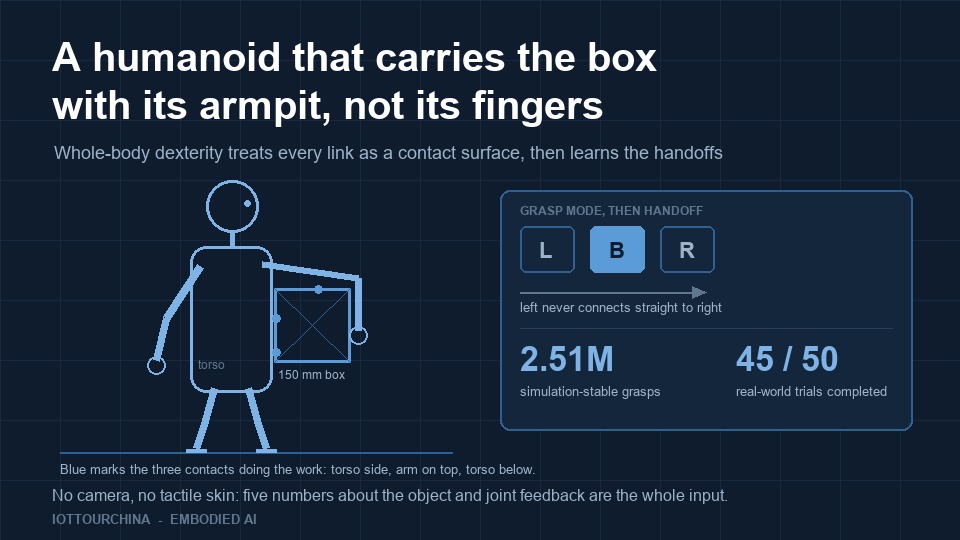
People rarely move things with their hands alone. A box gets braced against the chest, a basket rides on both forearms, a parcel is tucked under one arm so the other stays free. That everyday behavior is the target of a paper from Amazon, the University of California San Diego and the University of Michigan, which calls the capability whole-body dexterity and builds a pipeline from a generated grasp dataset all the way to a controller running on a Unitree G1.
The headline result is 90 percent. Across 50 real-world trials the distilled controller completed 45, against 9 for direct motion retargeting and 2 for a generalist whole-body controller. The more useful number is underneath it, because 45 out of 50 is not one task attempted fifty times. It is the sum of five separate ten-trial conditions: basketball to the shoulder and back, basketball into the armpit and back, box to the shoulder and back, box into the armpit and back, and a five-stage shelf sequence. Each of those has a different difficulty, and reading the aggregate without that decomposition flattens the result into something more impressive than it is.
What follows is an attempt to state what the paper actually shows, with the parts that usually get dropped in the summary: what the denominators are, what the controller is allowed to see, what it costs in GPU-hours to train one expert, and where the method currently stops.
The pipeline in one paragraph
Enumerate the ways a body can hold an object as contact configurations. Generate a large dataset of stable grasps for each object. Train a per-object reinforcement learning expert that can move the object between any two grasps in that set. Then distill the experts into a single controller that takes a coarse motion command from a human and refines it into joint targets that keep the object supported.
Each stage exists because the previous one cannot be skipped. The grasp dataset is what makes an any-to-any repositioning objective well defined, since the policy needs to know which object poses around the body are actually holdable. The experts are what generate the trajectories, because no human demonstration of sliding a box from the chest to under one arm at scale exists. The distillation is what makes it deployable, because the experts have privileged access to object state that a real robot does not.
The paper's contribution is not the term itself. Whole-body dexterity was used in 2025 for a snake-like arm that manipulates with its entire surface, and the authors cite that work directly. What is new here is treating arbitrary link-level contact as a general grasp formulation, generating it at scale, and showing that a single distilled policy transfers zero-shot to hardware.
Contact is the variable being learned
The formulation is worth stating precisely because it is what a reader could reuse. A grasp mode is the appendage that holds the object: left arm, both arms, or right arm. Goals are specified as an object position plus a target mode. Joint configuration is excluded from the goal, and so is object orientation. The policy is free to reach the target however it can, which is the point: it has to discover handoffs rather than imitate them.
With two arms this is harder than in-hand manipulation, not easier. A multi-fingered hand can move some fingers while others keep contact. A humanoid releasing one arm has nothing left to hold the object with unless the other arm first braces it against the torso. So the intermediate states matter as much as the endpoints.
Two constraints make that explicit. A single-arm goal requires that the inactive arm register no object contact at the goal, which forces a complete handoff rather than a hand resting against the object for balance. And the goal graph only permits mode transitions that are physically sensible: left connects to left and to both, right connects to right and to both, but left never connects directly to right. Every handoff therefore passes through a two-arm hold.
The goal graph is built by voxelizing settled object positions at two centimetres in the torso frame and grouping by mode. Across the object set that yields between 1.0 and 5.5 thousand occupied voxels and 1.7 to 9.1 thousand nodes, with spheres at the low end and elongated prisms at the high end, because a long object reaches more distinct settled centres for the same body region. The reachable envelope spans roughly 0.21 metres either side of centre and 0.03 to 0.45 metres vertically. That is the working volume the whole method operates in, and it is worth keeping in mind when reading success rates: this is a torso-sized workspace, not a room.
2.51 million grasps, filtered twice
Candidate grasps come from minimizing a differentiable force-closure residual over the object's signed distance field, initialized from randomized placements and optimized in GPU batches, with collision and joint-limit terms added as penalties. A single GPU holds 4,096 candidates for 4,000 AdamW iterations.
Raw candidates are not usable. The G1's grasps lean heavily on gravity and on friction between the object and the contact link, so the filter is deliberately harsh. Each candidate is pressed into contact and held under four times gravity while a sustained wrench disturbance is swept over the six axis directions. It survives only if contact persists. Survivors are then retested under standard gravity with no disturbance and must drift less than 10 centimetres and rotate less than 45 degrees, producing the settled pose used to initialize training episodes.
A further filter drops grasps whose object mesh sits more than 5 millimetres from the torso surface, or below a size-dependent height threshold. The result is 2.51 million simulation-stable grasps across 15 primitives: six spheres, four cubes, three rectangular prisms and two cylinders, with side lengths and diameters between 80 and 240 millimetres.
Coverage is reported with two denominators, and they differ enough to be worth separating:
| Measure | Tolerance | Coverage |
|---|---|---|
| Mean per-object, object centres around torso | Each object's minimum bounding-box half-extent | 90.1% |
| Pooled over all objects | Mean of minimum half-extents | 98.4% |
The 90.1 percent figure is the conservative one, since every object is judged against its own tightest dimension. The 98.4 percent is the looser pooled reading. Both are in the paper; quoting only the first understates the dataset, quoting only the second overstates it.
One design detail prevents a silent failure. The G1's torso can be contacted from every side, and optimizing against it as a single target concentrates contacts wherever they are easiest to find. So the torso mesh is split into named sub-regions, each optimized independently, which spreads the resulting grasps around the body instead of piling them in front. Those region names are then reused as goal labels downstream.
Experts, a curriculum, and a 0.48 second window
Each object gets its own expert, trained with PPO on a goal-conditioned MDP. Episodes start from a grasp sampled from the dataset and command a sequence of goals that advance toward a far goal drawn from another body region. With probability 0.2 the command is instead a hold, asking the policy to keep the object where it is.
The distance curriculum ramps the ceiling on commanded goal distance from 2 centimetres to 8 centimetres. Because each distance is drawn from the interval between 2 centimetres and that ceiling, raising it adds farther transitions without removing closer ones, so the policy sees both slow deliberate repositioning and faster dynamic rearrangement.
Success requires the object to settle at the goal in the required mode within a 2 centimetre region. The reward has seven groups: progress toward the commanded position, arrival in the goal region, a sparse completion bonus, hold quality, arm neutrality that pulls unused arms back to their default pose, a terminal failure penalty for drops, and five regularizers covering unsupported motion, excess object speed, large actions, action changes and joint tracking error.
The most interesting constraint is a tolerance rather than a penalty. Contact requirements are enforced throughout, but a brief loss of required arm contact is permitted inside a 0.48 second grace window. Without it, every repositioning would have to be quasi-static, and the fast reconfigurations that whole-body regrasping actually requires would be trained out of the policy.
One expert costs about a thousand GPU-hours
Training is done in two stages, and the economics are the reason. Experts trained from scratch do worse on small and non-uniform objects than on medium-large spheres, where the contact patches are large and the geometry is forgiving. So the sphere experts are trained first, and every other primitive is warm-started from that complete training state.
The numbers below are for representative runs on eight H100 GPUs and are per object:
| Stage | Iterations | H100-hours |
|---|---|---|
| Sphere pre-training, shared | 15,000 | About 270 |
| Post-training, per object after warm start | 35,000 | 660 to 815 |
| From scratch, per object | 50,000 | About 1,030 |
| Distilled controller, per model | 130,000 updates | About 22 |
Warm starting is not just cheaper. On the six objects where the comparison was run, the warm-started experts match or beat their from-scratch counterparts at a matched total budget, with a 20 percent reduction in aggregate iterations. The gain is largest on the shapes that are hardest to learn from scratch: a 100 by 100 by 200 millimetre prism goes from 23.30 to 50.12 percent mean route completion, and a 200 millimetre cube from 35.53 to 40.98.
That last figure should temper any reading of the method as solved. Which brings us to the table that the abstract does not show.
Experts are not equally good, and that is the ceiling
Each expert is scored on 14 standardized routes that traverse six body regions, with 2,048 trials per route and a 1,500 step budget. The spread across geometry classes is large, and the failure is region-specific rather than uniform:
| Object | Underarm | Four-goal loop | All 14 routes |
|---|---|---|---|
| Sphere 220 mm | 87.9 | 90.4 | 88.14 |
| Sphere 180 mm | 86.1 | 83.2 | 82.59 |
| Cube 160 mm | 75.6 | 19.8 | 54.91 |
| Cube 200 mm | 61.3 | 0.0 | 40.98 |
| Prism 80x160x220 mm | 47.0 | 0.1 | 25.05 |
Numbers are percent route completion. The pattern is consistent: underarm transfers survive across shapes, loops collapse for large objects, and the worst case in the set is a long thin prism at 25.05 percent. The paper attributes the difficulty to object size relative to the G1's limbs, and states that all experts still supply trajectories for distillation even when their route completion is poor, leaving improved expert success to future work.
The two objects used in the real-world experiments sit in the two strongest classes: a size 3 basketball is close to a 180 millimetre sphere, and the 15 centimetre cardboard box is close to the 160 millimetre cube. That is not a criticism of the demonstration, since the real tasks are short sequences rather than fourteen-route chains, and the shelf task is genuinely long-horizon. It does mean the 90 percent should be read as a statement about two well-behaved objects, not about the object distribution the experts were trained on.
Distilling into a controller that cannot see
The controller is trained on 274 thousand trajectories totalling 873 million frames, filtered for validity and balanced across objects, motion types and three speed bands.
Its architecture is a conditional diffusion model paired with an inverse-dynamics network. The diffusion model generates arm keypoint motions; the inverse model converts the selected motion into 14 joint-target increments. The input is 269 dimensions: four history entries at offsets of 15, 10, 5 and 0 control steps, each holding 24 torso-frame keypoint coordinates for two arms, 14 measured joint positions, 14 applied joint targets and 14 joint tracking errors, plus five static geometry features.
Those five features are the entire description of the object: log-sorted bounding-box side lengths, log volume, and sphericity. For a real object they are computed from measured dimensions, which is to say entered at setup rather than perceived.
This is the part that deserves more attention than it gets. The described system has no camera, no depth sensor, no tactile array and no object-state estimator. The controller is proprioceptive, and its only knowledge of what it is carrying is five numbers typed in advance plus whatever the joint encoders can infer from contact. When the paper says there is no privileged object state, that is literally true, and it also means the system cannot discover that it picked up something other than what it was told.
At inference the human's coarse command steers generation through gradient guidance. The guidance displacement is the difference between the forward kinematics of the requested configuration and the forward kinematics of the current command, and a tunable weight scales how hard the denoising is pushed toward it. Several candidate motions are sampled per update and the one closest to the guidance target is selected. On hardware the predicted increment is clipped to 0.025 radians per joint, then passed through a 0.35 radian tracking-error limit, a joint-speed limit and the joint limits.
The loop, in outline:
every control step at 50 Hz:
  history  <- 4 entries at offsets -15, -10, -5, 0 (50 Hz steps)
  cond     <- history (264) + 5 geometry features        # 269 dims
  cands    <- diffusion.sample(cond, 100 denoising steps)
  d        <- FK(q_requested) - FK(c_current)
  pick     <- argmin over cands of ||x5 - d/2||^2 + ||x10 - d||^2
  dq       <- inverse_model(history, pick, geometry)     # 14 increments
  publish(clip(dq, 0.025) + c_published)
That last line is a small piece of engineering worth noticing. By the time an increment is computed, the commanded target may have moved. So the publisher adds the already-computed increment to its latest applied target rather than overwriting with a stale prediction, and continues toward the result without applying the same increment twice. Skipping that bookkeeping is how these loops oscillate in practice.
Measured on the operator workstation with an RTX 5090, one inference update takes 11.8 milliseconds at the median and 17.3 at the 95th percentile. Updates arrive at 34.9 Hz on average against a 50 Hz command publisher. The delay from state publication to the robot's command buffer is 50.1 milliseconds at the median and 73.7 at the 95th percentile, excluding sensing and motor latency. Those are the numbers that decide whether a controller of this kind is deployable on a given platform, and they are stated plainly in the appendix.
What the simulation study actually tests
The distilled controller is trained on 13 of the 15 primitives, with a 180 millimetre sphere and a 180 millimetre cube withheld from training, validation and normalization. Each expert's policy is then degraded by adding independent uniform noise to all 14 arm commands, and the comparison is between the degraded expert alone and the controller refining it. Trials transfer objects among six regions: front, both underarms, both shoulders and back, with 256 matched initial grasps per object and a 600 second cap.
| Comparison | Training objects | Held-out objects |
|---|---|---|
| Failure time vs noisy expert | +70% | +158% sphere, +71% cube |
| Failure time vs clean expert, low noise, guidance 1 to 20 | +25 to 35% | +109 to 120% sphere, +25 to 47% cube |
The first row is the claim in the abstract. The second is the more surprising one: at the lower noise level and moderate guidance weights, refinement outlasts the uncorrupted expert, which suggests the controller learned to maintain supporting contact rather than to track commands. The paper's own explanation is that the low-noise, moderate-guidance regime lets the motion prior dominate, and the prior encodes stability.
The failure mode is equally instructive. Excessive command tracking degrades both stability and goals completed per trial. The guidance weight is therefore a stability knob, not a fidelity knob, and the right value depends on how much the operator can be trusted in a given phase. The paper later reports doing exactly that on hardware, switching between 10 for on-body repositioning and 100 for pick-and-place.
What the real-world tables show
The 90 percent aggregates cleanly once the five conditions are separated. Basketball round trips were 9 of 10 for the shoulder tap and 9 of 10 for the underarm stow. Box round trips were 10 of 10 on both. The shelf sequence completed 7 of 10.
The stage-by-stage breakdown for the shelf task is the clearest single result in the paper:
| Stage | WBD | GMR | SONIC |
|---|---|---|---|
| Pick | 10/10 | 10/10 | 10/10 |
| Stow | 9/10 | 3/10 | 0/10 |
| Carry | 9/10 | 2/10 | 0/10 |
| Un-stow | 9/10 | 1/10 | 0/10 |
| Place | 7/10 | 1/10 | 0/10 |
| Full sequence | 7/10 | 1/10 | 0/10 |
Every controller can pick a box off a shelf. The divergence starts at the moment the robot has to reconfigure its body while holding the object, which is precisely the capability the paper is about. SONIC reaches 10/10 on pick and 0/10 on stow, which locates the failure at support maintenance rather than at reaching.
The three dropped sequences are also worth naming. WBD lost contact and dropped the box in 3 of 10 attempts at the final placement. The abstract's 90 percent and this line describe the same system, and the second is the one an integrator needs.
One asymmetry is reported without being explained away. On the shoulder tap, GMR completed 4 of 10 box round trips but only 1 of 10 with the basketball, with mean successful times of 8.5 versus 30.1 seconds. The authors' hypothesis is friction: cardboard slides to the shoulder more easily, while a basketball has to roll along the torso and needs more deliberate arm motion. It is a hypothesis, flagged as one, and it points at the real sensitivity of the method, which is that behaviour depends on contact friction that the controller does not measure.
The baseline configuration matters for interpreting all of this. Both WBD and direct GMR use the same Xsens suit and the same General Motion Retargeting step to produce upper-body targets, with Adaptive Motion Optimization handling the lower body and balance. SONIC runs its public checkpoint in VR three-point mode, tracking head and wrist poses with a kinematic planner for the lower body. So the comparison isolates the refinement layer rather than confounding it with a different teleoperation rig. All trials were run by a single skilled operator with more than eight hours of practice on these tasks.
Where the method stops
Leg contact is excluded by design. The grasp set contains left-arm, right-arm and both-arm grasps, and the authors state the reason plainly: leg grasps would require learning manipulation jointly with balance and locomotion. Bracing a heavy box on a knee, which is one of the most human things a person does with a large object, is left as future work.
Goals exclude object orientation. A command specifies where the object should be and which mode should hold it, not how it should be rotated. Any task that needs the box turned before it can be stowed under an arm is outside the current formulation.
There is no exteroception and no tactile sensing. The controller cannot detect slip except through joint tracking error, and cannot identify an object except through five numbers supplied in advance. The paper is candid that its grasps depend heavily on gravity and contact friction, and the box-versus-basketball asymmetry is consistent with friction mattering more than the geometry descriptor captures.
The experimental base is narrow: one robot, two objects, one operator, ten trials per condition. Ten trials gives a resolution of ten percentage points, which is fine for separating 90 from 18 and useless for separating 90 from 80.
And the object envelope is 80 to 240 millimetres. The expert table shows why that matters: prism route completion falls to 25 percent at the upper end of that range, so the reported real-world success comes from the favourable middle of an already bounded distribution.
No code or weights appear to be released. Searches for an official repository return nothing, and the project page links only to the paper and a BibTeX entry. That is a meaningful difference from adjacent work in 2026, and it means the pipeline as described is reproducible in principle, not in practice.
Why it is still worth the attention
The reusable idea here is not a robot that carries boxes. It is the decomposition: treat whole-body contact as a grasp problem, enumerate the modes, build a goal graph over reachable object poses, let reinforcement learning find the transitions, then distil those transitions into a controller whose job is to keep contact alive while a human steers.
That decomposition makes the human's role explicit and small. The operator supplies direction, the controller supplies support. Most teleoperation failures in whole-body work come from asking one interface to do both, and the 0.48 second grace window is the learned version of what a human does when they let go with one hand and catch with the torso in the same motion.
The cost figures point at where this becomes practical. A thousand GPU-hours per object expert, and about 22 for the distilled controller that does the actual work, means the expensive part is generating demonstrations, not deploying them. If the warm-start transfer holds as the object set grows, the marginal cost of a new shape is the post-training run and nothing else.
The honest summary is narrower than the framing suggests and more useful than it. Support maintenance through contact transitions is the bottleneck for whole-body manipulation, it can be learned from generated grasps rather than demonstrated, and on two well-behaved objects with one practised operator the learned refinement raises complete sequences from 18 percent to 90. Everything beyond that, legs, orientation, unknown objects, larger shapes, someone else holding the controller, is still open.