The release counts five results and seven universities; the PDFs count six and eight
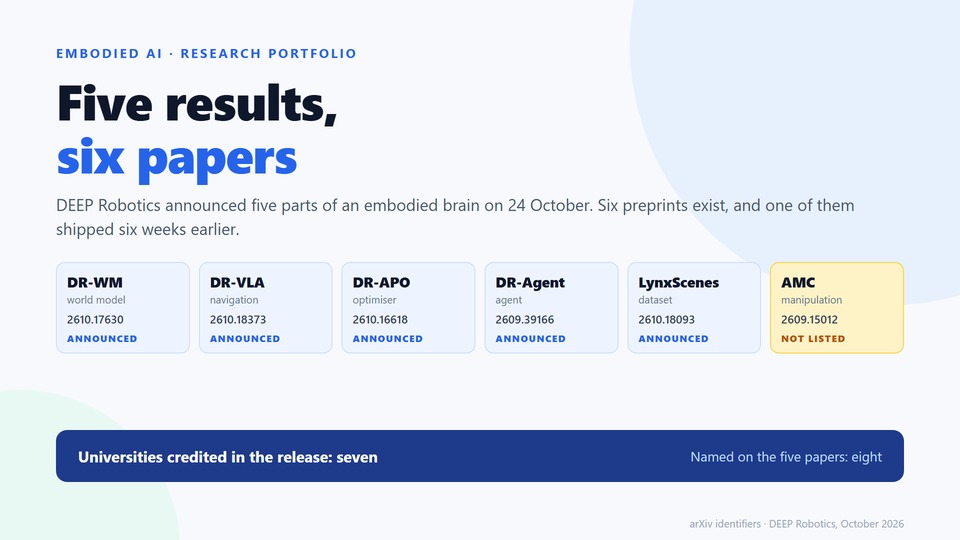
DEEP Robotics announced five research results on 24 October 2026, gathered under the name DEEPRobotics-Brain: a world model, a vision-language-action model, an agent, a policy optimiser and a data platform. The announcement is a vendor press release, which means the useful work is not reading it but reading what sits behind it, because this particular vendor published the PDFs first and the story second.
All five have arXiv preprints, submitted between 12 and 13 October. A sixth preprint, on manipulation, was submitted on 14 September and is folded into the navigation section of the release as though it were part of the vision-language-action model. The vendor's own developer centre lists six entries, not five, under the same research heading. That gap is the first thing to note, because it changes the arithmetic in the rest of the announcement.
The second thing to note is that the release makes six separate claims of a first, and none of the six preprints makes one. The only priority sentence anywhere in the set is a single line in LynxScenes, and it claims largest rather than first.
Five results, six entries, six PDFs
| Announced as | Preprint | arXiv | Submitted |
|---|---|---|---|
| DR-WM-1.0, world model | From Pixels to Executable Physics | 2610.17630 | 13 Oct 2026 |
| DR-VLA-2.0, foundation model | DR-VLA | 2610.18373 | 13 Oct 2026 |
| DR-APO, optimiser | DR-APO | 2610.16618 | 12 Oct 2026 |
| DR-Agent, agent | Beyond the Remembered World | 2609.39166 | 30 Sep 2026 |
| DR-Benchmark, data platform | LynxScenes | 2610.18093 | 13 Oct 2026 |
| Not announced separately | Atomic Motion Coordinate | 2609.15012 | 14 Sep 2026 |
The mapping is exact for four of the five, and loose for the second. The release describes DR-VLA-2.0 in a section that opens with navigation learning from human video and closes with a manipulation result built on thirteen atomic motion coordinates per arm. Navigation is one paper. The atomic coordinate work is another, with its own dataset, its own robot platform and its own partner list. The release merges them because the headline is a foundation model, and a foundation model that also manipulates is a better headline than a navigation model.
The two version suffixes are also new. No arXiv title carries a version number, and no page states what changed between DR-VLA and DR-VLA-2.0 or between DR-WM and DR-WM-1.0. A reader who wants to know whether the published numbers describe the released model or an earlier one has to assume they are the same thing.
The developer centre sorts the six entries under five tags: data closed-loop platform, embodied agent, embodied foundation model, embodied motion control and spatial intelligence. That is the cleanest statement of the architecture, because it is the vendor's own filing system rather than a narrative. Under it, the atomic coordinate work sits beside the navigation model rather than inside it.
Seven universities, or eight
The release credits work with seven institutions: MIT, UC San Diego, the University of Illinois, Tsinghua, Zhejiang, Hong Kong University of Science and Technology, and Beijing Institute of Technology. Every one of those appears on at least one of the five papers, so the list is not wrong. It is incomplete.
The Chinese University of Hong Kong is the fourth affiliation on the agent paper, alongside Zhejiang and UC San Diego. That makes eight partner universities across the five announced results, not seven. Include the sixth preprint and the count rises to fifteen institutions plus the Shanghai Artificial Intelligence Laboratory, since the manipulation paper adds Harbin Institute of Technology, Hainan University, the University of Wisconsin-Madison, Northwestern, the National University of Singapore, the Technical University of Munich and the Eastern Institute of Technology in Ningbo.
| Preprint | Universities outside DEEP Robotics |
|---|---|
| World model | MIT, Tsinghua, Zhejiang, Beijing Institute of Technology, Illinois |
| Navigation model | MIT, Tsinghua, Zhejiang, Illinois |
| Agent | UC San Diego, Zhejiang, Chinese University of Hong Kong |
| Optimiser | Zhejiang |
| LynxScenes | MIT, Tsinghua, Zhejiang, Illinois, HKUST |
| Atomic motion coordinate | Tsinghua, Zhejiang, Harbin Institute of Technology, Hainan, Wisconsin-Madison, Northwestern, NUS, Technical University of Munich |
No single paper has seven university authors. The largest is five. The seven is a union across the portfolio, which is a legitimate way to describe a research programme and a misleading way to describe a collaboration, since it implies a joint effort that no individual document demonstrates.
Six claims of a first, none in the PDFs
The release makes six priority claims, one per result:
- The first quadruped world model to build friction, roughness and stiffness into its terrain representation.
- The first quadruped navigation paradigm built on a domain-invariant scene representation.
- The first framework to put language control and force feedback into a single motion coordinate space.
- The first representation-decoupled reinforcement learning framework for generative policies, and the first to propose advantage-guided target improvement.
- The first self-evolving four-dimensional-belief navigation agent for a world that keeps changing.
- The first large-scale real-world dataset for outdoor wheel-legged robot scenes.
All six are absent from the papers. Searching the six preprints for first, for to the best of our knowledge and for to our knowledge turns up one priority sentence in total, and it is in LynxScenes: to the best of our knowledge, it is the largest publicly reported real-world wheel-legged robot navigation dataset with expert trajectories. Largest, not first, and about a dataset rather than a method.
The absence is not a scandal. Priority language is the currency of corporate announcements and the sentence usually belongs to the marketing department rather than the authors. It matters for how the claims travel, because a preprint is checkable and a release is not, and the sentence that ends up in a slide deck is the release's.
The world model's physical prior is three numbers, not a physics engine
DR-WM is the piece that carries the most weight in the announcement, because a world model that ignores physics is the standard failure mode: video generators happily produce a robot crossing snow at constant speed and constant heading, which is precisely what a robot does not do on snow.
The method does not build a new simulator. It learns three dimensionless channels per pixel, each in the range zero to one, for friction, roughness and stiffness, then maps them pointwise onto three executable terrain parameters in Genesis: a friction coefficient, a roughness proxy and a contact-constraint time constant. Higher visual stiffness maps monotonically to a shorter time constant. That field is what the physics step consumes.
The video model then sits on top of the simulation rather than replacing it. Given candidate actions, the simulator produces a robot trajectory, the trajectory produces camera poses, and two ControlNets condition a video generator on spatial structure and on those poses. Each rollout covers four consecutive 2.4 second chunks, so 9.6 seconds of predicted future. Generated frames feed back into the terrain reconstruction, which is how the model extends beyond the nine seconds without new real images.
The data behind it is called Physcene. Physcene-Image holds 2.58 million RGB and mask pairs with dense physical supervision: 1.5 million from the robot itself, 690,000 from public indoor sets, 44,600 from off-road sets and 350,000 from web video. Physcene-Robot holds over 100,000 clips with observations, robot states and control signals. The physical labels do not come from a sensor array; they are assigned through a class-to-property table built from language-model priors and then calibrated against real action-response data, which is the step that makes the three channels mean something on a specific robot.
The number a deployment team should take away is throughput. On the paper's own physical-property benchmark, the mapping step runs at 6.2 frames per second. The published baselines it is compared against run at 0.029 to 0.057 frames per second, two orders of magnitude slower, and they are also less accurate: 0.046 mean absolute error against 0.080 to 0.141. A physical prior that takes 17 to 34 seconds per frame is a research artefact. One that takes 160 milliseconds is a component.
The priority claim for this one belongs to the announcement, as the section above sets out. The paper's contribution list describes a unified framework for terrain-dependent action consequence prediction, and its abstract claims nothing about being first. The method may well be the first of its kind. The document does not say so, which means citing the claim is citing a press release.
Where the model pays for its accuracy is latency. Across 90 action-selection scenarios, an 8-billion-parameter vision-language model assisted by DR-WM beats an unassisted 32-billion-parameter model on five of six metrics. The sixth is arrival time, and the unassisted 8B model is still the fastest at 7.32 seconds against 7.53 with rollouts. With the 32B model the ordering reverses, 7.33 against 7.54, because the larger model's own decisions were slower to begin with. In other words the gain is real and the cost is one slow rollout per candidate action, which is the number that decides whether this runs on the robot or in the cloud.
Navigation gains are relative, and the metric is new
DR-VLA learns quadruped navigation from human walking video, which is a cheaper data source than teleoperation and a much harder transfer problem, since a head-mounted camera and a low-mounted four-camera fisheye rig see different worlds.
The datasets are EgoLynx-Web, 10,000 hours of curated egocentric video with no action labels, and EgoLynx-Robot, 2,000 teleoperated clips from real delivery runs, about 17 hours. The model is a mixture of three transformer experts, one for understanding, one for latent world modelling, one for action, exchanging information through shared attention, with the action expert producing trajectories by flow matching. The shared representation is called a domain-invariant scene representation, and it carries semantic, spatial and relational structure so that human and robot observations land in the same space.
The headline numbers are a five percent improvement in a navigation score and a 14.6 percent reduction in final heading error. Both are relative, and the paper says so explicitly: each is measured against the strongest competing result for that specific metric, not against a single baseline.
The score is worth pausing on. It is called the Quadruped Navigation Score and it combines safety, instruction compliance, comfort and progress in a pseudo-closed-loop evaluation, which is a better measure than open-loop trajectory imitation and also a measure that this paper introduces. A five percent gain on a metric defined by the authors is a weaker claim than a five percent gain on an established benchmark, and the release does not distinguish between the two.
The stronger result is the one the release leaves out. Trained separately on the NAVSIM driving benchmark with no web-video pretraining, the same framework reaches 92.1 PDMS, and removing the world expert drops that to 89.5. That is evidence the architecture generalises past quadrupeds, which matters more to anyone building on it than a five percent navigation gain on the vendor's own robot.
The manipulation paper that arrived as a subsection
The atomic motion coordinate work treats language control of a robot arm as a grounding problem rather than a prompting problem. Its premise is that vision dominates language in current policies: change the instruction, and the arm still executes the motion the scene suggests.
The fix is a per-arm coordinate of thirteen signed atoms, six translations, six rotations and a hold, grounded from text and forward kinematics with vision deliberately withheld during that stage. The coordinate is injected into every block of the action expert. Contact is handled separately, by a bounded residual that is recomputed from a fixed nominal latent and applied only to the part of the action horizon that has not yet executed.
The offline test is the part worth quoting, because it isolates the question. From 948 recorded robot states the authors built 1,880 cluster and mode pairs, 830 single-atom and 1,050 dual-atom, and ran four states per pair, giving 7,520 interventions per policy with images, state, normalisation and initial noise held fixed while only the prompt changes. Opposite-atom separation, the share of cases where flipping the instruction flips the motion, reaches 92.5 percent for single atoms and 83.1 percent for dual atoms. A reproduction of LA4VLA in the same harness reaches 39.1 and 24.0 percent.
On the real robot, a CR1 dual-arm platform with two seven-degree-of-freedom arms, each method ran 50 trials per task. Out-of-distribution fruit handling rises from 60.5 to 87.8 percent progress, plug insertion from 59.0 to 78.5 and vase wiping from 71.6 to 75.2 once force feedback is added. The abstract of the same paper gives the vase baseline as 71.5, a tenth of a point below its own introduction. Either figure is defensible; quoting one of them to a decimal place is not.
Two definitions matter for anyone quoting these numbers. Out-of-distribution here means held-out recombinations of known targets, known orders and known scene configurations, not unseen objects; the release's phrase about unseen layouts is consistent with that and a reader could easily take it further than the paper supports. And the parameter cost is small but not free: the atomic and force routes add 46.96 million parameters to a 3.353 billion parameter backbone, 1.40 percent.
The optimiser wins on success and loses on path length
DR-APO is the least glamorous of the five and the most reusable, because it addresses a problem every team training a generative policy has: reinforcement learning methods are written for one policy class. Gaussian policies get likelihood ratios. Diffusion and flow policies get multi-candidate sampling with a critic to pick the winner, which improves the return of the sampled batch more than it improves the policy.
The framework decouples the improvement from the representation. It builds a locally improved target action from advantage information, then fits whatever policy class is in use to that target, so the same optimisation runs on Gaussian, diffusion and flow policies without a likelihood term and without inference-time candidate selection.
The results are strong and oddly formatted. Across five MuJoCo-v5 tasks the method takes the best result in 9 of 10 diffusion comparisons and in all 10 of 10 flow comparisons, and stays competitive with soft actor-critic on Gaussian policies. Post-training a pretrained navigation policy called NavDP lifts simulated success from 70.33 to 89.55 percent, 19.22 points, and on a real M20 robot from 25 to 65 percent, 40 points.
The line the release does not carry is the next column in the same table. Success-weighted path length is 74.55 for the optimised policy against 77.67 for X-NavDP, the baseline it beats on success, so the policy arrives more often and takes a worse route when it does. That is a real trade for anything that bills by the kilometre or shares a corridor with people. A 0.92 point lead on success against a 3.1 point deficit on path length is the honest summary; the release quotes only the first. The real-robot figure comes from 20 scenarios, not a continuous run.
Two benchmarks, one of which is not out yet
The agent paper is framed around a specific failure: a robot that remembers where the mug was, arrives, and finds it moved. Its benchmark is built to punish exactly that.
EvoWorld-Bench runs 54 household scenes across 90 simulated days, 4,860 scene-days, with about 239,190 dynamic object state changes and 803,680 task instances after validity and observability filtering. The days are split chronologically, 80 for training, 5 for validation and 5 for test, which is how you avoid leaking the future into the past. The task mix is object search at 17 percent, object navigation at 27 percent, vision-and-language navigation at 26 percent and embodied question answering at 30 percent.
The method keeps a time-indexed belief over where each object might be, distinguishes staying in place from relocating, keeps probability mass on locations outside the known candidate set, and updates the belief with negative observations weighted by visibility. A frozen zero-shot vision-language controller then acts on the belief. Against the strongest memory baselines, first-inspection success rises from 45.33 to 61.32 percent and search success from 71.94 to 86.18. Real-robot evaluation used 64 matched trials per method on an M20.
| Benchmark | Platform | Scale | Headline result |
|---|---|---|---|
| EgoLynx | Quadruped, real deliveries | 10,000 h web video, 2,000 robot clips | Navigation score up about 5 percent |
| EvoWorld-Bench | Simulated households | 54 scenes, 803,680 tasks, 239,190 state changes | First-inspection success 45.33 to 61.32 percent |
| LynxScenes | M20 wheel-legged, outdoor | 833.6 h, 3,294.7 km, 100,000 clips | Dataset not yet released |
LynxScenes is the one with the most immediate value for anyone outside the company, and the one with the longest wait. It is 100,000 clips of 30 seconds each, 833.6 hours and 3,294.7 kilometres of outdoor driving, 3.0 million annotated frames, recorded on a wheel-legged M20 with four fisheye cameras, two LiDARs, an IMU, odometry and robot state. The annotations are 20.82 million oriented 3D boxes over 27 categories, 13.89 million road-structure annotations over four classes, and 20 navigation instructions organised in three layers and aligned with continuous future trajectories.
Four tasks are benchmarked on it, instruction-conditioned trajectory prediction, bird's-eye-view perception, future scene prediction and multi-view reconstruction. Each task carries its own baseline set, from classical navigation policies and VLA models to bird's-eye-view perception networks, action-conditioned video world models and Gaussian-splat reconstruction methods. The release counts 25 representative models in total. The paper reports them across four separate tables and never states a total, so the 25 is the announcement doing arithmetic the PDFs leave undone.
The release compresses the taxonomy into a list of four road-structure classes, three levels and 20 instructions, which reads as though the three levels belong to the road structure. They belong to the instructions. The road-structure axis has four classes and no levels.
The release calls LynxScenes the first dataset of its kind and the paper claims largest, and the difference is not pedantry: first is a statement about a category, largest is a statement about a measurement, and only the second has a sentence behind it.
What is usable next quarter, and what is not
None of the six entries publishes code, weights, checkpoints or a download link. The developer centre is a reading list with PDFs behind it. For an integrator the practical content of the announcement is therefore a set of architectural choices and a set of numbers to plan against, not a component to evaluate.
LynxScenes says the dataset and evaluation toolkit are planned for public release, with no date, no licence and no access procedure. Until that exists, the benchmark is a description of a benchmark.
The physical prior is calibrated on the vendor's own robots from real action-response data, and no paper claims it transfers to a different platform without recalibration. That recalibration is the actual work in adopting DR-WM, and it is not described as a service.
The metrics are not comparable across papers. A navigation score, a driving PDMS, a success rate and a search success rate are four different things measured on four different test sets, and the release's habit of listing percentages side by side invites a comparison the papers do not support.
Five things worth confirming in writing before any of this goes into a plan:
- Whether DR-VLA-2.0 and DR-WM-1.0 are the arXiv versions or later models, and what changed.
- Whether the 8B-instead-of-32B result, with its 0.2 second arrival penalty, was measured on the robot or on recorded scenarios.
- The release date, licence and annotation format for LynxScenes, and whether the four road-structure classes match a site's existing annotation scheme.
- Whether the thirteen-atom interface in the manipulation paper is exposed in any SDK, or remains an internal training detail.
- Whether the belief layer in the agent paper is available separately from the frozen controller it is paired with, since the belief is the contribution and the controller is off the shelf.
The architecture is coherent, which is rarer than it sounds: physical prediction, cross-embodiment navigation, representation-agnostic training, belief maintenance and a shared data spine all point at the same loop, and the papers are unusually candid about the conditions attached to their own numbers. What is missing is the part an integrator can hold. Six preprints and one press release is a research position, not a product.