Human tactile demos lift a dexterous policy to 70 percent, 41 points over the best baseline
Flipping a page looks like a vision task and is not one. The edge has to be found, then rubbed until the sheet separates, then turned by exactly one sheet while the thumb holds pressure without crushing the corner. A wrist camera sees the sheet move. It does not see the pressure that made it move, and it does not see the instant the sheet starts to slide.
That gap is the whole premise of a paper posted to arXiv on 28 September 2026 by eight authors from Shanghai Jiao Tong University, the State Key Laboratory of General Artificial Intelligence at BIGAI, Sharpa Robotics and the Beijing Institute of Technology. Their framing is a single sentence: hands can change, but the underlying physics of interaction does not. If contact formation, deformation, slip and release behave the same way under a human fingertip and under a robot fingertip, then the expensive resource is not robot demonstrations. It is touch, wherever it can be recorded.
The system built on that idea is called UVTA, for unified visual-tactile-action modelling. It pairs 1,000 human demonstrations with 150 robot demonstrations for each of five contact-rich tasks, trains one policy per task, and reports a 70 percent average stage-wise success rate against 29 percent for the strongest of three visual-tactile baselines. The tactile head that makes this work is switched off before the robot moves.
Two of the numbers that travel with this paper need separating before anything else, because they travel differently. The 70 percent is an average over all five tasks, with 10 real-robot rollouts per task. A second figure, 84 percent, appears in the scaling study and is an average over three of the five tasks. The project page states the restriction in its own caption. Restated without it, the two figures read as a progression the paper does not report.
What the wearable rig actually measures
The human half of the dataset is not video. It is a purpose-built motion-capture rig that a person wears, and every channel it produces has a counterpart on the robot side.
| Component | Setting |
|---|---|
| Fingertip sensing | four force-sensing resistor regions per fingertip, each 15 by 15 mm of active area |
| Wrist pose | two VIVE Tracker 3.0 units, one fixed to the table as the reference frame |
| Finger motion | passive 22-DoF linkage exoskeleton, carbon-fibre links on a compliant dorsal plate |
| Wrist camera | monocular fisheye RGB on a 3D-printed adapter |
| Synchronisation | shared host clock, all streams resampled to 30 Hz |
The exoskeleton does not drive the hand. It measures it: encoders on a passive linkage give fingertip poses through forward kinematics, and a constrained inverse-kinematics solve recovers 22 joint angles while keeping the thumb and the four fingers at plausible relative geometry, with joint limits as hard constraints and the thumb carpometacarpal and finger metacarpophalangeal couplings as soft linear ones. The wrist pose comes from the difference between two trackers, which is what lets the dataset avoid a shared global workspace: everything is expressed relative to the current wrist frame.
The camera is the part most easily missed. It is mounted so that its camera-to-wrist transform matches the camera-to-end-effector transform of the Sharpa North robot. The point is not that the images look alike. The point is that a policy trained on human wrist views sees the same geometry it will see on the robot, which is what removes a whole class of retargeting error before training starts.
What the rig costs to operate is not in the paper. There is no figure for collection hours, no per-hour throughput, no calibration time. The claim that human data is the cheaper source is plausible from the design, since nothing in the loop needs a robot, but it is an inference from the architecture rather than a measurement in the text.
Two hands, one 20-value touch vector
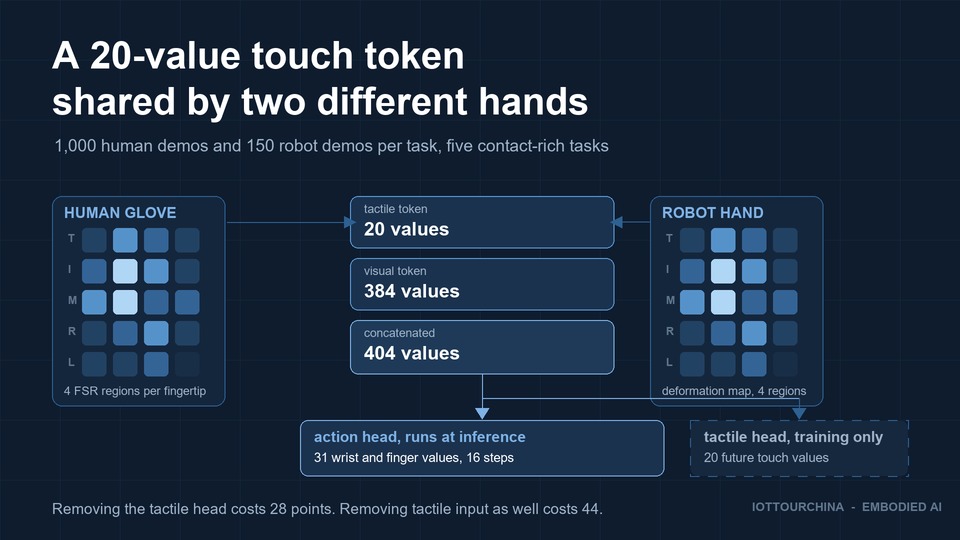
The robot hand in these experiments is a Sharpa Wave, whose fingertips sense touch optically: the sensor produces a deformation map. The human glove senses touch with resistors, four regions per fingertip. Those are not the same signal in any useful sense, so the paper defines a third representation and maps both onto it.
The mapping is called VTPM, for visual-tactile-to-piezoresistive taxel mapping. Each fingertip of the robot's deformation map is cut into four regions in a canonical fingertip frame aligned to the glove layout, the deformation intensity inside each region is collapsed into one scalar, and five fingers of four values produce a 20-dimensional vector.
That direction matters. The unified tactile space is defined by the glove's four-region geometry, which means the robot's spatially resolved tactile image is compressed into 20 numbers, and the compression is the same for both embodiments. Whatever the Wave sensor can resolve beyond four zones per finger is discarded before the policy sees it. The paper does not present this as a cost, but it is the price of a shared substrate, and it sets an upper bound on how much contact detail the model can use.
Actions get the same treatment. Both embodiments are expressed as 31 numbers: 3 of translation and 6 of continuous rotation for the wrist, giving a relative wrist motion, plus 22 absolute finger joint angles. The split is deliberate. A relative wrist keeps the policy independent of where in the workspace the arm happens to be, while absolute finger angles keep the hand configuration precise enough for contact work. Human motions land in exactly this layout, and they supervise training in it, but they are never sent to the robot as commands.
A single training sample therefore has a fixed shape, and the shape is the whole design.
wrist image      224 x 224 RGB, fisheye, 30 Hz
tactile token     20 values  = 5 fingers x 4 glove regions
action target     31 values  = 9 wrist delta + 22 finger angles
prediction        16 steps x 31 actions, and 16 steps x 20 tactile
execution         first 8 of 16 steps, then replan on a new observation
The model, in the settings the paper fixes
Nothing in the architecture is exotic, which is part of why the result is readable. A small ViT encodes the wrist image and produces a 384-dimensional visual token. The 20-dimensional tactile token is concatenated to it, not fused by a learned attention block, giving a 404-dimensional interaction representation. Two heads read that representation: a conditional one-dimensional U-Net that predicts a 16-step action chunk by diffusion, and a two-layer MLP that regresses the next 16 steps of tactile readings.
| Setting | Value |
|---|---|
| Visual encoder | ViT-S/8, trained from scratch |
| Visual and tactile tokens | 384-D and 20-D, concatenated to 404-D |
| Action head | FiLM-conditioned 1-D U-Net, widths 256, 512, 1024 |
| Tactile head | 404 to 512 with Mish, then 320 |
| Prediction horizon | 16 steps, 31 action values and 20 tactile values per step |
| Diffusion | 50 training steps, 16 DDIM reverse steps at inference |
| Executed per chunk | first 8 waypoints |
| Tactile loss weight | 0.2 in every experiment |
| Optimiser | AdamW, batch 250, 300 epochs |
| Data mixture | equal probability mass for human and robot samples |
The mixture rule is the one setting that does real work. The human set is roughly 6.7 times the robot set, so a naive sampler would let human frames dominate. A weighted sampler gives each source equal total probability and samples with replacement, which turns the ratio into a fixed mixing proportion rather than a property of the dataset size. There is no staged pretraining: one joint run per task, on the union of both sources, with min-max normalisation computed separately per embodiment and only the robot statistics used to decode at deployment.
The tactile head is not a small addition to that stack. It is the only path by which a human demonstration can influence a shared representation that a robot action is later read from.
Five tasks, ten rollouts each
The five tasks are page flipping, screwing in a light bulb until it lights, pushing a circuit breaker switch fully on, sorting visually similar balls into cups by material, and drawing and dispensing liquid with a dropper. Each is scored in stages rather than pass or fail, so partial progress counts: separating the page edge is worth 0.3, turning several pages 0.7, turning exactly one 1.0. The dropper task has four stages at 0.2, 0.5, 0.7 and 1.0.
| Task | UVTA | T-Rex | RDP | ViTacFormer |
|---|---|---|---|---|
| Flip page | 83 | 43 | 10 | 0 |
| Screw bulb | 80 | 26 | 20 | 4 |
| Toggle switch | 88 | 24 | 20 | 0 |
| Ball sorting | 56 | 36 | 18 | 0 |
| Liquid transfer | 44 | 15 | 0 | 0 |
| Average | 70 | 29 | 14 | 1 |
The baselines are a fair sample of the current visual-tactile literature: ViTacFormer, an ACT-style policy that already predicts future tactile readings as an auxiliary task; Reactive Diffusion Policy, which pairs slow visual chunking with fast tactile refinement; and T-Rex, a pretrained tactile-reactive dexterous model built on a variable-rate mixture of transformers. T-Rex is the strongest of the three and the one that matters, since it is also the one that arrives with large-scale tactile pretraining behind it.
Every method receives the same wrist RGB and per-finger tactile inputs, predicts the same action space, and is trained or post-trained on the same number of robot demonstrations. That sentence deserves a second read, because it defines what the comparison isolates. The baselines keep their own fusion and policy architecture and do not consume the human stream through an aligned action space. The 41-point gap therefore measures what a shared cross-embodiment training space buys, not whether tactile feedback helps in general. The auxiliary tactile-prediction idea on its own is not the differentiator either: ViTacFormer has it, and scores 1.
The granularity of the table is worth keeping in view. Each task number comes from 10 rollouts, and a full success is worth 10 points, so a 20-point gap on a single task is two rollouts. The five-task average rests on 50 rollouts and a gap of 41 points is well outside that noise, but the per-task columns are coarse, and the ordering of UVTA against T-Rex on ball sorting, 56 against 36, is the kind of difference that a single seed change could move.
The head that never runs at inference
The controlled ablations are the part of the paper most likely to be reused, because they show what the tactile prediction objective is actually buying.
| Variant | Average | Change |
|---|---|---|
| Full model | 70 | none |
| Tactile input, no tactile prediction | 42 | minus 28 |
| No tactile at all, vision only | 26 | minus 44 |
| Adding proprioception as a condition | 18 | minus 52 |
| Human demonstrations only | 0 | no robot data |
Removing the tactile prediction head while keeping the tactile input drops the average from 70 to 42. Removing the tactile input as well drops it to 26, which is consistent with touch carrying contact information that a wrist camera cannot see. Both of those are ordinary ablation results.
The proprioception row is not. Adding current proprioception as an extra conditioning input, which is standard practice in most manipulation policies and usually harmless, costs 52 points and lands the model below the vision-only variant. The authors' explanation is specific: with its own joint state available, the policy leans on it and starts replaying a nearly fixed demonstration trajectory, which is exactly the failure mode contact work cannot afford, because the correct action at each moment depends on what the sheet is doing rather than on where the arm is. The result is reported as support for conditioning both heads on the visual-tactile representation only. It also reads as a warning: this architecture is sensitive enough to conditioning choices that a 52-point swing can come from a feature that looks free.
The 0 percent row carries its own weight. Trained on human demonstrations alone, the same architecture never produces an executable robot action, which is the expected outcome given that human motions are supervision rather than commands. The complementary case, no human data at all, reaches 0 percent as well on the three tasks used in the scaling study. The paper's reading is that neither source suffices at this data budget. A more careful reading is that the 0 percent belongs to this architecture under equal-probability sampling, while a robot-only baseline with large tactile pretraining behind it, T-Rex, averages 31 percent on those same three tasks. Pretraining is the missing variable in that comparison, and the paper does not run a robot-only version of its own model with more robot data to close it.
The scaling curve covers three tasks, not five
The scaling experiment fixes the robot set at 150 demonstrations per task and adds human demonstrations in four steps, measuring the average of page flipping, screwing the bulb and pushing the switch.
| Human demos per task | Average of three tasks | Step gain |
|---|---|---|
| 0 | 0 | none |
| 250 | 8 | plus 8 |
| 500 | 29 | plus 21 |
| 750 | 51 | plus 22 |
| 1,000 | 84 | plus 33 |
The curve is monotonic and steepest at the last step, which is the strongest argument in the paper for collecting more human touch. Thirty-three points between 750 and 1,000 trajectories is not a plateau, and the authors correctly decline to claim saturation, since nothing beyond 1,000 was run.
The 84 percent, though, is the mean of three scores that the main table reports as 83, 80 and 88. Those are the three highest of the five tasks. Averaged over all five, the same 1,000-demonstration configuration is the 70 percent in the headline table, because ball sorting sits at 56 and liquid transfer at 44. The scaling study is therefore measured on precisely the subset where the method already performs best, and the gap between 84 and 70 is a task-selection gap, not a data-scale gap.
None of that is hidden. The project page labels the number as an average on the three scaling tasks, and the paper's own figure caption says three tasks while its appendix names which three. The problem is that 84 percent is a rounder, more quotable number than 70 percent, and re-reported without the qualifier it argues for a result the paper did not obtain: that human tactile data lifts this method into the mid-eighties across contact-rich manipulation in general. What the data supports is narrower and still notable. On the three tasks where contact events dominate, 1,000 human demonstrations move a 150-demonstration robot policy from 51 to 84 percent, with the curve still climbing.
What the paper leaves open
The limitations are stated plainly in the paper and are worth listing, because several of them decide whether the approach applies to a given problem.
The evaluation runs on one robot, a fixed-base platform with two 22-DoF Sharpa Wave hands, with the policy reading the right wrist camera and the right hand's fingertips. One policy is trained per task, 300 epochs each, and there is no multi-task or cross-platform result. Sensing covers fingertips only; the palm and the rest of the hand are blind, which rules out the whole-hand contacts that a page turn or a bulb screw partly depends on. Generalisation is demonstrated rather than measured: the project page shows page turning continuing under coloured lighting interference, with no success rate attached, and the paper reports no held-out object or unseen-scene experiment. Collection hours, calibration time and training compute are all absent, so the economics of the human half cannot be checked from the paper alone.
The most consequential limitation is the one the headline can obscure. Human data scales; robot data does not. The recipe is 150 robot demonstrations per task plus 1,000 human ones, and the 150 are not optional. The paper's own zero-percent result for the human-only setting says the same thing from the other side. What UVTA demonstrates is a cheaper ratio between the two sources, not a way to remove the robot from the loop.
The stack it sits in
UVTA is one of several recent pieces of work that treat touch as the transferable layer rather than the motion, and two of the entries below are built on the same 22-DoF hand.
| Work | Identifier | What it contributes |
|---|---|---|
| UVTA | arXiv 2609.34182 | human tactile demonstrations as supervision for a robot policy |
| SharpaDex v1.0 | Hugging Face dataset | 28,993 robot episodes, 59 tasks, 32.4 million frames |
| FTP-1 | arXiv 2606.13102 | one tactile policy across 21 sensor types, plus 31 percent on unseen setups |
| TacBPM | arXiv 2609.18174 | multi-scale contact priors distilled into a reusable latent controller |
| GALATEA | arXiv 2609.10050 | generated video as motion reference, grounded by simulation |
| DexEMG | arXiv 2603.05861 | surface EMG and a sensor glove as the teleoperation input |
| MoDE-VLA | arXiv 2603.08122 | force and touch injected into a pretrained VLA as a residual |
The dataset entry is the one an integrator should look at first, because its schema is public and its numbers are specific. SharpaDex v1.0 holds 28,993 episodes across 59 tasks, 32,396,172 frames at 30 FPS, which is 300.0 hours, with six synchronised video streams: two head cameras, two wrist cameras and two tactile views. Teleoperation used two 7-DoF arms and two 22-DoF hands. The tactile channel is 60 float values per frame, which is 10 fingertips, five per hand, each carrying three force and three torque components. State and action are 65-dimensional, of which 58 carry data and the seven torso dimensions are always zero, and the 24-dimensional TCP state carries pose in 12 values with its force and torque slots permanently zero.
Two of those details matter more than they look. The 60-value tactile layout is per-fingertip six-axis force and torque, which is a different representation from the 20-value four-region layout UVTA uses. Anyone hoping to combine the two datasets has to rebuild the mapping, because the shared space in the paper is defined by the glove and does not exist in the released robot data. And the zeroed force slots in the TCP state mean the released files contain no end-effector force signal, so force-aware work has to come from fingertip channels or from joint torque.
FTP-1 attacks the same heterogeneity problem from the other end, pretraining on roughly 3,000 hours aggregated from 26 sources across 21 sensors and reporting 17.2 points on seen sensor setups and 31 on two unseen ones. Where UVTA unifies human and robot touch into a single low-dimensional layout, FTP-1 keeps heterogeneous encoders and unifies at the latent level. The two approaches are compatible in principle and unresolved in practice.
What an integrator can take
Three ideas in this paper are portable well beyond dexterous hands.
The first is the training-only prediction head. Predicting a future tactile trajectory costs nothing at inference, because the head is dropped and only the shared representation it shaped survives. In this case removing it costs 28 points, which is a large return on a component that never runs. Any policy that already carries a secondary sensor can use the same trick: predict that sensor's future as an auxiliary objective, then delete the head.
The second is the deliberate bottleneck. Collapsing both embodiments into 20 scalars is lossy, and its value is that the loss is identical on both sides. A shared representation only transfers if it is defined by something both embodiments can produce, even when that means discarding resolution the better sensor has. The failure mode to watch is the opposite one: a unified space rich enough to keep the robot's detail usually stops being producible by the human rig.
The third is the budget, 150 robot demonstrations to 1,000 human ones per task. That ratio, not the absolute numbers, is the transferable result, and it comes with a matching constraint. The 150 are what teach the model to emit executable actions, and the paper shows the count cannot go to zero. A team considering this route should cost the human rig, its calibration, and the 150 teleoperated episodes before the 1,000 human ones, because the cheap half is only cheap relative to the other half.
What remains unanswered is the question the framing invites. If contact physics is genuinely embodiment-independent, the shared representation should hold across tasks and across hands, not just across the two hands in one laboratory. UVTA trains one policy per task on one platform, and the paper says so. The premise is stronger than the evidence, which is the normal state of a first result, and it is the specific thing the next round of work has to close.