A printed mesh interlayer keeps a tactile sensor linear to 360 kPa at 175.9 per kPa
Press a fingertip onto a table and the signal rises fast, then stops rising. That flat top is the oldest problem in flexible pressure sensing, and it is not a materials problem. The electrode-to-hydrogel interface that gives an iontronic sensor its sensitivity is the same interface that saturates it: once the two surfaces are fully in contact there is no interfacial area left to convert into capacitance.
The standard fix is to engineer the functional layer, moulding micropillars into the gel or stacking elastomers of graded modulus. It works, and it makes the process chain longer and the large-area array harder to build.
A paper in the AAAS open-access journal Science Advances on 23 October 2026 takes a different route. Eleven authors led by the Institute of Humanoid Robots at the University of Science and Technology of China, with The University of New South Wales, Soochow University, the University of Wollongong and Northwestern Polytechnical University, leave the gel and the electrode chemistry alone. They add a printed elastomeric mesh between them and let geometry decide when contact happens.
What the interlayer actually does
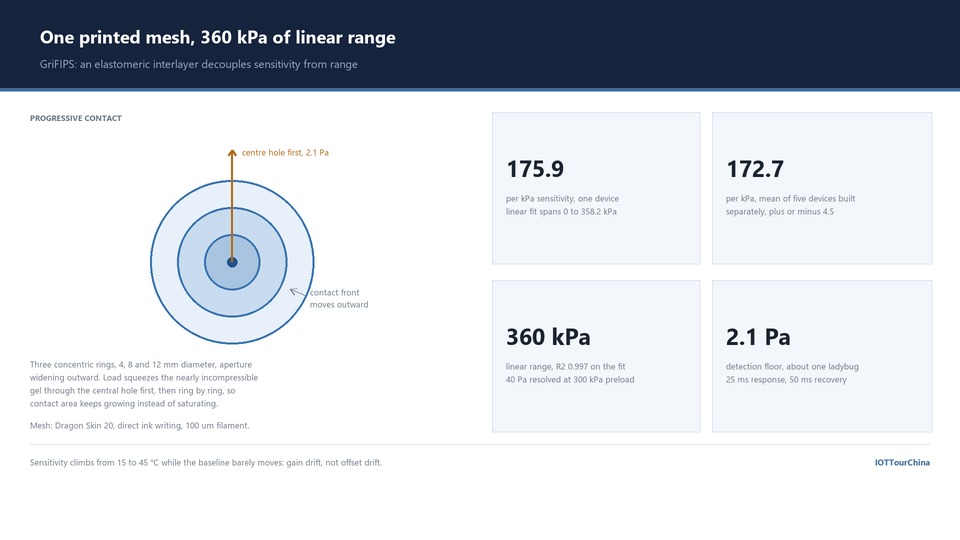
The stack is a soft liquid-metal electrode, the hydrogel, and the printed mesh, with the mesh sitting between the electrode and the gel. The gel is a PVA-H3PO4 ionic hydrogel, which is almost incompressible, so squeezing it does not shrink it. It has to go somewhere. The mesh bounds it, and the only place left is the apertures, where the gel extrudes out of plane until it touches the electrode above.
That would be a small detail if the apertures were uniform. They are not. The mesh is three concentric rings of 4, 8 and 12 mm diameter, printed in Dragon Skin 20 by direct ink writing with a 100 micrometre filament width and a 100 micrometre thickness, and the aperture size increases from the centre outward. Contact therefore starts at the small central hole, and as load rises the contact front moves outward ring by ring. The paper calls it progressive, stage-wise contact, and both finite-element simulation and optical observation show it happening.
The modulus ordering is what makes the mesh an interlayer rather than a spacer. The gel is the softest element, Dragon Skin 20 and PDMS sit above it, and the liquid-metal electrode is stiffer again at roughly 4 MPa. Because the mesh is stiffer than the gel, deformation stays concentrated in the gel while the mesh barely moves, which is exactly the mismatch the design depends on.
Geometry alone is not enough. A flat electrode-gel interface still saturates as soon as the gel arrives. The second half of the design is the electrode itself: a gallium-indium eutectic at 75.5 percent gallium and 24.5 percent indium, compounded with PDMS, insulating as cured, then ultrasonically sintered so the metal droplets fuse into a conductive path and leave a micron-scale rough surface behind. A smooth copper electrode saturates in the control experiment; the rough one keeps changing capacitance across the range.
Two scales, then, doing different jobs. The mesh sets how much area is in contact. The electrode surface sets how much of that area keeps responding once it is.
The measured numbers
| Metric | Reported |
|---|---|
| Sensitivity | 175.9 per kPa |
| Linear range | up to 360 kPa |
| Regression span | 0 to 358.2 kPa, R-squared 0.997 |
| Fit residuals | 1.86 percent RMS, 6.84 percent max, of full scale |
| Detection limit | about 2.1 Pa |
| Response and recovery | 25 ms and 50 ms |
| Cycling at 150 kPa | more than 6,000 cycles |
| Tensile cycling | 2,000 cycles at 50 percent strain, measured at 200 kPa |
| Resolution under preload | about 40 Pa at 100, 200 and 300 kPa background |
The 2.1 Pa floor is the paper's own ladybug comparison, not a press-release flourish: a ladybug weighs about that much. The useful figure for a robot, though, is the last row. Holding a 40 Pa step apart from a 300 kPa background is the difference between a sensor that works on a lab bench and one that still reports something after a gripper has already closed hard on a part.
Rate independence is checked too. Cyclic compression from 0 to 200 kPa at 5 and at 50 mm per minute produces consistent response, so the signal is not a function of how fast the load arrived.
The figure that travels alone
The 175.9 per kPa is one device. The paper also characterises five independently fabricated sensors, and those average 172.7 plus or minus 4.5 per kPa with a mean linearity of 0.99695 plus or minus 0.00032.
Two percent is a good spread for a hand-built device, and the overlapping curves are a real result. The point is only that 175.9 is a best-case number and 172.7 is the expected one. Anyone specifying this sensor for a production build should plan against the second figure and treat the first as a ceiling.
There is a related detail worth separating. The linear range is quoted as 360 kPa, but the regression that produces the 0.997 runs from zero to 358.2 kPa, and the residuals behind that fit are up to 6.84 percent of full scale at the worst point. Linearity claims in this field are almost always a statement about the fit, not about the sensor being locally perfect, and this paper reports the residual statistics so the distinction can be made.
Temperature moves the gain, not the zero
The environment section is the part an integrator will care about most, and it is the part most summaries drop.
Relative humidity from 20 to 80 percent produces only moderate variation in both sensitivity and baseline, which the authors attribute to encapsulation limiting water exchange with the hydrogel. Temperature is a different story. Raising it from 15 to 45 Celsius progressively enhances the pressure response, monotonically, because ionic mobility in the PVA-H3PO4 electrolyte rises with temperature and interfacial double-layer formation strengthens with it.
The saving grace is that the baseline capacitance moves much less than the sensitivity does, which the authors put down to the mesh holding the initial contact area small. Read as an engineering consequence rather than a paper claim: this is a gain drift, not an offset drift, so a single temperature coefficient on the sensitivity term should absorb most of it. That is a much cheaper correction than tracking a moving zero, and it is an inference from the reported behaviour, not something the paper measures.
From one channel to four quadrants
The single-cell device becomes a three-axis sensor without changing the mechanics. The gradient mesh is rotationally symmetric, so the top and bottom electrodes are partitioned into four quadrants by laser ablation, giving four sensing units with matched baselines while the mechanical stack stays intact.
A silicone hemisphere sits on top as the contact dome. A normal force compresses all four units together, so all four channels rise in step. A shear force tilts the dome, which loads one diagonal pair and unloads the other, and the sign of that split gives direction while the magnitude gives the load. The four units are labelled C1 to C4 counterclockwise in a fixed Cartesian frame.
What the recognition results do and do not show
Fourteen objects were chosen to span a wide modulus range: iron block, sponge, hard wood, air bubble film, expanded polyethylene foam, PDMS, Dragon Skin 20, Ecoflex 00-30, soft wood, paper box, soap, tissue paper, expanded polystyrene foam and concrete. A temporal convolutional network over the single-channel pressure signal classified them at 99.86 percent across 1,400 held-out trials, 100 per object.
The cross-device number is the more convincing one. A second, freshly built sensor collected 20 new complete press-release trials per object and was classified by the original model with no retraining, fine-tuning or hyperparameter search, landing at 97.5 percent. That is the test that separates a device from a demonstration, because a hand-built sensor with a different electrode roughness can otherwise shift the whole feature space.
Fabric texture is a separate experiment with a separate sensor. Twelve fabrics were slid past the four-quadrant sensor at about 2 mm per second under roughly 40 kPa of normal load: Oxford cloth, tweed, cotton-like polyester, Scottish tweed, double-faced wool blend, canvas, linen-cotton blend, corduroy, rib knit, faux suede, plain cotton and denim. The four-channel model reached 99.72 percent; models trained on any single channel reached between 76.81 and 83.19 percent.
Those are two different data sets and should not be merged into one claim. The fourteen-object set contains no fabric at all, and the twelve-fabric set is where the quad-channel advantage is measured. The gap between 99.72 and the 83 percent single-channel ceiling is the argument for four electrodes rather than one, and it is larger than anything the object results show.
Three demonstrations follow from the same hardware. A beaker is filled with water while the sensor reads the changing shear load, so the grasp tracks weight rather than position. A part is pulled sideways by hand and the robot releases on the detected external force. Blind-hole assembly is run against three hole geometries, cuboid, cylinder and triangular prism, each with a 15-degree inclined channel and a vertical one, and the robot backs off on the lateral resistance from the inclined case and seats the part in the vertical one.
What it takes to run one
The readout chain is ordinary, which is worth saying because it means the sensor is not gated on custom silicon. An FDC2214 capacitance-to-digital converter digitises the channel, an STM32F103 manages it, and the data goes to a host PC over Bluetooth, where filtering, trial segmentation and TCN inference run.
The robot side is equally conventional: the sensors are mounted on the fingertips of an Inspire-Robots RH56DF3-XR/L dexterous hand on a JODELL JQ3-5 six-axis arm. Nothing in the demonstration needs a research platform, and nothing in it is wireless at the sensor.
What the paper says it cannot do yet
The limitations section is unusually specific, and the four items are the ones that matter for anyone thinking about deploying this.
The medium-density mesh was chosen from three discrete spoke configurations rather than by continuous optimisation of the design space, so the geometry reported is the best of three, not the best available. The mesh is printed flat on a planar substrate, and wrapping it onto a curved finger or a palm will need either soft-mould replication or in-situ printing on a three-dimensional surface. The four-channel three-axis device is wired out, and scaling to an addressable array needs flexible printed circuits. And the TCN was trained and tested on the same set of objects and fabrics, so generalisation to unseen objects, and adaptation to sensor-to-sensor variability, are both still open.
That last point is the honest boundary of the 99.86 percent. The network has never been asked to classify an object it was not trained on, and it has never been asked to absorb a new sensor's offset without being shown that sensor. The 97.5 percent cross-device result shows the feature space is stable enough to survive a rebuild, which is a genuinely encouraging sign, but stability across one rebuild is not the same as generalisation.
Why the layer is the interesting part
Most tactile sensor papers in this range of performance get there by improving the functional materials, and the improvement is then locked into that chemistry. Here the tunable element is a printed structure sitting upstream of the functional layer. Changing the response means changing a print file, not reformulating a gel.
The authors note that the same strategy should transfer to piezoresistive and ordinary capacitive skins, since the argument is about contact-area evolution rather than about ionic transduction specifically. That claim is not tested in this paper and should be read as a hypothesis, but the underlying reasoning is sound: any sensor whose response saturates because contact area stops growing can be given a contact front to move.
The realistic reading of the result is narrower than the headline and more useful. It is a 172.7 per kPa sensor with a 360 kPa linear range, a temperature coefficient on its gain that has to be compensated, four quadrants that make shear readable, and a network that classifies things it has already met. That is a credible finger for a hand that has to hold something without crushing it. It is not yet a skin for a palm, and the paper says so.