Ego2X stops retargeting human hands and transfers contact instead — and X-VLA gains 26.5 points
Egocentric video is the most abundant robot-training data in existence and, as usually processed, one of the least trustworthy. The pitch is straightforward: humans do manipulation everywhere, cameras are cheap, so record first-person video and learn from it. The failure is equally straightforward. Reconstruct the hand, retarget it onto a robot, render the robot into the video, and you get a clip where a robotic gripper appears to pick up a cup. Frame by frame it looks right. Physically it is often wrong — the fingers hover a centimetre off the surface, the gripper closes on empty air, and the object does not move the way a real object would when grasped.
That gap is why ego video has mostly been used for pre-training on visual and motion priors, and rarely for the post-training stage where a policy actually learns a task. A 2026 paper from PowerTech (Beijing), Beijing University of Posts and Telecommunications and the Chinese Academy of Sciences — Ego2X: Contact-aware Transfer from Egocentric Human Data to Any Robot — argues the fix is to stop transferring hand motion and start transferring contact.
The representation: contact in the object's frame
Ego2X introduces CORE, a contact-centric object-interaction representation that lives in the object's coordinate system rather than the camera's or the hand's. Four fields:
- Contact point — where on the object surface the hand touches, plus the surface normal.
- Relative force — a structured prior over the relative magnitude and direction of force at each contact, including support force. The authors are explicit that this is estimated from vision and kinematics, not measured by a sensor; it is not a calibrated newton value.
- Grasp mode — power grasp versus precision pinch, and the variants between.
- Interaction state — approach, acquire, hold, transport, release.
The claim is not that this is a complete physical description of manipulation. It is that these four fields are the minimum needed to reconstruct an interaction on a different body, and that they are recoverable from monocular video with enough reliability to be useful. CORE is not a separate detector bolted onto the pipeline; it is the intermediate representation every later stage consumes.
Three mechanisms that turn contact into robot data
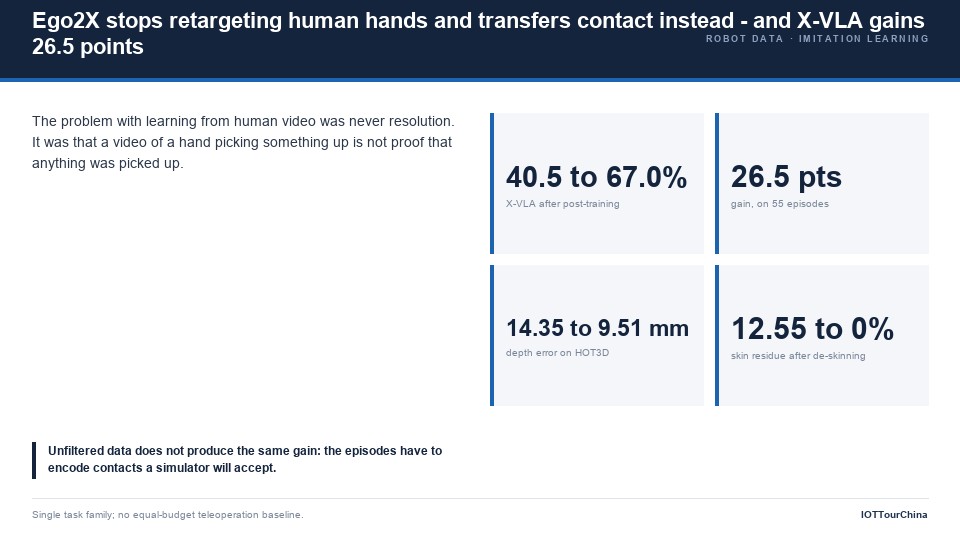
Decoupled depth correction. Monocular video has depth ambiguity: a hand and an object can look like they are touching in 2D while being centimetres apart in 3D. Ego2X uses the trusted contact points from CORE, together with object surface geometry, camera rays and multi-view information, to correct object pose and hand depth separately rather than jointly. On HOT3D, this cuts hand ray-direction error from 14.35 mm to 9.51 mm — about 33.7% better than the HaWoR baseline it starts from.
Contact-driven inverse kinematics. Instead of replaying human joint trajectories, the solver is driven by the contact point, normal, grasp mode and relative force. For a multi-fingered hand, it optimises the alignment of fingertip contact pads to surface anchor points. For a two-finger gripper, it synthesises an opposed grasp from the surface contact geometry — which is a different grasp, not a projection of the human one. On EgoDex, dexterous-hand contact achievement reaches 62.9%, against 27.9% for the official HuRo pipeline: +35.2 percentage points.
De-skinned, contact-aware rendering. Replacing a human arm with a robot arm normally means inpainting the arm out, and naive inpainting takes the grasped object with it. Ego2X uses the interaction state to protect the manipulated object during erasure, then composites the robot with contact-edge de-skinning. Across 14 sequences that were not used for tuning, skin residue at contact edges falls from 12.55% to 0%, with no object disappearance.
The output is not a video. It is LeRobot-format episodes carrying CORE contact labels, filtered by a physics replay in RoboTwin 2.0 — the manipulation either succeeds in simulation under the transferred contacts or the episode is dropped.
The result that matters: post-training, not pre-training
The experiment that justifies the whole architecture is a post-training run on X-VLA in RoboTwin 2.0. In the "Place Bread in Basket" task across 200 paired scenes, the zero-shot policy succeeds 40.5% of the time. After post-training on 55 physics-verified Ego2X episodes, success rises to 67.0% — +26.5 points. A "Place Bell on Scale" ablation shows the same shape.
The control condition is the interesting one: data that has not been through the physics filter does not produce the same gain. So the improvement is not simply "more data from a different distribution". It is that the episodes encode contacts that a simulator will accept, which is a much narrower and more useful property.
Where to be sceptical
Everything above is measured in simulation. The paper is candid that real-robot deployment and validation remain future work, which means the claim in the title — "to Any Robot" — currently means "to a dexterous hand and a parallel gripper inside RoboTwin".
The relative-force field is a visual prior, and the authors say so; it should not be read as force sensing, and any downstream controller that treats it as calibrated will be disappointed. Heavy occlusion is still named as an open problem for object pose, as are stable contact transfer into simulation and recovery of real contact force.
The baselines are the authors' own pipeline and the HuRo / ego2robot projects, and the headline post-training number rests on 55 episodes in one task family. A 26.5-point gain from 55 demonstrations is a strong result for that task, but it is not yet evidence that the pipeline generalises across manipulation categories, and there is no comparison against an equal budget of real teleoperated demonstrations — which is the baseline a robotics team will actually care about.
Why the architecture is the takeaway
Strip away the numbers and Ego2X is a template for a data business, which is presumably why a data-infrastructure company wrote it. Take RGB video from phones, GoPros and RealSense; reconstruct hands and objects metrically; express the interaction in the object frame; re-solve the grasp for whatever end effector you have; verify in physics; emit labelled episodes. Every stage is a filter that removes a class of physically impossible data, and the last one is the only stage that decides whether a policy can learn from the result.
That ordering — contact before retargeting, physics before training — is the transferable idea. Whether "human video as post-training data" becomes a real supply chain depends on the next step the authors have not taken: running those 55 episodes, and then 5,500, on hardware.