TF2-Steering: Zhejiang University steers actions with a tactile velocity field
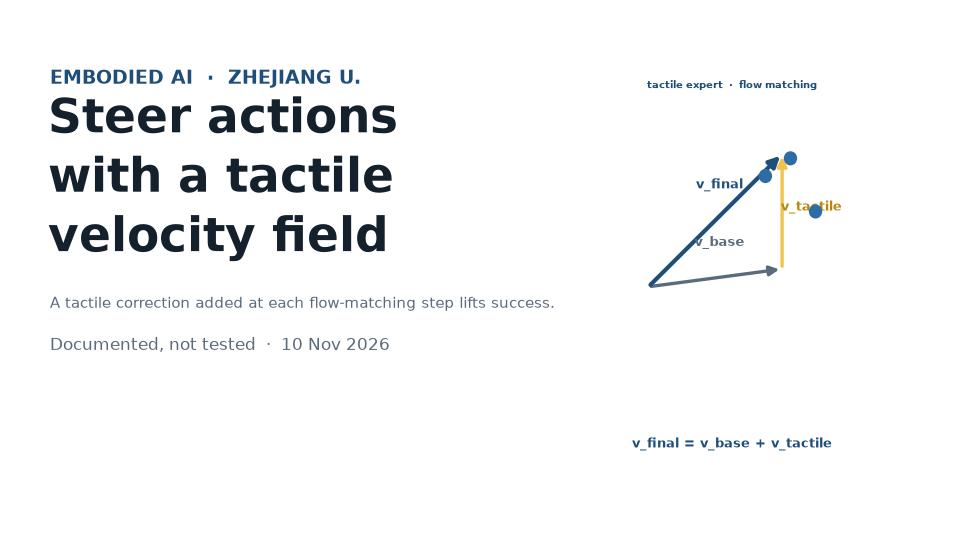
Tactile sensing tends to help most at the exact moment an action is generated, not as a separate input stream bolted onto a vision-dominated policy. TF2-Steering, from Zhejiang University and the Shanghai AI Lab, makes that idea concrete: a tactile expert predicts a velocity increment at every step of flow matching and bends the action's velocity field toward the correct contact.
The work is posted as a paper on arXiv and accompanied by an open project page.
The problem it attacks
Two questions have gone largely unanswered. First, how do you insert touch into a vision-dominated base policy? Touch is temporally sparse, contact happens only in a short segment of a task, and it carries far less data than vision, so naively concatenating it either gets ignored or pulls the model off course. Second, is touch only feedback, or should it also predict? Humans use both: we predict the right force from sight, then fine-tune online from feel. Most existing work does one or the other.
Residual connections can only correct after an action is already generated, so they cannot pull back a sequence that was wrong from the start. Gating protects the trunk but can attenuate the tactile feature before it reaches the action head, leaving the tactile contribution weak and unstable.
Velocity-field steering
Flow-matching action generation essentially integrates along a velocity field from noise to action. TF2-Steering's whole idea fits in one line: final velocity equals base velocity plus the tactile correction. The base policy's output, the rough direction to move, stays unchanged; touch only adds a local offset on top of that direction. A direct benefit is that the action expert can be completely unaware of touch: with no tactile sensor, run v_base alone and the model still works.
Two training constraints keep changing direction from becoming changing capability. Single-direction attention lets the tactile expert see the action expert's features but not the reverse, so the vision-action trunk never sees touch. Stop-gradient keeps the tactile correction loss from updating the action expert. The correction head is zero-initialised, so at the start the correction is exactly zero and the pretrained policy is not disturbed.
A small mixture-of-experts for touch
Inside the tactile expert is a small MoE: one path handles predicted future touch, the other handles real-time touch, each through its own feed-forward network, fused with a sigmoid weight. The two weights are not required to sum to one, so both streams can be fully active or both suppressed.
The tactile world model is built on LTX-Video at about 500M parameters, with multi-view cross-attention removed and only about a third of the layers kept. At inference it does not decode a tactile image; it passes the last-layer features straight to the tactile expert, because decoding is slow and loses information while the downstream task only needs task-relevant contact context.
Two rates: think at 5 Hz, correct at 30 Hz
A single system runs at two frequencies. At 5 Hz, the video world model, LTX-Video at 2.3B, and the tactile world model, 500M, provide long-horizon visual and tactile priors; one action chunk is reasoned about once and then held fixed. At 30 Hz, the action expert, 200M, and the tactile expert, 200M, regenerate the remaining actions from the latest tactile feedback every k steps, discarding what has already executed.
In the real-robot experiments the high-frequency tactile feedback comes from a 22-degree-of-freedom Sharpa dexterous hand on dual UR5e arms, with a top-mounted D455 and a wrist-mounted D405 camera. A randomly sampled delay d simulates feedback latency; the correction loss is computed only in a window after d, with a relative time encoding that tells the model which steps to correct. At inference, k is adjustable: that is the knob between responsiveness and compute cost. On a single RTX 4090 one action chunk returns in 240 ms.
Results
Simulation averages 68.3 percent, about 10.7 points above the strongest baseline FTP-1 at 57.7 percent. Almost all the gain comes from the Insert Hole task, 94.0 versus 56.0 percent; Insert Tube also rises from 68 to 80. By contrast Put Bottle drops to 44.0, FTP-1 is 74.0, Pull Out Key falls to 34.0, and Lift Can to 60.0. Tactile correction helps contact-geometry tasks and can even hurt grasp-and-transport tasks where it perturbs an already-correct action.
On the real platform, six tasks averaged a progress success rate of 71.5 percent, 9.1 points above T-Rex at 62.4 percent.
| Task | TF2-Steering | T-Rex |
|---|---|---|
| Unscrew cap | 67 | 58 |
| Dropper transfer | 66 | 46 |
| Whiteboard wipe | 76 | 61 |
| Zipper | 60 | 56 |
| Cup separation | 90 | 87 |
| Fruit plating | 70.0 | 72.5 |
| Average, six tasks | 71.5 | 62.4 |
Per task: unscrew cap 67 versus 58, dropper transfer 66 versus 46, whiteboard wipe 76 versus 61, zipper 60 versus 56, cup separation 90 versus 87; only fruit plating at 70.0 trails T-Rex's 72.5 and FTP-1's 75.0. The metric is progress success, scored 0 to 1 by milestones over 20 trials, so 71.5 percent means about 70 percent of the task completed on average, not 71.5 percent of trials fully succeeded.
Ablations on three real tasks give three counter-intuitive findings. Real-time feedback beats prediction: dropping prediction leaves 63.0 percent, minus 9.3, while dropping real-time leaves 69.7, minus 2.7. Correcting during generation beats correcting after: an action-space residual scores 61.3, nearly identical to no touch at 61.7. Isolation cannot be skipped: removing both the attention mask and stop-gradient drops to 62.7, near the no-touch level. Removing async inference drops unscrew cap from 67 to 56.
How this was checked
The paper, its abstract and the project page were read directly. The arXiv entry 2611.01483 and the project page yiming-cc.github.io/tf2-steering were confirmed to exist. The Sharpa hand, UR5e arms, D455 and D405 cameras, LTX-Video, flow matching and the simulation and real-robot numbers were taken from the source text. No model was trained or run for this article, and no robotic success-rate claim was independently verified.
Source: DeepBlue Embodied Intelligence, WeChat, 10 November 2026.