Open-HumanWAM: the 50,000-hour egocentric pretraining paper and the name on its title page
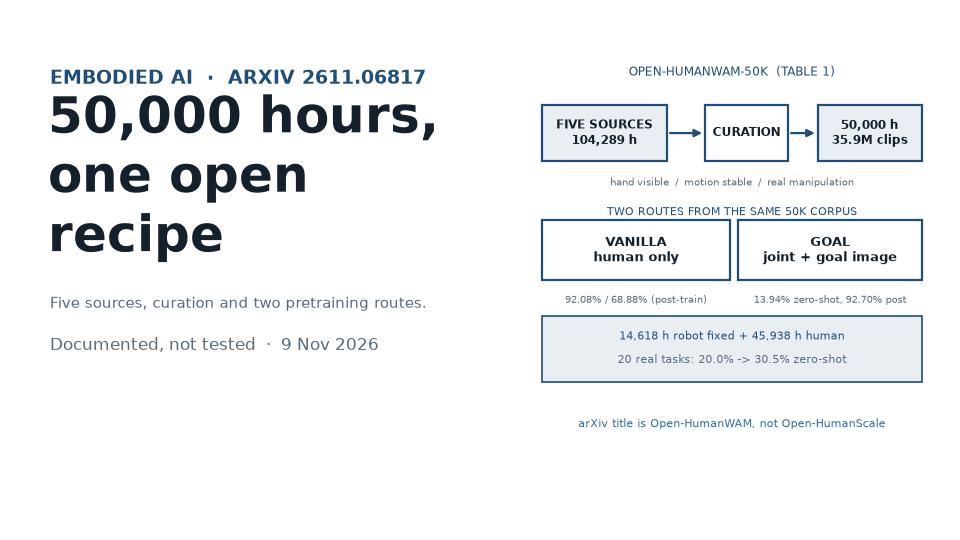
Egocentric human video is abundant, and robot demonstration data is expensive. A paper posted to arXiv in early November 2026 asks a narrower question than whether human video helps: how much of it helps, how should it be cleaned, and how should it be mixed with robot data. A Chinese-language write-up published on 9 November brought the work to a wider audience, but its reference list also introduced a naming error that is worth correcting before the result gets cited.
The name on the title page
The write-up lists the paper as Open-HumanScale: An Open Recipe for Scaling Human and Robot Experience for Embodied Foundation Models, and links to a separate project page under that name. The arXiv record says otherwise. The paper is Open-HumanWAM: An Open Recipe for Scaling Human and Robot Experience for Embodied Foundation Models, arXiv:2611.06817, submitted on 4 November 2026 and revised on 5 November. A search of the full paper text finds no occurrence of the string Open-HumanScale.
The headline of the write-up calls it the first fully open baseline. The abstract says the authors introduce the first fully open recipe for scaling egocentric pretraining to 50,000 hours. A recipe is a published data pipeline, training procedure and set of checkpoints; a baseline is a comparison system with a fixed score. The difference matters here because the contribution is explicitly the released corpus, curation code, pretraining code and checkpoints, not a new leaderboard entry that others are meant to beat.
The arXiv comments field lists only a GitHub repository and a project website. There is no conference or journal name in the record, so none should be attached to the work. The subject classes are computer vision and robotics.
What the 50,000 hours are
The corpus is called Open-HumanWAM-50K. Table 1 of the paper gives the arithmetic that a short summary usually drops. Before curation the five sources total 104,289.41 hours; after curation the corpus is exactly 50,000.00 hours. The paper counts 31,396,799 physical episodes, which become 35,934,235 continuous clips after filtering, because a single episode can be split into several retained segments.
| Source | Hours before curation | Hours retained |
|---|---|---|
| HumanNet subset | 90,275.25 | 40,743.58 |
| EgoSuite-Open100K | 11,193.99 | 7,081.65 |
| EgoDex | 829.45 | 335.43 |
| Gen-HumanEgo | 1,847.39 | 1,814.53 |
| EgoVerse | 143.33 | 24.81 |
| Total | 104,289.41 | 50,000.00 |
Curation is not just concatenation. Clips are kept only when the hands are visible, when wrist and camera motion are stable enough that pose estimates do not jump, and when actual manipulation is taking place rather than a static scene. The authors then map heterogeneous hand annotations into one bimanual end-effector representation: position, orientation and gripper openness for each hand. That is the interface that lets a human wrist and a robot gripper be expressed in the same terms without pretending they have the same joints.
The paper reports an empirical log-linear scaling law linking pretraining hours to downstream robot success. It also compares two ways of growing the data: adding more hours of similar footage, versus adding hours while widening task and scene coverage. The latter gives larger gains out of distribution, which is a more useful finding for anyone planning a data collection budget than the headline hour count.
Two routes and their numbers
HumanWAM-Vanilla is pretrained only on human egocentric video and then post-trained on robot demonstrations. HumanWAM-Goal adds joint human-robot pretraining and a visual goal image as a condition, alongside the current observation, language instruction and robot state.
| Result | HumanWAM-Vanilla | HumanWAM-Goal |
|---|---|---|
| RoboTwin 2.0 Clean2Clean after post-training | 92.08 percent | 92.70 percent |
| RoboTwin 2.0 Clean2Random after post-training | 68.88 percent | 84.60 percent |
| RoboTwin 2.0 mean zero-shot success | not reported in the abstract | 13.94 percent |
| RoboDojo mean success and progress score | 14.17 percent and 19.00 | not reported in the abstract |
The write-up quotes 88.65 percent as the post-trained average for HumanWAM-Goal, which is simply the mean of the two RoboTwin conditions. It also quotes 13.94 percent as a native zero-shot result, and here a caveat is in order: the paper has a dedicated section comparing zero-shot performance against existing foundation models, so the claim that most open baselines cannot be evaluated this way should not be repeated as a fact about the field.
The physical-robot experiment is the most carefully controlled part of the paper. The robot corpus is held at 14,618 hours while human data is added in a hybrid series at 15,901 or 45,938 hours. Across a 20-task real-robot zero-shot suite, mean success rises from 20.0 percent to 30.5 percent. That is a measured gain from adding human video at fixed robot-data cost, not a claim that human video replaces robot data. The paper is explicit that embodiment, joint limits, gripper geometry and control error still have to be learned from the robot's own demonstrations.
Reading the numbers without merging them
Three distinctions keep this result honest. Simulation benchmark scores and real-robot scores are different experiments. Zero-shot inference and post-trained evaluation are different conditions on the same model, and the gap between 13.94 percent and 92.70 percent on RoboTwin 2.0 is a gap between those conditions, not an improvement over time. A success rate is not a progress score, and a mean over 20 physical tasks is not a mean over two simulation settings.
The write-up also describes a qualitative behaviour where swapping the goal image moves a bottle to a different target without any parameter update, which the paper frames as embodied in-context learning. That is a demonstration of conditional behaviour on a trained policy, not evidence that the model understands arbitrary images in the way a person does.
What is genuinely open here is verifiable: the corpus, the curation and pretraining pipelines, the pretrained and post-trained checkpoints, inference code and the simulation evaluation suites are all released. That is a stronger basis for comparison than a single headline percentage, and it is the reason to cite the paper under its correct title.
How this was checked
The arXiv abstract page and the full HTML text of version 2 were read directly, including Table 1, the scaling sections and the real-robot experiment description. All percentages, hour counts, clip counts and dataset names come from those pages, not from the secondary write-up. The naming discrepancy was resolved by searching the full paper text for the alternative title. No model was run, no checkpoint was downloaded and no benchmark was reproduced for this article.
Source: DeepBlue Embodied Intelligence, WeChat, 9 November 2026.