Eleven open-source world models, sorted by what they actually give you: frames, meshes or state
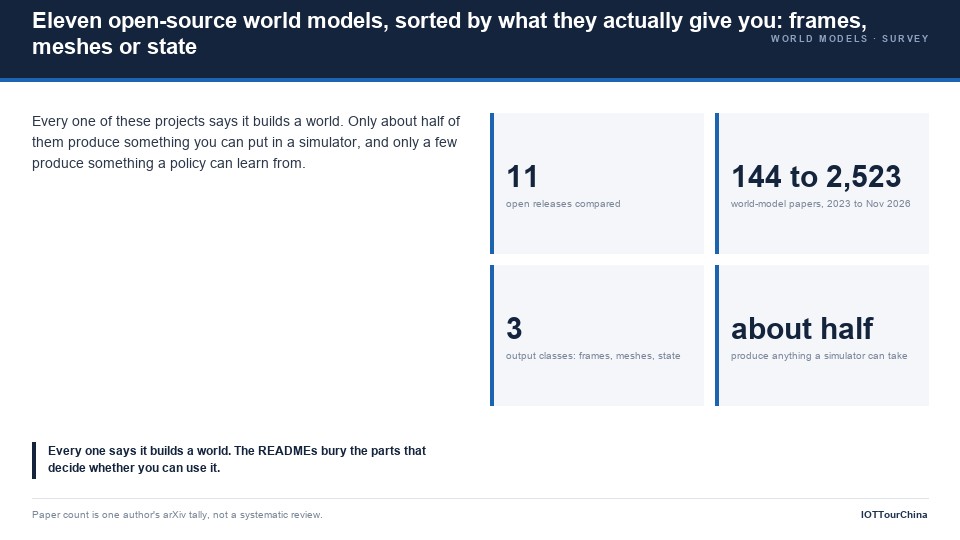
The number that frames this whole category: "World Model" papers went from 144 in 2023 to 622 in 2025 to 2,523 in the first eleven months of 2026, according to the count published alongside this roundup — about 17× in three years, and +306% year over year on a like-for-like January-to-November window. Treat the absolute figures as that author's own arXiv tally rather than a bibliometric fact. The direction is not in doubt.
What matters more for anyone who has to actually run one of these is that the open-source releases have stopped being demos. Weights, inference code and in several cases training code are out, and the projects have split into three camps that solve genuinely different problems.
Camp one: interactive video worlds
These take a text prompt or a reference frame plus a control input, and keep emitting frames fast enough that a human can move through the result.
LingBot-World Infinity (Ant Group's Robbyant, github.com/Robbyant/lingbot-world-v2) is the reference implementation of the "unbounded" pitch: causal video modelling so the horizon is not a fixed clip length, distillation to make a real-time variant affordable, and 14B and 1.3B checkpoints. The vendor demo is 720p at 60 FPS with shooting, movement and spell-casting inputs. The 2026 addition is an Agentic Harness — one agent drives the character, another injects events — which is the difference between a world that responds to a keyboard and a world that has things happening in it.
HY-WorldPlay (Tencent Hunyuan, github.com/Tencent-Hunyuan/HY-WorldPlay) attacks the specific failure everyone hits after thirty seconds of exploration: turn around and the room has changed. It streams video conditioned on camera motion, and rebuilds context memory dynamically from earlier clips so newly generated frames can reference geometry that has already been seen. Dual action representation covers keyboard and mouse camera control; distillation cuts the sampling steps.
Matrix-Game 4.0 (Skywork AI, github.com/SkyworkAI/Matrix-Game) makes the most pragmatic architectural bet of the eleven: let a conventional game engine own physics, collision, character state and object persistence, render a low-poly proxy, and use a causal DiT to turn that proxy into something that looks real at 480×864 in four-frame chunks. You keep deterministic rules and get generative visuals. Inference is tuned for RTX 5090, 5080 and 5070 Ti, so a single GPU is a supported configuration rather than a footnote.
SANA-WM (NVIDIA, github.com/NVlabs/Sana) is the efficiency play. Video diffusion's attention cost explodes with resolution and duration; SANA-WM uses a hybrid linear-attention architecture (gated delta rule blocks mixed with softmax blocks), takes 6DoF camera pose as a control signal, and generates along a specified viewing path. If your problem is "long and controllable" rather than "photoreal", this is the architecture to study.
ABot-World-0 (Alibaba AMAP CV Lab, github.com/amap-cvlab/ABot-World) is the one that answers the cost question directly: 5B parameters, causal generation plus distillation, 720p at 16 FPS on a single RTX 5090 at about 19 GB of VRAM, with keyboard control, a local Gradio demo, and weights on Hugging Face and ModelScope. Roughly 2.5k stars. It also generates new scene content as you explore rather than replaying a fixed path.
Camp two: generate the 3D asset, not the pixels
The objection to camp one is fair: a video that looks like a room is not a room. A robot needs to know where the table leg is, not what it looks like from one angle.
HY-World 2.0 (Tencent Hunyuan, github.com/Tencent-Hunyuan/HY-World-2.0) generates a panorama, plans an explorable camera trajectory, expands the world with a stereo/keyframe pipeline, and reconstructs — outputting mesh, point cloud or 3D Gaussian Splatting that can be opened in Blender, Unity, Unreal or Isaac Sim. Its WorldMirror 2.0 component predicts depth, surface normals and camera parameters from multi-view images or video, which is the geometry backbone that makes generation and reconstruction one system rather than two.
Lyra 2.0 (NVIDIA Spatial Intelligence Lab, github.com/nv-tlabs/lyra) starts from a single image and keeps extending. The hard constraint it targets is that returning to a previously visited place must produce the same place; the pipeline maintains a spatial memory of dense 3D correspondence and generates new regions against it rather than regenerating the whole scene per view.
The practical payoff of this camp is that the output is an asset with a licence to be edited. The cost is that you inherit 3D reconstruction failure modes — thin structures, reflective surfaces, textureless walls — that a video model would simply hallucinate past.
Camp three: predict the state, not the picture
The third camp argues that pixel prediction is the wrong objective. An agent does not need to know what the future looks like; it needs to know how the state evolves under an action.
V-JEPA 2 / 2.1 (Meta FAIR, github.com/facebookresearch/vjepa2) learns in latent feature space: pretraining on the order of a million hours of video and a million images, then an action-conditioned variant (V-JEPA 2-AC) post-trained on roughly 62 hours of robot interaction data to predict future states for candidate actions and support manipulation planning. 2.1 tightens the self-supervised objective toward denser, temporally consistent features. No decoder, no pixels.
NVIDIA Cosmos Predict (github.com/nvidia-cosmos/cosmos-predict2.5) goes the other way and leans into generative prediction of physical scenes, unifying Text2World, Image2World and Video2World in one family, with multi-camera models for driving so the same scene can be predicted from several viewpoints at once. That multi-view capability is the part that makes it useful for synthetic data and closed-loop simulation rather than for pretty clips.
AlayaWorld (github.com/AlayaLab/AlayaWorld) is the systems answer: autoregressive generation with an explicit 3D cache for space and compressed history features for time, so returning to an old location restores from the cache instead of re-imagining it. It also accepts prompt changes mid-generation — new weather, new lighting — without restarting, and is trained against its own accumulated drift so error does not compound indefinitely.
DreamerV3 (Google DeepMind and University of Toronto, github.com/danijar/dreamerv3) predates this wave and remains the cleanest statement of the idea: learn a latent dynamics model, then train the policy inside it. Imagination training means the agent practises in the learned model instead of the real environment, which is exactly what you want when real interaction is expensive. Its significance is generality — one configuration across Atari, Minecraft and robot control, published in Nature in 2025.
How to choose, and what to check before you clone
Pick by output, not by benchmark. If a downstream consumer needs pixels at frame rate, camp one. If it needs a mesh or a splat to put in a simulator, camp two. If it needs a dynamics model to plan against, camp three.
Then check five things the READMEs bury:
- VRAM and frame budget. "Real-time" usually means 720p at 16–20 FPS on a 5090, not 1080p60 on a laptop. ABot-World-0's 19 GB is unusually candid; most projects are vaguer.
- What the memory mechanism actually is. A 20-chunk attention window is not long-term memory. Explicit 3D caches and dynamic context reconstruction are.
- The action interface. Keyboard events, 6DoF camera poses and continuous robot actions are three different contracts, and only the third transfers to a policy.
- Whether weights are real. Some releases ship inference code and a demo endpoint with weights "coming soon".
- Licence. Several of these are research-only, which rules out product use regardless of technical fit.
The honest summary of where 2026 landed: open-source world models can now generate a plausible, explorable, sometimes persistent environment on one GPU, and can predict physical state changes in latent space well enough to train a policy. What none of them demonstrate is that the generated world obeys physics for long enough to be trusted. Long-horizon spatial consistency and physical correctness are still the open problems, and they are the reason the field has not converged on a single architecture.