One million synthetic door and drawer episodes train a robot policy that transfers to real arms
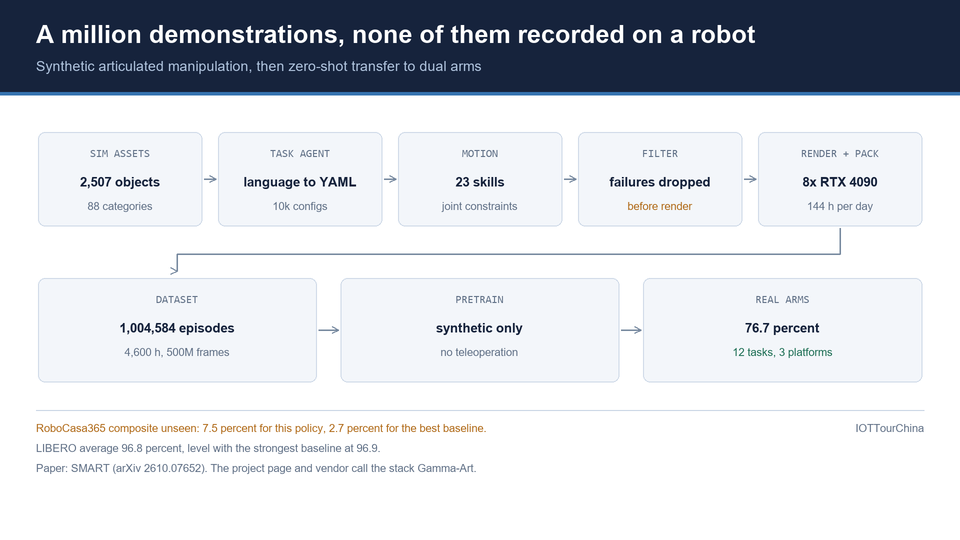
Manipulating a door is not a harder version of picking up a cup. The cup is a rigid body whose pose is the whole state. A door is a joint whose state is an angle, and the robot has to hold contact while moving along a constraint that its own controller did not define. Collecting a million demonstrations of that on real hardware is expensive enough that most groups do not try.
A team at the Institute of Artificial Intelligence at China Telecom, with Zhejiang University, the Technical University of Munich, Harbin Institute of Technology, Shanghai Jiao Tong University, Tsinghua and Gamma Robotics, built the demonstrations in simulation instead. The resulting dataset holds just over a million trajectories, and a vision-language-action model pretrained on nothing but that synthetic data reached a 76.7 percent average success rate on twelve real dual-arm manipulation tasks without seeing a single real-robot demonstration during pretraining.
One naming note before the details, because it will otherwise send you to the wrong page. The paper calls the stack SMART, with SMART-Sim, SMART-Data and SMART-VLA. The project page and the vendor call the same pipeline Gamma-Art, with Gamma-Sim, Gamma-Art-Data and Gamma-Hive. The arXiv identifier 2610.07652, the project site and the dataset all describe one system under two names, and the technical report is dated 6 October 2026.
Why articulated objects break the usual data recipe
Three properties separate this from rigid-object manipulation.
Task progress lives in the joint state rather than the object pose. Whether a cabinet door is open is a hinge angle, whether a drawer is out is a displacement along a rail, whether a knob is turned is a rotation about its own axis, and one cabinet can carry a door, a drawer and a flap that each need their own axis, range and current position.
The instruction also picks the part. "Open the cabinet" implies the handle because the door edge works less reliably; "pull the drawer" implies the handle so the pull stays parallel to the rail; "turn the knob" implies approaching near the rotation center. Same verb, different contact geometry.
Then the trajectory has to obey the joint: an arc for revolute, a line for prismatic, with wrist, arm and sometimes base adjusting as resistance changes. Same start, same end, different path in between is normal.
None of this survives teleoperation cheaply. An operator has to judge whether to pull, push, turn or press, then drive a body whose arm length and reach differ from their own, and a trajectory that drifts slightly can spike the contact force or jam the part. Change the handle position, hinge direction or resistance and the demonstration may need to be redone. Handheld and egocentric capture systems cut the hardware dependency but still lack the target robot's joint states, gripper opening and contact forces, so retargeting has to close that gap, and the retargeted path can collide or drift off the hinge axis.
The asset layer is where most of the work went
The simulation platform, SMART-Sim, is built on Isaac Lab and carries four things that a general-purpose generator usually does not.
| Asset layer | Count | Why it matters |
|---|---|---|
| Articulated objects | 2,507 | revolute, prismatic and compound joints, kept as intact part hierarchies |
| Functional categories | 88 | cabinets, drawers, fridges, ovens, dishwashers, dispensers, windows |
| Scenes | 1,452 | 300 generated room meshes plus gaussian-splat reconstructions |
| 4K indoor images | over 10,000 | generated as pseudo-backgrounds and as light sources |
Part annotation is the piece that makes the rest possible. The pipeline screens operable parts from orthographic views with a vision-language model, locates each part in 2D with DINO-X, recovers its surface point in the object frame by ray tracing, and extracts an anchor action frame through iterative erosion and 2D-to-3D back-projection. The same model labels part materials, which later drive visual and physical randomization.
That action frame is a small but consequential convention. The plus-Z axis is the approach direction, the plus-Y axis is the parallel axis, plus-X follows from the right-hand rule, and the origin sits at the gripper-object contact point. For revolute joints the parallel axis is aligned with the rotation axis; for prismatic joints it lies in the plane perpendicular to the translation direction. Get this wrong and every generated trajectory fights the joint instead of following it.
Motion generation splits at the moment of contact. In free space the platform uses cuRobo for GPU-batched trajectory optimization and collision-aware planning, then perturbs the result. Once contact is established, the generator must consume the joint type, joint position and valid motion range explicitly, because the end effector is now constrained to the part's own kinematics. Every generated trajectory is then checked for collisions, joint limits, contact loss and configuration deviation, and the failures are dropped.
The output of that layer is 23 manipulation skills, abstracted from joint types and manipulation semantics: pushing, pulling, sliding, pressing, door opening, rotating, flipping, knob turning, plus grasping, placing and alignment. Each skill carries its own constraints and parameters and can be decomposed into sub-steps. Roughly the same 23 number appears again in the dataset, which is a coincidence worth flagging: 23 of the 88 categories show up in the released trajectories, and that is a different 23.
Task generation is a language model writing configs
The agentic part is a natural-language front end over the simulator. A request is resolved against the asset library, the object identity and initial pose are fixed, the target part's annotation is looked up, and a skill program is assembled. The output is a task file holding scene, object, robot, skill sequence, initial state, success condition, and the render, physics, randomization and parallel-execution parameters, with standardized definitions across 10k task YAML configurations. Two touches inside that matter: the agent picks path tracing for transparent or reflective objects where rasterization artifacts would confuse the policy, and it sizes the number of parallel environments from the predicted task length.
Randomization is part-level rather than scene-level, which is the difference between useful and decorative. Friction and density are drawn per part, joint stiffness and damping move within a narrow band, materials and textures are sampled independently while part structure is preserved, and lights vary in position, intensity, color and temperature against resampled HDR environment maps. Camera intrinsics are held equal to the target camera while extrinsics absorb mounting error, calibration noise and pose offset. Joint states are sampled around a nominal configuration, and containers are transformed as a whole before their contents are randomized individually.
Throughput comes from not rendering failures
The distributed system, Gamma-Hive on the project page, splits work by resource type instead of running one pipeline serially. Trajectory generation and validation are CPU-heavy. Rendering is GPU-heavy. Format conversion, into LeRobot format, is CPU plus high-frequency storage I/O. Keeping them in one queue means each stage waits on the slowest.
| Stage | What it does | Load |
|---|---|---|
| Trajectory generation and validation | batch variants, terminate failures early, filter collisions, joint limits, contact loss, jitter and task failure | CPU, massively parallel |
| Visual rendering | replays the stored seed, generates camera views, writes observations and actions | GPU |
| Format conversion | streams HDF5 into LeRobot format, encodes multi-view video, maps fields across embodiments | CPU and I/O |
Shared storage connects the three, and the scheduler splits long tasks, monitors state and retries failures. The design consequence is worth more than the throughput figure: a failed trajectory never consumes render time, which is the expensive resource. The released dataset was generated with 96 workers, and a single server with eight RTX 4090 cards produces roughly 144 hours of data per day.
What is actually in the box
| Property | Value |
|---|---|
| Trajectories | 1,004,584 |
| Total duration and frames | over 4,600 hours, about 500 million frames |
| Robot setups | 5 (AC1, R1Pro, dual RM75, single and dual Franka) |
| Task types | 44 atomic types, with composite and long-horizon tasks built as sequences |
| Complexity split | 69.4 percent atomic, 20.9 percent composite, 9.7 percent long-horizon |
| Object categories used | 23 of the 88 available |
| Scenes used | 1,122 |
The comparison that matters for anyone judging scale is against the two closest synthetic sets, and it has to be made on articulated-object trajectories rather than total trajectories, because the totals mislead.
| Dataset | All trajectories | Articulated trajectories |
|---|---|---|
| SMART-Data | 1.0M | 1.0M |
| RoboCasa365 | 655k | 415k |
| MolmoBot | 1.7M | 125.6k |
| InternData-A1 | 630k | 74.4k |
Read carefully, that table says the 2.4-times figure against RoboCasa365 and the 8-times figure against MolmoBot both refer to the articulated subset. MolmoBot is larger overall and much smaller in the specific thing being claimed, which is the kind of comparison vendors usually get wrong and this report gets right.
Does it transfer
Pretraining used behavior cloning on SMART-Data alone. No real robot demonstrations entered pretraining, and post-training used task-specific synthetic episodes rather than teleoperation.
Real-world evaluation ran on three dual-arm platforms, a RealMan RM75, an R1Pro and an AC1, each with one head camera and two wrist cameras whose intrinsics and extrinsics were aligned between simulation and the real rig. Twelve tasks were built as eight types plus four cross-platform variations, spanning prismatic, revolute and compound joints and both single-stage and multi-stage interactions: bucket-handle lifting, drawer pulling, dispenser pressing, cabinet-door sliding, toaster-lever pressing, microwave door closing, microwave knob rotation and toolbox-lid flipping.
| Benchmark | SMART-VLA | Best non-synthetic-pretrained baseline |
|---|---|---|
| Real dual-arm, 12 tasks, average | 76.7 percent | 59.4 percent (pi-0.5), 69.4 percent (real-data pretraining) |
| LIBERO average | 96.8 percent | 96.9 percent (pi-0.5) |
| LIBERO long-horizon subset | 94.0 percent | 92.6 percent (InternVLA-M1) |
| RoboCasa365 atomic seen | 52.8 percent | 51.1 percent |
| RoboCasa365 composite seen | 23.1 percent | 14.8 percent |
| RoboCasa365 composite unseen | 7.5 percent | 2.7 percent |
Three things in that table deserve to be read together. On the real robots the synthetic-pretrained policy leads the strongest real-data-pretrained comparison by 7.3 points and the pi-0.5 baseline by 17.3. On LIBERO it is a tie at the top rather than a win, and the variant pretrained on real data still scores higher at 97.8. On RoboCasa365 the absolute numbers are low and the advantage is concentrated exactly where it should be: composite and unseen splits, where the baseline collapses to 2.7 percent and this model holds 7.5.
The authors also varied task plane and height on the AC1 platform to break the spatial arrangement seen in training. The synthetic-pretrained model degraded modestly while some baselines failed outright on multiple tasks, which is the expected payoff from randomizing object pose, robot configuration and contact conditions during synthesis.
Scaling is the more useful result
The experiment that tells you whether the data engine works is not the zero-shot number but the slope. Five tasks were post-trained with 1, 10, 50, 200 and 500 synthetic episodes each.
Bucket-handle lifting on the R1Pro moves from 13.3 percent at one episode to 73.3 percent at fifty. Toaster-lever pressing goes from zero to 60.0 percent over the same span. Microwave knob rotation on the AC1 goes from 6.7 to 46.7 percent. Drawer pulling produces nothing at all below fifty episodes, reaches 40.0 percent at 200, and all five tasks clear 80.0 percent at 500. Loosely constrained tasks saturate early while the ones requiring sustained contact and constrained paths keep climbing, which is the signature of data that contains real variation rather than repeated noise.
What the report does not solve
The limitations section is unusually direct, and the three items are the ones an integrator would hit first.
Synthesis throughput drops for long-horizon tasks because planning and execution success rates fall as horizons extend, so the cost per usable episode rises exactly where the data is most valuable. The proposed fix is to synthesize short subtasks independently and reconnect them through consistent boundary states.
Agentic task generation inherits the failure modes of the language model doing the generating. Hallucinated parts or infeasible skill sequences are a real category of bad sample, mitigated only by stronger verification and human checks.
Articulated assets need substantial post-processing for geometry separation and articulation annotation. That is the part of the pipeline that stays manual, and it is why the library reaches 88 categories while the released data covers 23.
Two more boundaries show up in the numbers rather than the text. Camera intrinsics were deliberately held identical between simulation and hardware, an assumption a deployment with a swapped lens will not enjoy. And 7.5 percent on composite unseen tasks is a long way from a product, however much better than the 2.7 percent baseline it is.
What to take away if you build these systems
The reusable idea is not the dataset. It is that the annotation schema did the heavy lifting: an action frame whose axes are defined by joint type, an origin pinned to the contact point, and a skill library indexed by joint type and manipulation semantics. Once those exist, a language model can write task configs, a scheduler can grind out demonstrations, and the failure filter has something objective to test against.
The second is resource separation. Synthetic-data pipelines are usually limited by rendering, and rendering failed trajectories is pure waste. Terminating them before the renderer sees them beats any optimization inside the renderer.
The third is a caution about dataset comparisons. Total trajectory counts hide which subset is relevant. One of the largest synthetic sets on the market holds 125.6 thousand articulated trajectories out of 1.7 million total, and the 8-times claim only means something once that split is on the table.