A judgment-only model reaches 13 percent of a gateway's paid teams, then six robot loops
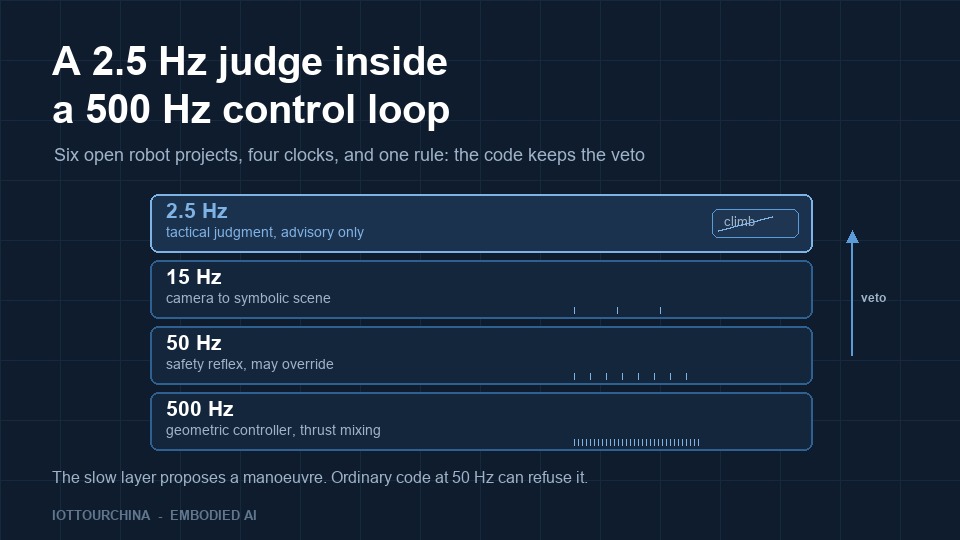
A quadrotor threading a sliding gate at 3.6 metres per second has no use for a model that answers in seconds. Its attitude controller updates five hundred times a second. The camera produces a usable picture fifteen times a second. Anything slower than that is not in the loop at all.
And yet one open project puts a hosted model called Jev into that stack at roughly 2.5 Hz, and reports that the drone only finishes the course when the model is there. The same pattern appears in a driving simulator, two robot-arm comparisons and an arm that chains primitives on command. Taken together they sketch a place in the control stack that is neither planning nor control, and the interesting part is not the model. It is the veto that keeps a slow component from becoming a hazard.
Jev is TypeSafe's model, and the company describes it as the first System One model: it takes a state and a set of typed questions and returns typed answers with probability distributions, without generating text. Two of the six projects below benchmark it against a general-purpose language model on the same task. Neither of those benchmarks is a success-rate study, and one project's own ablation shows the model gaining nothing on an earlier version of its own task, which is worth keeping in view before the pattern gets read as a general result.
Before the six projects, the claims that made the model worth trying belong on the record. Three of them are quoted constantly, and only one of the three survives without a qualification attached to it.
What the launch numbers actually count
Vercel published its launch numbers on 18 September, three days after the model went live. Within 24 hours of being listed on AI Gateway, Jev had reached more than twice as many paid teams as any previous model launch on that platform, and by hour 24 nearly 13 percent of paid teams were using it. The post splits that into two comparisons, twice the share of the GPT-5.6 family and more than six times the share of Fable 5.1, and gives the shape of the curve: a tenth of teams inside 18 hours, where every other recent launch stayed below 7 percent after a full day.
That number is real and it is narrower than the phrasing suggests. The denominator is paid teams on one gateway, counted during a launch window, on a model that still had an early access list. A specialised component with a single obvious job is exactly what a team tries once to see whether it fits, and a launch-day share measures the trial. Whether the same teams were still routing production traffic to it a month later is the number that decides whether the pattern holds, and Vercel names that gap itself, in the closing line of the post.
| Share | What it is a share of |
|---|---|
| nearly 13 percent after 24 hours | paid teams on AI Gateway |
| 2x the GPT-5.6 family | share of those teams, not request volume |
| more than 6x Fable 5.1 | share of those teams, not request volume |
| a tenth of teams after 18 hours | fastest launch on that platform |
None of that measures whether the judgments are good. A model that answers in 200 milliseconds gets tried more often than one that takes 20 seconds even when both are equally right, which is why adoption and accuracy have to be read as separate numbers here.
The speed and cost multiples come from the vendor
The two figures that travelled furthest sit on TypeSafe's home page: 193.6 times faster and 444.6 times cheaper. Both come from the company's own workflow evaluations, four workflows published alongside the model, and the method decides how far they travel.
Every model runs the same compute graph, written in code, instead of being asked to reason its way to an answer. The reference is not a ground truth label. It is the average of the two models TypeSafe rates highest, GPT-6 Astra and Fable 5.1, so the score measures agreement with the strongest available answers rather than correctness. The language models are run through the company's own System One wrapper, which constrains them to emit the same typed structure the API expects.
TypeSafe states the caveats in the same post, which is more than most launch posts manage. The reference average biases answers toward OpenAI and Anthropic. The workflows were written by people on its own capabilities team, so bias toward its own model is possible. The wrapper that forces language models into structured output tends to be slower and more expensive than asking for a decision without probabilities. And the sentence that matters most for anyone quoting the figure: the company expects the results to sit at the higher end of real world gains.
| Claim | Where it appears | Reference |
|---|---|---|
| 193.6x faster, 444.6x cheaper | TypeSafe launch post | four of its own workflows, averaged GPT-6 Astra and Fable 5.1 |
| up to 194x faster, 445x cheaper | Vercel launch post | the same evaluation, attributed to TypeSafe |
| 40x to 200x faster | TypeSafe launch post | 70 to 500 ms against 3 to 329 seconds |
The raw latency pair is the least contested part. A frontier model answering a hard question takes between 3 and 329 seconds end to end, and the hosted service answers in 70 to 500 milliseconds. The bounds of the multiple come from dividing those ranges, and they hold for any query shaped like a decision over a fixed option list, whether or not a language model could have answered it better. Pricing is published the same way, at $0.042 per million input tokens with output described as too cheap to meter, against $0.20 to $10 per million input tokens for the frontier models it compares to, where output runs about five times the input price.
The only outside test rests on five agent runs
LangChain published the first evaluation that did not come from the vendor, on 20 September, and the setup is small enough to check line by line. A weather agent built on Deep Agents was run once on five requests, and each captured run was frozen into a dataset so that every judge scored identical input. Two signals came back per run, a quality score that is continuous and a pass or fail decision that is binary. A human reviewer labelled the same five runs against the same rubric, and those labels became the oracle.
Each judge repeated the whole set 100 times, which produces 500 binary decisions per judge. Against the human labels, Jev agreed on every one. GPT-5.6 Terra agreed on 99.8 percent, GPT-5.6 Luna on 96.4 percent and Claude Sonnet 4.6 on 80 percent. The gap between the first two is one decision out of 500 on a five example set, so it is not a capability result. The gap to the third one is.
| Judge | Agreement with human labels | Quality variance against Jev |
|---|---|---|
| Jev | 500 of 500 | baseline, 0.0000149 |
| GPT-5.6 Terra | 99.8 percent | 913 times higher |
| GPT-5.6 Luna | 96.4 percent | 433 times higher |
| Claude Sonnet 4.6 | 80.0 percent | 92 times higher |
The Claude row is the one to keep. Its pass rate sat flat at 0.56 across all 100 repetitions, the lowest variance of the three language models and the least accurate judge in the set, which is exactly why LangChain reports accuracy and repeatability as separate axes instead of folding them into one score. A judge can be wrong consistently. Cost and speed landed in the same direction, at $0.00035 per call and 0.44 seconds on average, with the whole run costing $0.34 against $28.17 for Claude. LangChain's own reading is that it cannot say why the variance gap appeared, describing the result as observational and warning that low cost also amplifies mistakes at scale.
Zero hallucinations means zero type errors
The home page claim that reads as the boldest is the one with the smallest scope. What the guarantee covers is the output space. Possible answers and their structure are declared in advance, so the model cannot return a fifth option when four were offered, cannot emit prose where a number belongs, and cannot produce a valid looking object with the wrong field names. TypeSafe calls this mathematically impossible rather than unlikely, and it is a property of decoding against a declared schema, not a claim about being right.
The same post says what the guarantee is not. The hallucination rates in its comparison charts come from OpenRouter and carry a routing bias the company names, and its own zero is not measured, because schema matching is guaranteed and a zero can therefore be entered by construction. A wrong answer inside the declared set is still a wrong answer. What the schema removes is the class of failure where a downstream parser breaks, which is the failure that stops automation outright rather than degrading it.
One limit belongs in any design. A choice question tops out at 255 options, and above that the service runs two stages, scoring candidates and then making an explicit choice, which is why the high cardinality demos in the launch post run slower than the rest. Past a few hundred options the pattern is no longer a single call, and the latency budget has to be built for the two stage version.
Where the shape of the output comes from
TypeSafe's founder, Diogo Almeida, worked on the instruction tuning and human feedback methods at OpenAI that he describes as the research behind ChatGPT, and the launch post is explicit that Jev applies the same argument one step further. The argument was published separately, five days before the model, under the title The Bitterest Lesson, and it reduces to an ordering: doing the right task beats more data, which beats more compute, which beats a better algorithm.
The evidence offered is InstructGPT. The 2022 paper's headline result was that a 1.3 billion parameter model tuned on human feedback was preferred by labellers over the 175 billion parameter model it was built from, and the blog restates the same result as GPT-2 sized models more than a hundred times smaller than GPT-3 beating GPT-3 once they were trained on the task people actually wanted. Read that way, what a chat model lacks when it is dropped into automation is not scale. It is that the model was trained to produce a string when the program needed a decision.
The training method follows. TypeSafe contrasts its own approach, Reinforcement Learning for Calibrated Decisions, with the two methods behind the frontier chat models: reinforcement learning from human feedback, which optimises for what a rater prefers, and reinforcement learning from verifiable rewards, which optimises for what can be checked automatically. Neither optimises for a probability that matches the model's own error rate, and a model that is right 95 percent of the time without saying which 5 percent it is wrong on cannot be left alone in a control path.
The names are footnotes that carry the thesis. System One comes from Kahneman's fast and deliberate split, with a deliberate claim to the reliability that the psychology literature does not grant. Jev is named after William Stanley Jevons, whose observation about coal was that making steam engines more efficient raised total consumption rather than lowering it. The bet underneath the naming is that orders of magnitude cheaper judgment will be requested in quantities nobody is currently planning for, which is the argument the six robot projects below end up testing from the other end.
Four clocks in one airframe
The clearest description of where a slow component can sit comes from jev-drone, a MuJoCo project that flies the Skydio X2 airframe from the Menagerie asset set through five stations with only its onboard camera. The author lays the stack out as four rates.
| Rate | What runs at that rate | Who owns it |
|---|---|---|
| 500 Hz | geometric controller, thrust mixing | ordinary code |
| 50 Hz | guidance and safety reflex | ordinary code, with veto |
| 15 Hz | depth and segmentation to symbolic scene | numpy |
| about 2.5 Hz | tactical judgment | Jev, advisory |
The perception stage is deliberately unglamorous. Classical vision condenses depth and segmentation into five forward range sectors, the height of whatever is blocking the lane, whether the obstruction's top edge is even visible, and where the target is. Jev never sees a pixel. It receives that summary and answers three questions in one call: which manoeuvre applies, how urgent the collision risk is on an ordinal scale, and whether the target is genuinely lost or briefly occluded.
The manoeuvre question is a choice among six fixed options, hold course, take the gap on the left, take the gap on the right, climb, brake, or reacquire. There is no seventh option for something the author did not anticipate, which is exactly the constraint that makes the component cheap and the reason the model cannot be the whole controller.
The veto is the design decision that matters. A reflex layer at 50 Hz overrides any judgment when something is close, and a proposed climb is refused unless the measured top edge of the obstruction actually falls inside the aircraft's climb ceiling. The model can suggest an illegal action, and the code will not execute it. Without that arrangement, a component running one two-hundredth as fast as the controller would be a liability rather than an asset.
What the drone run actually measured
The ablation is the same stack with the judgment call removed and replaced by a greedy rule that steers toward the wider side. The baseline never crashes and never gets past the second station, because flying over an obstacle is not an action it can express. That is a structural difference, not a tuning gap.
| Metric | Baseline | Jev engaged |
|---|---|---|
| Furthest point reached | 17.7 m, three runs | 77.5 m, whole course |
| Target kept in view | about 19 percent | 82 percent |
| Time pinned in reflex | 65 to 71 percent | 9 percent |
| Collisions | 0 | 0 |
The complete run takes about 47 seconds, and the log shows the recovery that separates a demo from a system: inside the pillar cluster the drone loses the rover, flies to where it estimates the rover has gone, and picks it up again.
The author is unusually direct about what that table does not show. The Jev column is one 65 second run, not a seed-matched average. On an earlier and simpler arena, a matched three-seed comparison showed no advantage at all, with both stacks crossing zero times out of three, because the extra manoeuvring cost target visibility. The claim the repository will defend is narrow: the baseline is structurally unable to express the manoeuvre, and the model supplies it.
The call rate deserves the same care. The stack is described as running at about 2.5 Hz, but the measured line in the same README reads eighty calls over 65 seconds, which is closer to 1.2 Hz, and another sentence in the same document says a typical flight costs about 110 calls. The gap is explained by the design: code decides when to ask, and identical scenes are fingerprinted so an unchanged situation reuses the last judgment. The model is permitted to run at 2.5 Hz. It does not run that often.
The one unconfident judgment is the most informative row in the repository. Given a 0.6 second occlusion over a clear path, the choice came back muddy at p=0.24, while the truth value for the loss question stayed low. The failure mode is not a wrong answer delivered confidently. It is a spread-out distribution, which is the case the surrounding code has to handle.
A driving simulator that asks four times a second
JevPilot applies the same division to road driving in a Three.js simulator. The simulator samples candidate steering and speed combinations, favours paths that keep the whole car on asphalt, and sends Jev a compact table of eligible paths, road boundaries, nearby traffic, signals, recent stop memory and destination guidance. Detailed geometry and control stay local.
Requests run up to four times per second near turns or traffic and about 1.5 times per second on a clear road. Questions with a single eligible answer are resolved locally without a call, which is the same filtering idea as the drone's scene fingerprint, expressed as a condition on the option set instead. An immediate stop is only offered within 2.5 metres of a blocker or a required stop line, at the destination, or when no eligible moving path exists, so the model is never asked to make a stop decision it has no basis for. Collision risk is handled by a separate safety brake rather than by the model.
This is the cleanest illustration of the pattern the other projects share. The slow component is not choosing how to move. It is choosing among movements that other code has already proven feasible.
Two arm experiments, one seed each
The arm projects move the same idea from choosing a manoeuvre to choosing a step, and both compare against a language model. The Franka experiment stacks a blue cube on a red one with a four-finger Allegro hand. Ordinary code proposes small moves and simulates each one ahead in a scratch copy of the physics. Jev picks the move, decides when to grasp and release, and decides when the task is done. The baseline is Claude Opus 5 given three tools and asked to reason through every step itself.
The xArm7 experiment places an apple on a plate. Each cycle makes two calls: one picks an intent from approach, grasp, lift, carry, lower, release, withdraw or finish, the other picks a sign per axis and a gripper command. The model never emits absolute coordinates or joint torques. A shared executor scales the step to 18, 4 or 2 millimetres near geometric targets and applies fixed-orientation inverse kinematics inside workspace bounds on a 0.32 second physics increment.
| Controller | Result | API cost | Wall time |
|---|---|---|---|
| Jev, Franka stack | stacked | $0.0006 | 19.1 s |
| Claude Opus 5, Franka stack | stacked, one retry | $0.75 | 158.8 s |
| Jev, xArm7 apple | placed, 113 cycles | $0.018825 | 181.8 s |
| GPT-6 Astra, xArm7 apple | placed, 106 cycles | $5.933624 | 707.3 s |
Both repositories describe their numbers as single trials. The xArm7 one says so in the first paragraph after the table: one seed-0 trial per controller, not a success-rate estimate. Its third controller, GPT-4.1 mini, never placed the apple and stopped at a 160 cycle budget, which is the honest shape of a comparison where one model is given less capability and the same clock.
Two details cut against a simple reading of the Franka table. The Opus run that cost $0.75 needed one retry, and clean first-try runs took about 55 seconds and $0.19, which narrows an 8x gap in wall time to roughly 3x. And on the xArm7 task the language model used seven fewer control cycles than the decision model, so the cheaper component was not the more efficient one per step. It was faster and cheaper per call, and it made more calls.
Thirty primitives and one pick per step
The most constrained version is jev-askable-arm, which runs on ManiSkill with a Franka Panda and takes goals in plain English. The skill library is about thirty mutually exclusive primitives such as open the gripper, move up one centimetre, hover over an object, descend onto it, press it, or declare done. Jev returns one primitive per step, and a small PD executor drives the end effector delta for that skill before the loop asks again. The policy, in any meaningful sense, is whatever sequence the model strings together.
There is no camera in this one either. State is privileged simulator geometry: object positions, gripper state, distances, and the recent chain. A reach takes about one second per pick. The author's summary is the sentence the whole pattern reduces to: Jev never outputs torques or a trajectory, it picks one primitive per step.
The other answer: make the action itself faster
The reason this pattern looks novel is that the field has spent two years attacking the same latency problem from the opposite direction, by making the fast part of a vision-language-action model faster rather than inserting a separate slow judge above it. Three papers mark the range of that approach.
| Model | Slow layer | Fast layer | Where it lands |
|---|---|---|---|
| Fast-in-Slow | VLM System 2 shares parameters | System 1 inside the VLM | 21.9 Hz unchunked |
| DualVLN | 7B VLM at 2 Hz | diffusion policy at 30 Hz | 200 Hz controller |
| AR-VLA | perception backbone unchanged | autoregressive action expert | streams between updates |
Fast-in-Slow embeds the execution module inside the vision-language model by partially sharing parameters and runs the two at a 1:4 frequency ratio, reporting 21.9 Hz without action chunking and 117.7 Hz with an action chunk of eight on a single RTX 4090. DualVLN splits a 7B planner that emits pixel goals at 2 Hz from a diffusion policy at 30 Hz, with a conventional controller at 200 Hz underneath. AR-VLA keeps the chunk-based head but replaces it with an autoregressive action expert that carries its own history, so the policy does not restart from a fresh observation at every chunk boundary.
These are a different answer to a different question. The dual-system papers keep the decision inside the learned model and raise its rate. The Jev projects move the decision outside the model and make it cheap. Both report a large number and neither is comparable to the other, because one measures control frequency on a desktop GPU and the other measures wall-clock time and dollars on a simulated task. Nothing in either literature establishes that a separate judgment layer beats a well-trained fast policy on the same task, and none of these six projects ran that comparison.
What a System One model actually returns
The reason a component like this can be dropped into a control stack at all is the shape of its output. TypeSafe's documentation exposes three question types. A Choice returns the selected option, a probability for every option, and a confidence value. A Score returns a level on an ordered rubric with the same distribution. A Noul returns a single number between zero and one for a yes-or-no statement. A fourth type, Box, returns the four edges of a rectangle around something in an image.
Confidence is not a separate model output. It is a statistic derived from the distribution, and the documentation gives the formula for the three-option case as three times the largest probability minus one, divided by two. That matters for integration, because it means the number a control loop thresholds on is a deterministic function of the same probabilities it can read directly, rather than an opaque score. The documentation's own guidance is to ask atomic questions and combine them in code, which is the pattern every project above follows.
Images are a qualified capability rather than a headline one. They are off by default and require an extra request header, and the documentation labels images and Box questions as not yet ready for production, subject to format changes between releases and to accuracy that will move as the models are updated. That is a more conservative position than the marketing around speed and cost, and it explains why the drone project chose symbolic scene summaries over pixels even though the API accepts images.
The integration claim is thinner than it looks
The pattern also shows up in a general robotics CLI. quackd, which commands a flock of robots each with a language model as its pilot, added an optional decision model in front of the pilot: a component that generates no text, scores a fixed set of options against a state, and returns one with a probability. It names eight implementations: Jev, OpenAI's Decisions API, four named servers you run yourself, a generic local endpoint and one model that runs inside its own process. Asking for Jev defaults to version 1.13.
The interesting part is the mode that exists to measure one before trusting it. In shadow mode the decision model is asked every turn and changes nothing, and the run record shows what it would have chosen beside what the language model did. Turning it on lets it answer only the turns whose answer is a choice among calls the robot already has, and every pose, sentence and feasibility verdict stays with the pilot model.
The same README is honest about maturity in a way that the surrounding enthusiasm does not always match. It states that the client has never been run against any decision model's real API, hosted or self-hosted, and never on hardware, so the speed and cost figures in its page are estimates rather than measurements. It also says shadow mode has only run beside a learned policy with a stub decision model. A pattern that appears in four working demos and one integration layer is a real pattern, but the integration layer is still a specification.
What would make the middle layer more than a demo
Four things separate the current state from a claim anyone should build on.
The first is a matched comparison. Every project that reports a win reports it at n=1, and the one project that ran three seeds on an earlier arena found no advantage. A layer that costs an extra network hop per decision has to beat the alternative of asking less often, or of using a cheaper model, on the same task and the same seeds.
The second is a shared metric. Course completion, wall-clock seconds and dollars per task measure different things, and none of them measures whether the judgment was correct. The drone project's seven hand-built scenes, six of them answered correctly with strong probabilities, are the only attempt in the set.
The third is a failure taxonomy. The muddy occlusion case shows the useful failure mode, an unconfident distribution that the outer code can catch. What is not documented anywhere in these six projects is what happens when the model is confidently wrong, which is the case that decides whether a veto is sufficient.
The fourth is latency under load. Median latency of 0.11 seconds on a hosted endpoint is fine for a 2.5 Hz loop on a bench. It is not the same number as the tail latency a robot sees on a congested network, and none of these projects reports a tail.
The defensible reading is narrower than the framing that usually accompanies it. What these projects establish is an engineering pattern, not a result: a slow, typed, probabilistic judge can sit inside a fast control loop if, and only if, ordinary code retains the authority to refuse it. Every number here is small, single-seed and measured on a simulator. The veto is the part that generalises.