NavGPT-3 reaches human-level navigation by letting the planner inspect the route
A model that walks well and a model that reasons well fail a robot in opposite directions. A vision-language-action policy updates its trajectory at one to two hertz, fast enough to keep a robot moving smoothly, but it has no reliable way to say whether the sentence it was given has actually been satisfied. A frontier language model can compare a route against that sentence and catch a missed landmark, but it reaches a decision only once every three to nineteen seconds, which is far too slow to steer anything.
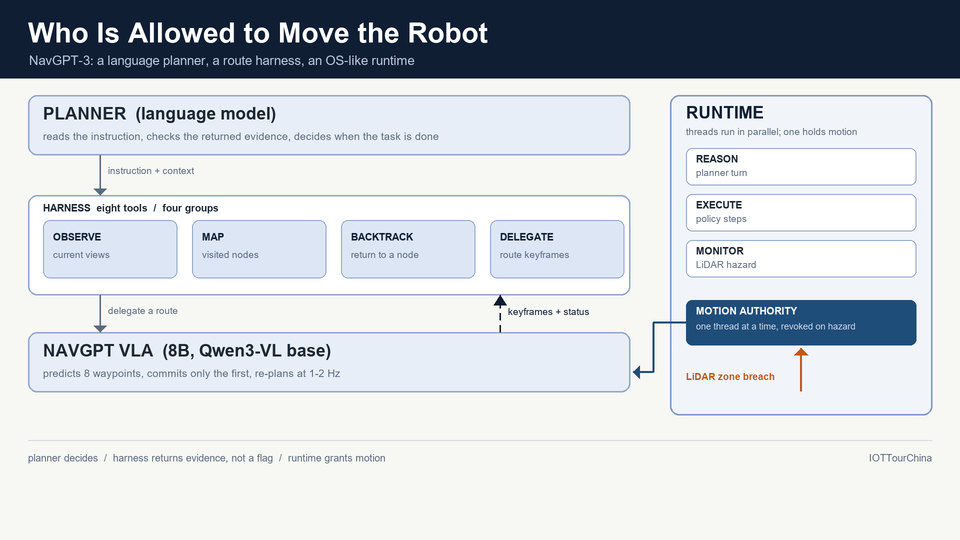
NavGPT-3 does not try to settle that trade-off by training a better model on either side. It wraps both in two layers: a harness that turns execution into inspectable evidence, and an operating-system-like runtime that decides which piece of software is currently allowed to move the robot. The work comes from the Australian Institute for Machine Learning at Adelaide University, with Metacognition, ANU, PKU, SJTU, UNSW, UNC Chapel Hill and Roblox among the co-authors.
With a Qwen3-VL-based 8B policy underneath and a GPT-6 Astra planner on top, the system reports 81.51 success rate on R2R-CE and 90.43 on the RxR-CE Val-Unseen split. The published human reference on that split is 90.4, with a normalized dynamic time warping score of 77.7 against the system's 78.47. Episodes finish in 1 minute 22 seconds, against roughly three minutes for a human follower.
Two failure modes, and the fix that does not work
Give a capable language model a set of navigation tools and no policy, and every environment action becomes a planner decision. That is the slow path. Its advantage is judgement: the model can read a long instruction, check a landmark against the text, notice that something was skipped and go back. Its cost is that the robot waits for the next token.
Give the job to a policy instead and the robot moves continuously, but the policy is trained to follow a route, not to audit one. It can walk a hallway competently and still stop in the wrong doorway, because nothing in its output represents task completion.
Chaining the two naively does not help. If the policy runs while the planner idles, the robot stalls every time the planner thinks. If an obstacle appears mid-rollout, a stop request cannot queue behind a language-model call that takes seconds.
What the harness adds: route evidence, not a success flag
The harness is eight tools in four groups. Four are always present: observe_forward and observe_panorama to look around, navigate_relative to move by a stated angle and distance, and terminate_episode to end the episode explicitly.
| Group | Tool | What the planner gets back |
|---|---|---|
| Observation | observe_forward() | Forward RGB for close inspection |
| Observation | observe_panorama() | Multiple views with direction labels |
| Observation | observe_map() | Observed space and numbered visited places |
| Motion | navigate_relative() | A checked local move or turn, with what was executed |
| Delegation | navigate_by_instruction() | Route keyframes and execution status from the policy |
| Revision | navigate_to_node() | Return to a place the robot actually visited |
| Revision | annotate_node() | A semantic label on a visited place, position unchanged |
| Termination | terminate_episode() | Explicit task completion |
Two properties matter more than the tool count. The map contains only space the robot has observed, so unexplored area is never presented as free. And a delegated instruction comes back with up to eight sampled route keyframes, an endpoint panorama and a status, not with a boolean. The planner's next decision is grounded in what the robot passed, which is the only way to tell an overshoot from a correct stop.
The 8.54 metre correction
In one R2R-CE episode the policy drove past the hallway table the instruction named and stopped in a bedroom. Reading the returned keyframes, the planner recognized that the table had appeared earlier in the route, called the revision tool to retrace 8.54 metres to node 1, and then verified a 1.2 metre local correction before ending the episode.
A policy rollout ending is not the task being finished. A policy-only system has to reason from a single frame at the stopping point, where an overshoot and a correct arrival can look identical. The harness converts that ambiguity into a question with an addressable answer: which recorded place did I pass, and can I go back to it.
Who is allowed to move the robot
Above the harness sits the runtime. Reasoning, execution and monitoring run as threads with their own context, tools and permissions, at their own cadences. Only one thread at a time holds motion authority, the permission to issue task motion.
The scheduling rules are stated as policy rather than learned. Protective events carry the highest priority, episode limits outrank routine review, and a stale event cannot restore an operation that has already been superseded. A handover preserves each thread's context and takes effect only after the runtime authorizes it and execution acknowledges it.
Concurrency here does not mean the robot obeys three models at once. It means three processes can think in parallel while exactly one of them is permitted to command movement, and a hazard monitor can revoke that permission without waiting for an inference to finish.
The policy underneath
NavGPT VLA starts from Qwen3-VL-Instruct and adds an MLP action head. Both the 4B and 8B variants take an instruction plus up to sixteen retained observations, each carrying front, right, back and left views, and predict eight cumulative waypoints in the agent's current frame, with x forward, y left and heading in radians. Execution commits only the first waypoint before predicting again, which is what produces continuous motion instead of a locked plan.
The visual budget is allocated rather than fixed. Under a scheme the authors call codec allocation, the earliest image in each view acts as an I-frame with full score, later ones as P-frames scored by the mean pixel difference between consecutive 64 by 64 thumbnails, and whole-image resolution is then set jointly by that change score, recency and camera direction. The token total does not change: a constant score recovers the older positional rule, so the gain comes from where the tokens sit rather than from how many there are.
Training used one epoch over roughly 19.28 million effective records, a mixture spanning instruction following, point-goal and object-goal navigation, target tracking, outdoor driving, embodied question answering and visual grounding. The figure counts records per epoch, not unique trajectories, and the paper says so.
Results, and the configuration they depend on
| System | R2R-CE SR | R2R-CE SPL | RxR-CE SR | RxR-CE nDTW |
|---|---|---|---|---|
| Human reference | not reported | not reported | 90.4 | 77.7 |
| Qwen-RobotNav 8B | 72.1 | 66.6 | 76.5 | 72.5 |
| NavGPT VLA 8B, policy only | 76.94 | 70.61 | 82.39 | 76.74 |
| NavGPT-3 with Claude Opus 5 | 79.01 | 70.16 | 84.80 | 75.09 |
| NavGPT-3 with GPT-6 Astra | 81.51 | 70.42 | 90.43 | 78.47 |
Two details in that table are easy to miss. The policy alone already leads published methods on RxR-CE at 82.39 before any harness is added, but it does not lead R2R-CE on its own, where Robostral Navigate reports 77.4 against 76.94. And the human-level row is one specific planner: the same 8B policy with the same harness reaches 84.80 on RxR-CE with Claude Opus 5, and drops from 81.51 to 79.01 on R2R-CE.
Path fidelity behaves strangely in the Opus configuration. Its nDTW of 75.09 sits below the 76.74 of the policy alone, even as success rate climbs, so more episodes are completed along paths that resemble the human route less closely.
The human reference itself carries a footnote. The table identifies it as RxR Val-Unseen English human followers from Ku et al. (2020), measured in DE, which makes the comparison one between a system following English instructions and a human baseline gathered under a German condition. The authors state the caveat in the table rather than in the text.
The same runtime transfers to object-goal navigation, at 59.2 success rate and 25.2 SPL on MP3D and 75.3 with 40.8 SPL on HM3D. That is the best MP3D success rate in the comparison and second place on HM3D, 0.3 points behind Qwen-RobotNav 4B, with a 10.2 point advantage in path efficiency.
The policy helps one planner and slightly hurts the other
| Planner on 100 R2R-CE episodes | Map and backtracking | Policy delegation | Success rate | Interval per action |
|---|---|---|---|---|
| none | no | yes | 71 | 0.78 s |
| GPT-6 Astra | no | no | 72 | 3.3 s |
| GPT-6 Astra | yes | no | 83 | 6.2 s |
| GPT-6 Astra | yes | yes | 82 | 0.78 s |
| Claude Opus 5 | no | no | 66 | 8.9 s |
| Claude Opus 5 | yes | no | 73 | 19.3 s |
| Claude Opus 5 | yes | yes | 79 | 0.78 s |
Read the two planner blocks separately and the result stops being one story. With GPT-6 Astra the best configuration on this subset is map and backtracking with no policy at all, at 83 success rate; adding delegation lowers it to 82. With Claude Opus 5 the direction reverses, from 73 to 79.
The policy buys reaction time in both cases. The mean interval between environment actions falls from 6.2 seconds to 0.78 for Astra and from 19.3 to 0.78 for Opus. Tokens per episode fall from 190.8k to 155.0k and from 483.4k to 185.6k, and cost per episode from 0.469 to 0.391 dollars and from 0.990 to 0.397. What the policy does not buy is a guaranteed gain in success rate.
Reviewing the route more often is not free either. On the same subset, never reviewing gives 77 success rate for 179.2k tokens per episode, reviewing every 32 policy steps gives 78 for 1,529.9k, and reviewing every 16 gives 83 for 2,319.5k. Six points of success rate costs roughly thirteen times the tokens, which is the trade the runtime's cadence settings have to resolve.
On a Unitree Go2
The real-robot work used a Go2 with RGB input, remote or onboard policy inference and a runtime LiDAR hazard monitor, across 30 episodes per condition in three scripted scenarios: route revision during a long rollout, a soft obstacle entering a protected region, and a hazard injected during repair or near policy completion.
| Configuration | Revision SR | Repair | Missed stops | Halt p95 |
|---|---|---|---|---|
| Policy alone | 60.0 | not measured | not measured | not measured |
| Planner with basic tools | 70.0 | 14.2 s | 9 of 30 | 2150 ms |
| Sequential, queued | 73.3 | 12.8 s | 7 of 30 | 1840 ms |
| Sequential, priority | 76.7 | 11.5 s | 2 of 30 | 420 ms |
| Overlapping, queued | 76.7 | 9.6 s | 5 of 30 | 1310 ms |
| Overlapping, priority | 83.3 | 7.9 s | 0 of 30 | 180 ms |
The two runtime features separate cleanly. Priority handling alone takes missed stops from 7 of 30 to 2 of 30 and halt latency from 1840 to 420 milliseconds. Overlapping execution alone takes repair from 12.8 to 9.6 seconds. Together they reach 83.3 revision success, zero missed stops in 30, a 180 millisecond p95 halt and 80 percent correct resumption, with stale commands accepted falling from 8 of 30 to 1 of 30.
The 180 millisecond figure only means something with that decomposition beside it. It is the combined configuration, and priority handling on its own already reaches 420.
What the result does and does not show
The real-robot evidence is 30 episodes per condition on one quadruped, in three scripted scenarios with a purpose-built hazard monitor. It is not a claim about open-world safety. The 180 milliseconds measures a trigger inside a calibrated protected region to a physical halt, which is a different quantity from the policy's inference time and from any general assurance argument.
The 100-episode ablation subset is small enough that a one-point difference between configurations should not be read as a ranking. Most of the system's strongest numbers come from simulation benchmarks, and the real-robot work concentrates on runtime behaviour rather than on navigation accuracy at scale.
The harness interface was itself the product of a development-time search. The authors describe a loop in which one process proposes edits to the system prompt, the tool set, the spatial state and the observation formats, another checks them against interface constraints and earlier failures, a third scores them on episodes, and a fourth records what was confirmed and what remained unresolved. That search was frozen before evaluation, with no online updates to planner or policy weights. The paper does not claim the resulting tool set is optimal; its own ablation shows different planners preferring different tools.
What to take from it
For anyone wiring a reasoning model to a motion controller, the interface is the deliverable. Return route evidence rather than status codes, because a policy that stopped is not a task that finished. Keep an ordered list of visited places so backtracking is addressable by name. Make termination a separate explicit call so completion cannot be inferred from silence. And give the hazard monitor its own permission path, so a stop never queues behind an inference.
None of that requires a new model. It requires deciding, before anything moves, which component is allowed to say move and what evidence it must leave behind when it does.