RoboAtom spreads 1.45 million atomic-action labels at 0.000028 dollars an hour
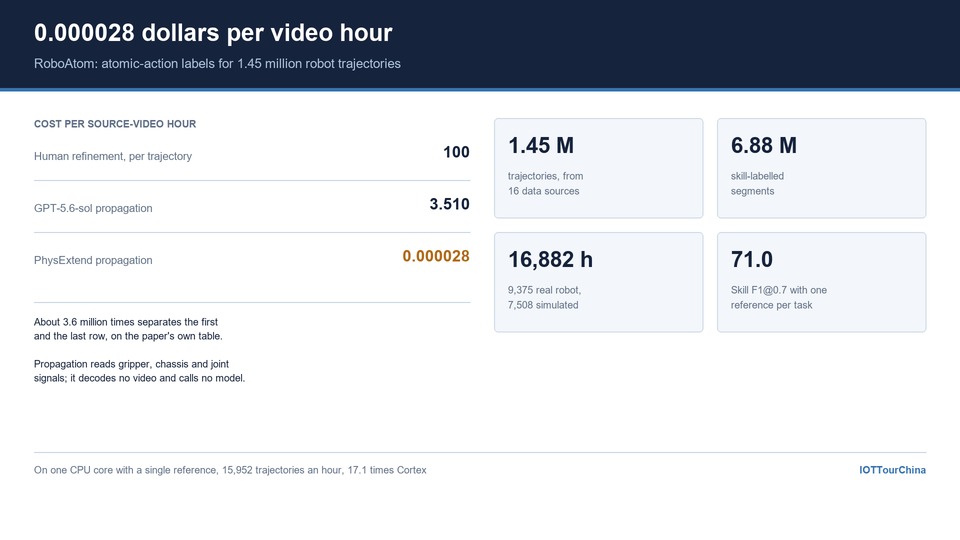
A trajectory that opens a cabinet, picks up a pudding and puts it down is one instruction and three skills. A model trained on it needs both: the task-level sentence, and the frame ranges where each skill starts and stops. Producing that second layer by hand costs about 100 US dollars per source-video hour, which is tolerable for a demo set and impossible for a corpus.
A paper from Shanghai Artificial Intelligence Laboratory with Zhejiang University, Fudan University, Tsinghua University and Shanghai Jiao Tong University attacks the second layer instead of the first. RoboAtom keeps human refinement for a small number of seed trajectories, then copies those boundaries onto the rest of the trajectories that execute the same task, using only the robot's own state and action signals. The result is a dataset of 1,446,974 trajectories carrying 6,876,282 skill-labelled segments across 16,882.1 hours, and a propagation step that costs 0.000028 dollars per source-video hour.
What an atomic-action label contains
Each segment carries three fields: a skill class from a fixed vocabulary, a free-text action description, and a start frame and end frame. The skill class is what makes heterogeneous sources comparable, because AgiBot World, RoboMIND, RoboCOIN, RH20T and the simulation sets name the same motion differently. The description keeps the object and the specifics. The frames are what attach both to a physical trajectory.
That structure is why the dataset can claim 3,334 tasks across 32 embodiments while a benchmark can still score it. The paper fixes 29 skill classes for the data and 15 for the benchmark, where those 15 cover 99.2 percent of all labelled segments.
PhysExtend: boundaries without video
The propagation method, PhysExtend, never decodes an image and never calls a model. It reads the signals a robot already logs: motion intensity, pauses, direction reversals, gripper opening and closing, grasp state, and chassis speed. A gripper transition is direct evidence for a pick or a place boundary. A chassis start and stop brackets a move segment.
For a group of trajectories that execute the same task in the same skill order, PhysExtend takes the order from the reference, then solves for all boundaries at once with a dynamic programme that carries an order constraint, scoring candidate cuts against relative progress, expected segment duration and gripper events. Solving the whole trajectory jointly is the point: deciding segment by segment lets one wrong cut push every later boundary out of place.
The comparison case is Cortex, which aligns by fitting the reference trajectory's feature distribution. That works while executions look alike, and drifts when a run is slower, pauses, or retries a grasp, because the feature distribution moves with it.
| Annotation path | Cost per source-video hour |
|---|---|
| Human refinement, per-trajectory | About 100 USD |
| GPT-5.6-sol propagation | 3.510 USD |
| PhysExtend propagation | 0.000028 USD |
The three rows are the paper's own table, and the spread between the first and the last is roughly 3.6 million times.
Accuracy at that price
On 100 tasks, five human-labelled trajectories each and one reference per task, PhysExtend reaches 71.0 Skill [email protected], against 48.5 for Cortex and 35.0 for GPT-5.6-sol. Skill [email protected] is strict: the skill label has to agree and the temporal intersection over union has to be at least 0.7. Mean IoU is 76.8, against 66.5 for Cortex and 58.9 for GPT-5.6-sol. Episode accuracy, where every subtask in a trajectory must be semantically and temporally right, is 69 percent against 46 percent for GPT-5.6-sol and 37 percent for Cortex.
Adding references helps, and cheaply. With four references the same method reaches 79.3 Skill [email protected], because the boundaries solved from each reference are fused by position.
Throughput is where the cost gap comes from. On one CPU core with one reference, PhysExtend processes 15,952 trajectories per hour, 17.1 times Cortex, at 0.000307 dollars per 1,000 trajectories against 0.005253.
The dataset, and what the hours contain
RoboAtom-Data spans 16 sources, 3,334 tasks and 32 embodiments. Of the 16,882.1 hours, roughly 9,375 come from real robots and 7,508 from simulation, so the corpus is 55 percent real and 45 percent simulated, and any comparison against a real-only dataset has to account for that.
Against the nearest published subtask-annotated sets, the paper reports 6.1 times the trajectories and 14.4 times the tasks of RoboInter-Data, and 6.9 times the segments and 5.7 times the hours of AgiBot World Beta.
Quality control is a gate rather than a claim. The team set a release threshold of 85 percent subtask segmentation accuracy and 75 percent episode accuracy, and states that the data ships only after both are met, with corrections iterated in between.
A benchmark that removes the reference
Propagating labels assumes a task repeats. Judging whether a model can produce labels from scratch is a different question, and the existing WGO-Bench, with 100 trajectories and open-vocabulary labels, answers it only loosely.
RoboAtom-Bench is 500 trajectories carrying 4,018 ground-truth segments, drawn from 800 candidates screened by source, view count and segment count, then reviewed by embodied-data specialists. It runs 5.81 hours, its median trajectory holds 5 segments and its longest 62, and it accepts video plus the task instruction and nothing else.
The result is a clean split between knowing what happened and knowing when. GPT-5.6-sol scores 63.4 on skill-sequence edit distance, which ignores time, and 28.0 on temporal [email protected]. Segment length is also mishandled in both directions: on the short subset four reference models over-segment at 1.48 to 1.70 times the true count, and on the long subset they merge at 0.51 to 0.65 times.
RoboAtom-Anno is trained on the dataset to close that gap. The 9B version starts from Qwen3.5-9B through robot-domain mid-training, supervised fine-tuning and GRPO, and reaches 30.1 Skill [email protected] against 21.4 for GPT-5.6-sol, at 0.006 dollars per video hour against 4.330. The 27B version, from Qwen3.8-27B, reaches 33.8 at 0.078 dollars.
The ablation ladder shows where the gain sits: 3.5 with no annotation processing, 6.6 with the source labels, 17.1 after vocabulary alignment and ambiguous-sample filtering, 23.0 with RoboAtom-Data and a language-side LoRA only, 30.1 after updating the vision module, mid-training and GRPO. The reinforcement stage alone lifts temporal [email protected] from 35.5 to 41.0 and brings the predicted-to-true segment ratio from 1.20 to 0.99.
On the external WGO-Bench Robot split the 9B model reaches 48.3 temporal [email protected] against 31.3 for the strongest reference model; the 27B reaches 49.2 and, on egocentric human video it never trained on, 28.3 against 14.1.
Does the supervision change what the arm does
The control experiment keeps the post-training budget, the observation space and the action space fixed and changes only the conditioning. The baseline is pi-0.5 trained on task-level instructions and run end to end. The treatment is pi-0.5 fine-tuned with the segment's skill label and action description added to the task instruction, wrapped in a two-level loop where a Qwen3.8-27B planner picks the current subtask from the task plan, the current frame and the execution progress.
Success rises 3.20 percentage points on LIBERO-Long to 98.20, 4.13 points on LIBERO-Plus overall with 6.63, 6.41 and 3.73 on the Object, Goal and Long subsets, and 1.80 points on RoboTwin to 66.17 as the mean of the Clean and Random settings.
Those three benchmarks are simulated. The paper says so in its limitations, alongside two other open items: atomic-action supervision has not been tested in large-scale policy pretraining, and egocentric human video, which dwarfs robot data in volume, is excluded because human atomic actions often last under a second and cannot be bounded reliably at the current sampling rate.
Why this matters for a device catalogue
The Chinese embodied-robot stack has spent two years producing hardware and the datasets to feed it, and the annotation layer between them has been the unglamorous bottleneck. Every entry in RoboAtom's source list is a Chinese or China-hosted corpus: AgiBot World in both its Beta and 2026 versions, RoboMIND, RoboCOIN, InternData-A1, RoboCasa, RoboDojo, RH20T.
What the paper shows is that the expensive part of that layer can be reduced to a seed set, and that the cheap part can run on a CPU without a video decoder. That is a claim about the economics of robot data rather than about any single robot, and it is the kind of claim that decides which of these datasets get re-annotated and which stay as they are.