AW-0 writes its own task program and keeps it in the loop: code, video and action generated in one Mixture-of-Transformers
"Add two to the number on the scoreboard, then press the button." A person hears that once and does it. A robot has to find the scoreboard, read the number, flip the right number of pages, check it flipped correctly, and only then reach for the button — and any single misstep wastes everything before it. Accuracy of motion is only the first requirement. The robot also has to know which step it is on, and real instructions carry quantities and conditions that survive neither a change of background nor a change of lighting. That is why so many models look strong in simulation and fall apart on a bench.
The two families of method each solve half of it. World-action models predict the next frames, which gives actions a physical basis, but they do not know which subtask they are executing. Code-style robot systems write the task as a program and call existing skills, which is legible and structured, but they tend to be blind to what the world is actually doing. AW-0, from UC Berkeley, NVIDIA and the University of Pennsylvania, connects the halves: the robot writes its plan as code, and that code stays present while future video and continuous actions are generated.
One backbone, three experts
The architecture is a Mixture-of-Transformers. Each planning step generates three things at once — the current skill program, the upcoming frames, and the robot's action chunk — from multi-view observations, the language instruction, and the robot state, plus a compact memory of the program fragments generated so far.
Each modality has its own expert with its own parameters: a code expert writes a parametric skill program from the scene and the instruction, a video expert predicts the following frames, an action expert emits continuous action blocks. They exchange information through shared attention, and the direction of that exchange is fixed: code flows to video and to action, and video flows to action. Video and action can both read the code; action can also read the video representation. That ordering is the whole architectural claim — the task plan participates in prediction, and prediction provides semantic guidance to control.
Generation is synchronised rather than sequential. Code is produced by discrete masked diffusion, filling in masked program tokens step by step. Video and action are produced by continuous flow matching, refining from noise. All three denoise inside the same iteration steps, so the action expert does not wait for a finished program. During training the video noise distribution is resampled and the per-modality loss weights are balanced, so that video features are actually useful to action prediction rather than merely well-formed.
Where the program annotations come from
A model that writes code needs supervision that says which program belongs to which demonstration, and nobody has labelled hundreds of hours of robot video at subtask level. The pipeline builds that supervision.
First it discovers skills. For each task it samples demonstrations, has a coding agent write subtask programs against a predefined primitive interface, and has a coordinator agent find operations that recur across tasks and promote them into reusable skills. Then the skill library is frozen, and the sampled demonstrations are re-annotated so that each subtask maps to one program from that frozen vocabulary, with the mapping cached. Finally the annotations are extended to the full corpus: for each new fragment, the system checks whether a cached program matches on contact and motion evidence — if yes, it reuses it; if not, it generates a new annotation and adds it to the cache.
The result was 50 skills across the pretraining corpus, 23 from the YAM robot data and 27 from human egocentric video. Pretraining combined roughly 2,000 hours of YAM demonstrations with 1,000 hours of human manipulation video, and downstream tasks were annotated with the same frozen library before joint fine-tuning of code, video and action.
What the numbers say
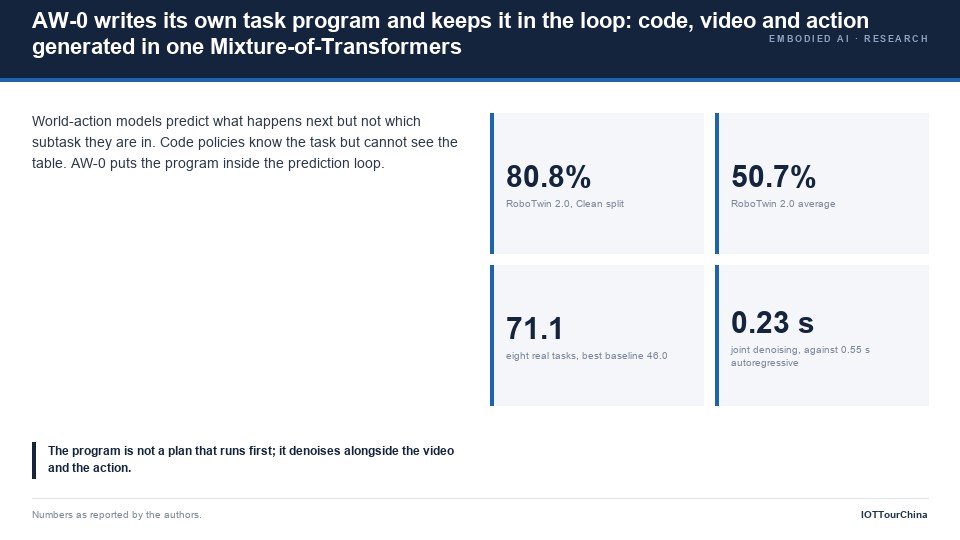
In RoboTwin 2.0, AW-0 in its default configuration averages 50.7% success across the Clean and Random settings. The Clean number is the strong one: 80.8%, against 64.8% for the best baseline, WLA — 16.0 percentage points. Under Random, where background, table texture and lighting vary, the default drops to 20.6%, below π0.5's 27.7%. A hybrid execution mode reaches 29.2% under Random but only 63.1% under Clean. The two configurations trade places, which is itself the finding: execution mode and training data have to be evaluated together.
On real hardware the team used a YAM dual-arm platform with parallel grippers and a Tianji–Sharpa platform with two 22-DoF dexterous hands, across eight tasks: arranging fruit, packing a backpack, replacing a lightbulb, folding towels, fruit with tongs, dealing cards, flipping the scoreboard, and solving a cube under constrained settings. Each task used 100 demonstrations for post-training, three seeds, sixteen evaluations per seed, scored by task-step completion so partial credit counts — these are average rubric scores, not whole-task success rates.
AW-0 averages 71.1 against DreamZero 46.0, π0.5 43.6, WLA 39.9 and EgoScale 35.9, a 25.1-point margin over the strongest baseline. The gains land on specific capabilities rather than spreading evenly: arranging fruit 91.7 and flipping the scoreboard 68.8 both require following a quantity in the instruction, while dealing cards 58.3 and replacing a lightbulb 75.0 exercise bimanual coordination and fine contact.
Programs also help when they are allowed to execute. On the same post-trained model and the same evaluation conditions, folding towels on YAM rose from 84.4 with pure action-block execution to 90.6 when verified program steps took over part of the task — an experiment confined to that platform and that task, and not evidence of a general gain.
Three ablations worth reading
Where the code sits. Comparing no code, video→code→action, and code→video→action, the third wins: the plan should influence both video and action generation, not just action. The code expert also needs its own vision encoder — a dedicated ViT representation scores 71.1 against 55.6 when it reuses VAE features.
What inside the program matters. Removing comments or the reusable skill calls degrades all eight tasks; removing skill calls drops dealing cards from 58.3 to 42.0. The full program beats plain natural-language subgoals on seven of eight, which suggests that skill abstraction, explanatory language and program structure each carry planning information rather than being interchangeable prose.
How the code is generated. Joint denoising beats autoregressive code generation on seven of eight tasks (71.1 against 54.5) and is faster: 0.23 s end-to-end against 0.55 s on the tested configuration, a 2.39× speed-up. Compared with a no-code version at 0.19 s, the code stream costs 0.04 s and improves real-robot performance.
What is still missing
The system does not learn online from its own interaction. Skills improve only through re-annotation and fine-tuning, not through the robot noticing mid-task that a grasp failed and rewriting the program. The authors are explicit that visual randomisation and program reliability still have room, and the Random-setting result is the honest measure of how much: a code plan that is legible and correct still needs perception that survives a changed table texture.
The interesting part is not that adding code to a world-action model raises a score. It is that the program becomes a shared representation between planning and prediction — something a person can read, a simulator can execute, and an action expert can condition on. Whether that becomes a general interface for embodied models depends on the next step nobody has demonstrated: a robot that edits its own program because the world disagreed with it.