ReflexArc delivers tactile withdrawal to humanoid motors within 10 ms
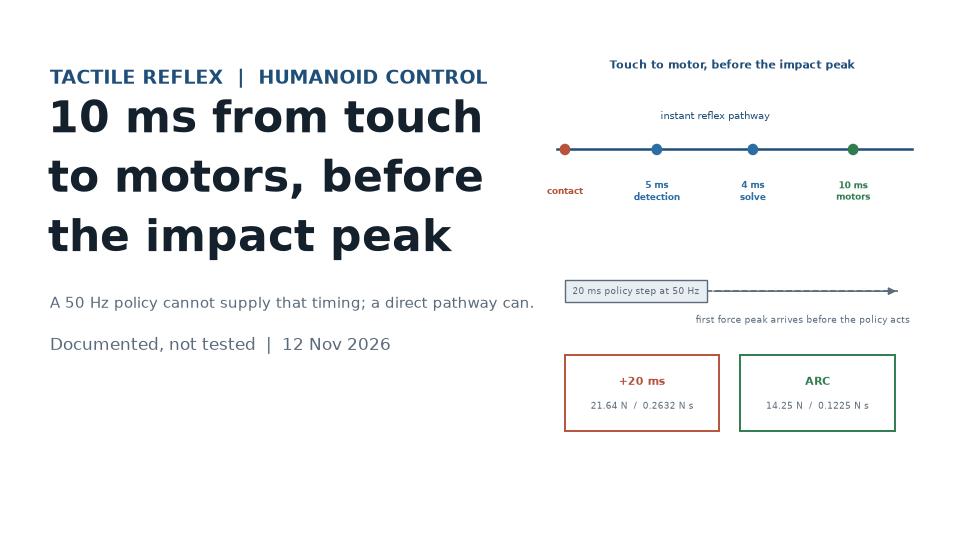
A whole-body control policy running at 50 Hz needs one full inference step before it can react. That is 20 ms of waiting, while the first peak of an unexpected contact arrives within tens of milliseconds. ReflexArc, a preprint from researchers at Tsinghua University, Peking University and Galbot, argues that this is a structural delay rather than a tuning problem, and routes a tactile withdrawal around the policy to the motors.
The method is called ARC, short for Ascending Reflex Control. The paper is arXiv:2611.04424, submitted on 3 November 2026, and the authors deploy it on a Unitree G1 with 29 joints.
Why a reflex and a policy cannot simply take turns
On a fixed manipulator, a collision reflex can stop the task and take over the joints for a few hundred milliseconds. A humanoid cannot do that, because withdrawing a hand or a knee changes the support polygon and the centre of mass. Balance has to stay with the learned policy while the reflex acts on the same joints at the same time. A policy trained to track a reference motion will read the withdrawal as tracking error and try to cancel it; stronger domain randomisation makes that rejection stronger.
ARC splits the problem in time. A fast pathway handles the first milliseconds, and three training and interface designs keep the policy from undoing what the pathway did.
The tactile pathway
Flexible piezoresistive patches sit on the wrists, elbows, knees, chest, back and the upper surfaces of both feet. Each 16 cm by 8 cm patch samples 128 taxels at 300 Hz, with each taxel reporting an 8-bit pressure value. After mounting, every taxel is calibrated into a digital twin with its parent link, position and surface normal, so a contact can be turned into a direction to withdraw.
Detection uses two features rather than a learned contact classifier. A collision excites a spatially connected cluster of neighbouring taxels whose readings rise together, while vibration from the body is diffuse. An adaptive threshold makes normally quiet taxels more sensitive. The paper reports contact localisation and a withdrawal direction within 5 ms of onset.
The solver then searches for a whole-body pose that retreats from the contact without tipping the robot. It combines local withdrawal, a directional cone, inertia-weighted whole-body motion, centre-of-mass costs and joint regularisation, subject to joint limits, a fixed support frame and self-collision clearance. A short sequence of local quadratic programs refines one target pose, with every round measured from the same initial configuration. The onboard solve completes in under 4 ms, putting a command at the motors within 10 ms. If a second contact interrupts the first, the new solve is anchored to the terminal pose of the reflex it interrupted rather than to the measured pose.
Three designs that keep the policy from cancelling it
Reflex-in-the-loop learning adds patch activation, contact location and direction, and the applied offset to the policy observation, and changes the tracking target to the reference plus the reflex offset during a reflex. Because reflex events are rare and fire at different times across parallel environments, the authors built ARC-Gym, which alternates tracking and reflex iterations across 4096 parallel environments and batches the quadratic-program solves for buffered collisions.
Reflex-transparent alignment subtracts the reflex offset from the joint positions the policy observes and adds it back to the joint targets the policy emits. A DAgger-style objective then supervises the policy against the output it would have produced with no reflex, so it does not slowly erase the withdrawal at the execution layer.
Reflex-informed adaptation handles the seconds after the local withdrawal. An AMP reward learned from human repositioning motions is active only during a reflex, shaping natural stepping once the policy leaves its reference trajectory. With the long-horizon task direction reversed and a small set of human demonstrations, the system also steps over obstacles and climbs stairs using foot tactile sensing without vision.
What the box-contact experiment measured
The force sensor was mounted on the fixed box being struck, not on the moving robot, to avoid vibration noise from fast motion, and a 240 Hz action camera tracking an optical marker provided a second timing estimate. The baseline is the same reflex with an added 20 ms delay.
| Condition | First force peak | Contact impulse over 100 ms |
|---|---|---|
| ARC reflex | 14.25 N | 0.1225 N s |
| Same reflex delayed by 20 ms | 21.64 N | 0.2632 N s |
That is a 34.1 percent reduction in the first force peak and a 2.15 times ratio in contact impulse. The project page reports the same comparison as a 53.5 percent lower impulse.
Reading the ablation table correctly
| Variant | Survival rate | Withdrawal distance | Compensation score | Contact impulse | Trials reaching 1.5 m at 3 s |
|---|---|---|---|---|---|
| ARC | 99.2 % | 11.06 cm | -9.1 % | 3.42 N s | 63.0 % |
| Without reflex-in-the-loop | 82.0 % | 5.65 cm | 25.0 % | 4.34 N s | 8.9 % |
| Without transparency | 99.2 % | 6.74 cm | 29.7 % | 4.22 N s | 57.3 % |
| Without adaptation | 77.3 % | 7.03 cm | -8.7 % | 3.63 N s | 6.8 % |
| Explicit retreat reference | 96.1 % | 10.89 cm | -8.6 % | 4.91 N s | 14.1 % |
A positive compensation score means the policy is opposing the reflex. Removing transparency produces some flattering recovery numbers while cutting withdrawal distance to 6.74 cm, which the authors describe as recovery without withdrawal, a false success. Removing adaptation leaves local withdrawal intact but a root displacement of -0.01 m and recontact in 88.0 percent of trials.
Replacing the AMP reward with direct tracking of a retreat motion gives a withdrawal distance of 10.89 cm, slightly below the 11.06 cm of ARC, not above it. Its contact impulse rises to 4.91 N s, only 14.1 percent of trials reach 1.5 m at 3 s, and the paper reports a 0 percent success rate on stair climbing and step-over tasks once the AMP reward is removed. Retreating further and recovering well are different things.
What is and is not available
The experiments cover three categories of hazardous contact on the G1: striking a static obstacle, being struck by a moving object, and colliding with a moving person or another robot. The authors recorded several human motion-capture trajectories covering locomotion, martial arts and dance; the paper does not give a count of tasks.
The arXiv preprint and a project page with an interactive demo are public. On that project page the paper link, the code link and the BibTeX entry are all marked as coming soon, so no implementation has been released. The preprint carries no conference or journal comment, and none is claimed here. The authors themselves describe tactile skin cost, wiring and coverage trade-offs, and a lack of comparison against alternative approaches, which keeps this a clearly defined prototype rather than a production safety layer.