ECHO-G generates full-body co-speech motion directly in humanoid joint space
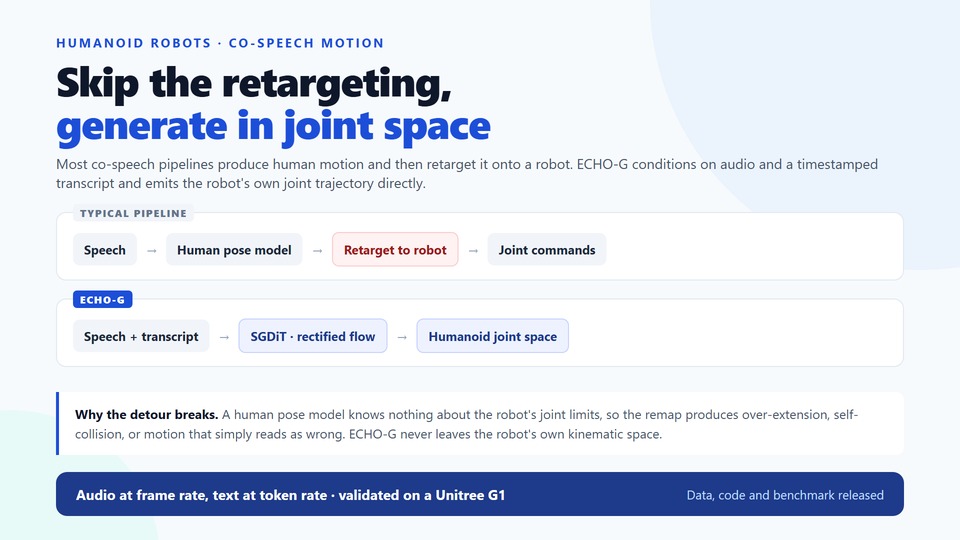
When humans talk, they gesture. A raised hand sharpens a point, a sweep of the arm carries a mood. Recreating that for a humanoid robot is harder than it looks, and most approaches still go through a detour: generate human motion first, then remap it onto a robot body. That detour is where the trouble starts.
A human pose model does not know the robot's joint limits, so remapping produces over-extension, self-collision, or motions that simply look wrong. And many systems take only audio, or only text, which means the gesture either tracks the rhythm of speech or its meaning, but rarely both at once.
ECHO-G, a framework built by researchers from Nanjing University, Beihang University, the Hong Kong University of Science and Technology and Mondo Robotics, skips the detour. It generates full-body co-speech motion directly in the robot's own joint space, conditioned on two inputs at once: the speech audio and a timestamped transcript. The team validated it in simulation and then ran it on a physical Unitree G1 humanoid, and they released the dataset, the full training and inference code, and a dedicated evaluation benchmark.
The core module: SGDiT
The heart of the work is the Speech-Grounded Diffusion Transformer, or SGDiT. It uses rectified flow matching as its generative backbone, which lets it model the one-to-many nature of the problem: one line of speech can reasonably map to several different full-body poses, and sampling produces different but plausible results each time.
The conditioning keeps each modality in its native grain instead of forcing both onto a single timeline.
- Audio: a frozen wav2vec 2.0 extracts acoustic features, interpolated to align with motion frames, producing frame-level audio features that capture speech rate, stress and pauses.
- Text: the timestamped transcript is passed to a frozen large language model, which outputs token-level language features that carry sentence meaning.
Because the two stay at their own resolution, the model keeps both the rhythm of speaking and the semantics of what is being said.
Aligning meaning and timing
Text features act on the motion sequence through a two-branch cross-attention design.
- The global branch lets every motion frame see all text tokens, so the gesture understands the whole sentence.
- The local branch introduces a Gaussian temporal prior, biasing the current motion toward the words spoken at that moment.
The two branches are fused with weighting, so a gesture both understands the sentence as a whole and stays locked to the word being spoken right now.
The training objective combines a base flow-matching loss, which teaches the network to evolve from noise toward real robot motion, with an extra temporal loss that constrains changes between neighbouring frames and suppresses violently jittery, malformed motion. At inference, Euler integration samples a normalized motion sequence, which is then de-normalized into a complete full-body reference trajectory for the robot.
Real-robot execution
The SGDiT output, a set of target joint angles, is handed to the SONIC whole-body motion tracker, which produces real-time control output while the speech audio plays, so the robot talks and moves at the same time. In the physical deployment, the model runs on a Jetson AGX Orin compute module and is fed sentences that were not in the training set. The robot's arm extension, hand pose and torso posture shift dynamically with what is being said.
There is a real-world constraint worth stating plainly: SGDiT only outputs joint reference targets, and the underlying motion tracker applies its own safety constraints, so the motion the physical robot finally executes differs slightly from the model's raw output.
A robot-specific dataset and benchmark
Public co-speech gesture datasets mostly output a human skeleton, not the audio-text-robot-joint triples a real humanoid needs. The team rebuilt one from BEAT2.
The raw data was cut into 22,192 utterance segments by speech pauses, then remapped from SMPL-X human motion to a Unitree G1 (29 degrees of freedom) robot using the GMR retargeting algorithm. Two filters followed:
- Robot motion quality filter: removes segments with self-collision, abnormal foot contact, joint-limit violation, or high-frequency jitter.
- Multimodal consistency filter: keeps audio duration and robot motion duration within one frame of each other.
That leaves 14,987 training segments and 3,242 validation segments.
The benchmark scores across three dimensions, and this is the part that sets it apart from prior gesture work that only graded human-motion quality:
- Co-speech gesture features: Frechet Gesture Distance, diversity, multimodality, beat alignment, measuring how well the generated gesture matches speech rhythm.
- Robot physical quality: jerk, foot-off-ground error, contact sliding velocity, measuring whether the motion is feasible on a real robot.
- Runtime efficiency: per-frame end-to-end inference time and peak memory, aimed at embedded robot boards.
How it compares
Three main baseline groups were tested: EMAGE plus GMR and GestureLSM plus GMR (generate human gesture, then retarget), Human-Retargeted (generate human motion, map to robot with a VAE), and ECHO-G itself, plus a modality ablation comparing audio-only, text-only and audio-plus-text.
Against the retargeting baselines, ECHO-G takes the best score on all four co-speech gesture metrics and posts the lowest single-frame inference latency. The honest caveat: Human-Retargeted beats ECHO-G on some physical-quality metrics, such as jerk and foot error. Directly training in robot space does not automatically win every physical metric; its main gains sit in gesture semantics, rhythm and latency.
The modality ablation confirms a tradeoff: audio-plus-text gives the best gesture features overall, but jitter and foot sliding are actually worse than audio-only input. Pushing for more expressive gestures tends to produce larger limb motion, which nudges the physical-stability numbers the wrong way. This is the classic tension between expressiveness and robot motion stability.
A user study with 45 participants rating rendered video on humanness, rhythm match and motion quality on a five-point scale put ECHO-G first on all three and on the combined score, suggesting that to the human eye the joint audio-text condition clearly beats single-modality and retargeting baselines.
What it shows and where it goes
ECHO-G demonstrates that fusing frame-level audio rhythm with token-level text meaning through global-local cross attention, using rectified flow matching, can generate full-body speaking motion straight in humanoid joint space rather than depending on human-motion retargeting. With the BEAT2-derived robot dataset, full code, and a benchmark all released, plus a verified Unitree G1 deployment, it is a concrete step toward robots that move while they talk.
The work also makes the tradeoff explicit: audio-plus-text conditioning improves gesture expressiveness and latency, but expressiveness still fights against robot physical stability. The authors point to three next directions: balancing gesture expressiveness with robot motion consistency, expanding the training samples for deictic semantic gestures, and moving to streaming causal generation to meet the needs of real-time conversational humanoid interaction.
IOTTourChina covers open-source hardware and the developer ecosystem around it as part of its editorial resources. This is editorial coverage, not an endorsement or an advertisement; specifications, availability and licensing should be confirmed with the project before you build or deploy. Figures and metrics in this summary are drawn from the project's own paper and release.