Xindu Qiyuan folds 160 ms of link latency into an uncertainty-theory state estimate
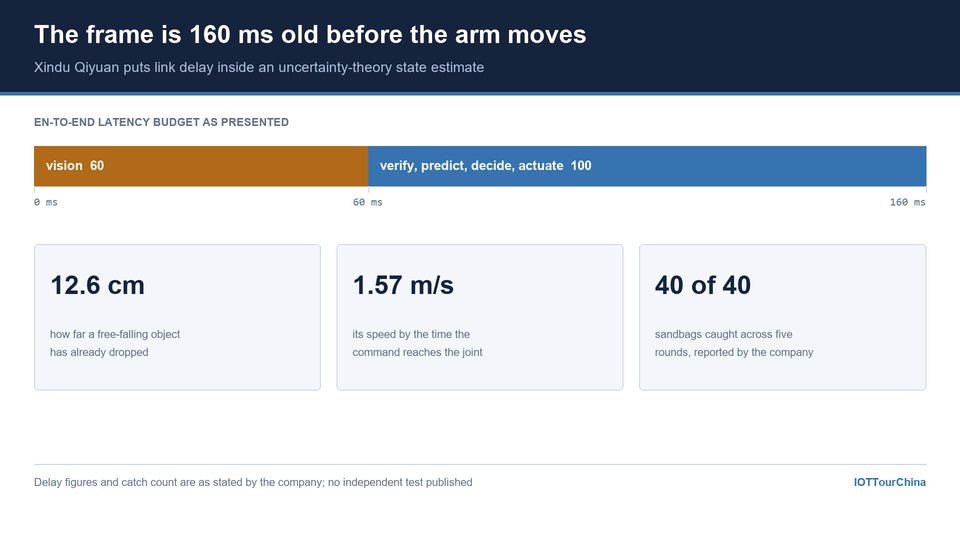
A robot that acts on a frame from 160 milliseconds ago is not acting on the world in front of it. That interval is short enough to sound like an engineering detail and long enough to matter: a freely falling object drops about 12.6 centimetres in that time and is moving at roughly 1.6 metres per second by the end of it. Grasp planning that assumes the target is still where the last image put it will miss, and the faster the task, the worse the miss.
At a developer workshop in Shanghai on 24 October, Dai Wei put that number on the table as a budget rather than a complaint. Roughly 60 milliseconds from photons to a processed frame, roughly 100 milliseconds from a decision to a joint actually moving. Dai is the technical lead of Xindu Qiyuan, a Hangzhou company incorporated this year, and the argument he built on top of that budget is that the interesting constraint in embodied AI is not how many parameters a model carries but whether its answer is still true when the arm arrives.
The presentation was part of a session on where the embodied brain goes next, one of four workshops at the 2026 Global Developer Pioneers Summit in Zhangjiang. Xindu Qiyuan's answer to the latency problem is unusual enough to be worth spelling out, and thin enough in evidence that the evidence has to be spelled out too.
The claim, in the company's own arithmetic
The pitch is that delay should not be treated as a defect to be shaved down by a faster inference engine, but as an input to the state estimator. In Xindu Qiyuan's account, the prediction module first characterises the latency of each link in the chain statistically, then uses measurements from an earlier instant to estimate where the robot and the target are now, and from there propagates forward to where they will be when the command lands. Delay compensation stops being a patch applied after the fact and becomes one stage of the model.
That is a recognisable idea. What is not standard is the mathematics used to carry it. The estimator is built on uncertainty theory, the axiomatic system of belief degrees developed from the 1990s by Liu Baoding, a professor in Tsinghua University's department of mathematical sciences. Dai's doctorate at Tsinghua was supervised by Liu, and the company describes its framework, which it calls the Xindu world model, as an extension of that theory into differential geometry: classical differential geometry describes where the robot and the object sit in space and how that configuration evolves, and the uncertain version replaces the deterministic disturbance term with an uncertain process.
The theory's own framing is that probability models frequency, while uncertainty models belief. Liu's standard illustration is a sealed jar of water: you do not know how much water it holds, you cannot sample it without opening it, and the only thing you can state is a degree of belief that it is under some volume. Where a system offers no stable frequency and no repeatable trial, the argument goes, a probability distribution is an assumption dressed as a measurement.
What the axiomatics actually change, and where the article got it wrong
The operational difference is not philosophical. It sits in the product axiom. For independent events, a probability measure multiplies: the joint probability of two independent events is the product of the two. Liu's uncertainty measure instead takes the minimum of the two measures. That single choice propagates through the whole calculus, and its practical consequence is what makes the framework usable for a control loop.
For independent uncertain variables with regular distributions, the inverse distribution of a monotone function of those variables is obtained by substituting one shared confidence level into each variable's inverse distribution. Nothing is convolved. Where a probabilistic treatment of ten independent error sources has to combine ten distributions and accept whatever tail the combination produces, the uncertain treatment picks a belief level, reads each source at that level, and composes the values. The output is an interval, not a distribution, and it is indexed by a number the engineer chooses.
That is exactly what the company's control story needs, because it produces a boundary that a verification module can test against in a fixed time. Xindu Qiyuan's safety argument is that the module checks at millisecond scale whether the current state has left the trusted boundary, and if it is close, slows, stops or replans without waiting for the higher decision layer to finish thinking. A distribution does not give you that cheaply. An interval at a stated belief level does.
The cost is real and worth stating plainly. Under the min rule, combining more evidence does not sharpen the estimate the way multiplying probabilities does, because at any given confidence level the boundary is set by the weakest contributing link. A model built this way is conservative by construction, and conservative in a way that can leave performance on the table when the system genuinely does have frequency information available. The same property is why it degrades gracefully when it does not.
One correction to the popular telling. The company's own account of the theory's origin, repeated in the coverage that followed the workshop, dates it to 2007. That year is the first edition of Liu's Springer monograph, not the theory. Liu was already described in 2007 as having opened the branch, was awarded the National Science Fund for Distinguished Young Scholars in 2004 and the China Youth Science and Technology Award in 2006, and received a National Science and Technology Progress Award second class in 2009. The monograph has since been translated into Russian, Japanese and Chinese. The distinction matters for anyone assessing maturity: this is a body of work with roughly three decades of papers behind it, not a recent paper with a company attached.
Seven modules, three of which still run a network
The architecture has seven modules, three for perception and four for everything downstream. Hearing, touch and vision handle sensing; verification, prediction, decision and control handle everything downstream. The company's claim is that the back four are implemented as mathematics rather than as a large network, so the core reasoning path does not depend on a model whose latency and memory footprint you cannot bound.
That claim is narrower than the headline that travels with it. The front end still uses neural networks to extract features, which is where a substantial share of the 60 millisecond vision term lives. Removing large models from the last four modules does not remove model latency from the loop; it removes the part of the loop where latency is hardest to predict because it scales with model size and sequence length. The engineer's question is which of the two dominates on a given stack, and the company has not published a per-module measurement.
A sanity check is available without any proprietary data. A 30 frame per second sensor imposes about 33 milliseconds of frame period before any processing begins, so a 60 millisecond capture-to-feature figure is in the plausible range for an RGB-D pipeline with a light network. A 100 millisecond decision-to-motion figure implies a comparatively slow command path: bus latency, servo update rate and the mechanical rise time of the joint all inside that window. Both figures are round numbers presented without a measurement method, and any integrator evaluating a claim of this shape should ask for the breakdown per stage, with mean and worst case separated.
Two videos, forty sandbags, no benchmark
The public evidence consists of two demonstrations. The first, from August, shows a humanoid tracking a pulley-mounted tray that a person pushes so that it stops at an arbitrary point on a table, then picking up the cup on it and handing it over on a voice instruction. The company says no task-specific pretraining and no scene calibration went into that grasp, and that the interval from buying the robot body to a working deployment was about one month.
The second is the one that carried the workshop. In a single continuous shot of just under five minutes, a Unitree body fitted with a third-party dexterous hand catches sandbags dropped without a fixed pattern from above, two hands at a time, and puts them in a bin. Across five rounds of eight sandbags, the company reports that all forty were caught. It also says the capability took only a few days to reach, attributing the short interval to a hardware change.
Those two timelines describe different things and should not be merged into one deployment figure. One is bring-up on new hardware; the other is a skill on hardware that had already been brought up. Neither is documented beyond the videos.
What the sandbag test does establish, if the video is what it appears to be, is that the loop closes on a target whose position is not known in advance, with a hand the company did not build and a body it did not build. The cross-embodiment claim rests on that, and it is the most decision-relevant thing in the story for anyone integrating robot arms rather than building humanoids. A soft, irregular, non-rigid target that changes shape on contact is also a harder perception problem than a cup, which is presumably why it was chosen.
What it does not establish is a rate. Forty successes out of forty attempts is a small sample, gathered by the company, counted from its own recording, on one object class, in one room, over five rounds inside a single session. There is no failure taxonomy, no distribution over drop heights, no force or contact data, no cycle count, and no long-horizon task. The company itself says long-horizon execution, multi-robot coordination and unstructured environments are still being validated, which is the honest framing and should be carried forward rather than dropped.
There is also no paper and no third-party evaluation. The theory it rests on is published and citable; the robot that demonstrates it is a video.
What an integrator should take from it
For a line building stationary pick-and-place with fixed fixtures, none of this is necessary, and a conventional pipeline with a faster camera will be cheaper and easier to certify. The interesting case is the one where the target moves, the fixtures are not fixed, or the site cannot spare a GPU: depalletising from a moving conveyor, bin picking where parts shift, feeding a machine whose position drifts, any cell where the SKU set is small but the poses are not.
Three questions separate a real capability from a demo in that setting. First, what is the latency budget per stage, measured on the actual hardware, with the tail reported and not just the mean. Second, what happens at the boundary: whether the system slows and replans as claimed, and whether that behaviour is logged well enough to audit after a near miss. Third, what the failure mode looks like when the object leaves the modelled envelope entirely, because a conservative interval is only an advantage if the system recognises when the assumption behind it has broken.
The intellectually interesting part of Xindu Qiyuan's position is that it takes a thirty-year-old branch of mathematics that most control engineers have never used and asks it to do a job that data-driven world models currently do badly. Whether the answer holds up outside a five-minute video is a question that only more trials, run by someone other than the company, can settle.