JAKA shows embodied-AI robots doing real factory work at the 2026 Industry Fair
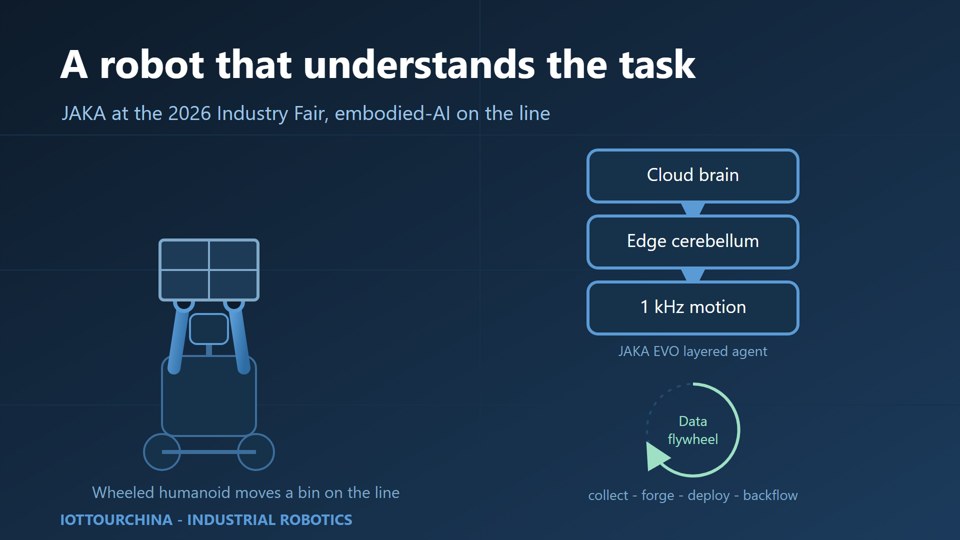
Industrial lines, not show floors, are the proving ground for embodied intelligence. At the 2026 China International Industry Fair, JAKA Robotics presented its work under the theme Universal is the future, built around three threads: collaborative intelligence, embodied scenarios, and a data flywheel. The throughline was that a robot should move from demonstrating a motion to actually performing a job on a production line.
JAKA EVO, the embodied operating system
JAKA released the JAKA EVO embodied-intelligence operating system globally in 2025. It uses a layered agent architecture. A cloud large model handles visual perception, task planning, skill selection, and anomaly decisions. An edge model combined with a rule engine handles motion planning and force-control execution, and turns domain knowledge, atomic skills, and process experience into reusable assets. A bottom layer of mature motion-control algorithms responds at 1 kilohertz to guarantee stable execution, which keeps model hallucination away from the safety-critical control loop.
The skill system breaks a long, complex task into short executable units. Industrial process constraints are baked into the skill logic, so the robot avoids thin-wall edges, pre-routes cables, and picks high-strength contact points for eccentric parts. Mature skills can be called directly, missing skills can be trained quickly from collected data, and engineers can define their own skills and orchestrate task flows on site.
Kargo, from demo to production
JAKA Kargo bin handling was pulled from the factory of a global top automotive parts maker and iterated on site by the engineering team. Within one month the single-bin cycle dropped from 105 seconds to 28 seconds and met the project's staged acceptance criteria. The set of atomic skills, the standardized basic units of bin work, grew from 12 to 78. The deployment window for a comparable new scenario shrank from 12 months to 57 days.
The Kargo50 heavy-load wheeled humanoid robot made its global debut at the fair and extends the already factory-validated mobile operation to higher-load industrial scenes. The Zu50 large-load collaborative robot appeared alongside it and completes JAKA's product range from light to heavy loads.
| Metric | Before | After |
|---|---|---|
| Single-bin cycle | 105 s | 28 s |
| Atomic skills | 12 | 78 |
| New-scenario deployment | 12 months | 57 days |
What the system actually runs
On the Kargo platform, EVO drives a single-machine ECU intelligent assembly, a server optical-module plug and unplug handled by two coordinated robots, and a new-energy motor assembled by multiple coordinated robots. The S3 mobile operation robot, paired with the AL series, performs lock-screwing on aerospace structures. EVO now backs twelve benchmark projects with scenario validation in automotive and 3C electronics manufacturing. In long-horizon, multi-step tests of roughly two-minute continuous tasks such as pick, place, handover, and precision assembly, about 200 training samples were enough to reach an above 85 percent success rate.
Collaborative intelligence and fast changeover
The Zu50 robot with the JAKA palletizing package reads box size, pallet size, and stack pattern, then palletizes automatically and is ready in thirty minutes after a changeover. Behind it is JAKA Studio Pro, a virtual simulation and offline programming tool with AI built in, whose trajectory, cycle, and logic data migrate to the real line as a high-fidelity digital twin. The S5 force-control robot uses six-axis force sensing and 2D vision for flexible electronic assembly. The A5L intelligent vision robot uses 2D vision, air-pressure sensing, and multi-angle capture to cover more than ten inspections such as lighting, light pattern, and air tightness, raises detection efficiency by three times, reaches 99 percent AI-fusion detection accuracy with under 2 percent misjudgment, and switches vehicle models in five minutes with magnetic quick-change tooling linked to a parameter library.
| Product | Type | Role |
|---|---|---|
| JAKA EVO | Operating system | cloud-edge embodied brain |
| JAKA Kargo50 | Wheeled humanoid | heavy-load mobile handling |
| JAKA Zu50 | Collaborative arm | large-load range |
| JAKA K series | Dual-arm humanoid | on-site data collection |
The data flywheel
The K-series dual-arm humanoid demonstrated data collection from real physical interaction, feeding process data back to the EVO base to iterate skill models and closing the loop of on-site job, data collection, model update, and redeploy. Two platforms drive the flywheel together. The OTA cloud data center opens an end-cloud channel for task planning, secure multimodal upload, gray-scale skill delivery, remote operation, and result return. AiHub forges models and skills through data governance, auto-labeling, distributed training, simulation and real-machine evaluation, and industrial skill packaging. The full cycle, collect, forge, deploy, backflow, iterate, is traceable and keeps compressing the landing time of industrial embodied intelligence. The K series uses self-developed APEX integrated joint modules and is already supplying embodied-AI vendors and research labs, with cable-plug flexible insertion trained from data moving from the lab toward the line.
Beyond the factory floor
JAKA also extended its general-purpose robots to public and entertainment settings. JAKA Pi, Paizai, took orders from visitors and coordinated two Lumi robots to handle retail and drink-shop flows such as task decomposition, parallel scheduling, picking, and delivery, and performed on a stage in costumes designed with Donghua University.
Why it matters
The shift on display is from a robot that executes a fixed program to a robot that understands a task and completes it autonomously. For manufacturers moving to multi-variety, small-batch, frequent-changeover production, the cost of re-fixturing and re-teaching for every new product is the binding constraint. A system that changes over by learning a process rather than rewriting a program is the core promise of flexible manufacturing.
Most of the accuracy and deployment figures come from JAKA's showcase stations and pilot lines rather than long-run production data, and the public record has not yet detailed which line is involved, who delivers it, or how the brain layer plugs into the wider architecture. The claim worth testing is whether reprogram-free changeover actually holds at scale, and whether yield, takt, and stability on real lines match the showcase numbers.