China's 136 scenario projects are where robot acceptance clauses will be set
On October 20 the National Development and Reform Commission, together with five other ministries and commissions, published a list of 136 landmark application scenario projects. The list covers five categories, from frontier fields to public services, and the projects name more than 1,700 new technologies, more than 1,200 new products and more than 2,200 new standards and specifications.
For a hardware supplier, the count is not the interesting part. What the list changes is where a product gets tested, who is in the room while it is tested, and what the result is worth afterwards.
What the list actually commits to
The instrument behind it is a State Council Office directive issued in November 2025, numbered 2025 No. 37, which required the commission to publish scenario project lists in batches. The same directive defines a scenario, and the definition is worth reading closely because it is more specific than the English word suggests.
A scenario is a concrete situation used to systematically validate the industrial application of new technologies, new products and new business formats, together with the supporting infrastructure, business models and institutional policies. It is described as the bridge that connects technology to industry and research to market.
Three things follow from that wording. A scenario is not a demonstration, because validation implies stated criteria and a result that can fail. It is not a showroom, because the infrastructure and the business model are part of what gets validated, not context around it. And it is not a single company's pilot, because the institutional policy layer is explicitly in scope, which is why procurement rules and acceptance standards can be rewritten as a result.
The commission framed the shift in its own words as a move from designating industrial parks and allocating factors of production toward designating scenarios and supplying access, environment and rules. That is a real change in what the policy hands out. Land and subsidies are transferred before anyone knows whether the product works. A scenario is transferred at the point where the answer is still unknown, which is why it is cheaper to give away and harder to waste.
Why a lab result does not transfer
The argument for field validation is not that labs are sloppy. It is that a lab answers a different question.
A bench test establishes that a principle holds under parameters someone chose. A field deployment has to answer whether the device coexists with equipment already installed, whether the cost per unit of work closes, and which step in the existing process it blocks. Ambient temperature swings, electromagnetic interference from adjacent drives, and variation in the material being handled all rewrite the measured performance, and none of them appear in a datasheet. A specification that holds at 25 degrees in a clean room is a starting hypothesis.
The constraints are concrete and differ by site. A chemical park requires explosion protection, so a device has to demonstrate it cannot produce an ignition source before it is allowed near a tank farm. A high-voltage substation requires insulation and a maintained safety distance, which rules out most of the arm geometries that work well in a lab cell. A city campus has to cope with pedestrian traffic, changing light and unscripted events. None of these can be reproduced at scale on a test rig, which means the only way to accumulate evidence is to accumulate hours.
There is a third reason the list exists, and it is financial. Money and land answer whether something can be built. First-unit insurance and procurement fault tolerance answer whether anyone dares to buy it. Neither answers where the product practices. That gap used to be closed by one company negotiating site access at a time, carrying the cost of every failed conversation and every failed month. The list converts that from a private negotiation into a published channel, which mainly helps the suppliers too small to afford the negotiation.
Where acceptance criteria come from
The least discussed benefit is the one that shows up in the next contract.
A device that runs a full quarter in a tank farm produces a record. That record can be written directly into the acceptance clause of the following purchase order, which means the technical requirement stops being a number copied from a brochure and becomes a measured figure with a site, a duration and a witness behind it. For a buyer this is the difference between specifying a capability and specifying an outcome. For a supplier it means the reference list matters more than the specification sheet, because the customer is buying the quarter, not the datasheet.
This is also where the mechanism can disappoint. Acceptance criteria that grow out of one site carry that site's conditions with them, and a quarter is long enough to encode a particular climate, a particular duty cycle and a particular maintenance regime. A record from a northern substation is evidence, not a guarantee, and a supplier who treats it as a guarantee will discover the difference in the second deployment.
Robots are inside the projects, not the subject of them
The list is not a robot list, and reading it as one leads to the wrong conclusions about where the money is.
The examples the commission chose to explain the list are a smart mining scenario that opens more than 2,800 mines to cloud computing, industrial IoT, sensing and autonomous haulage; a brain-computer interface cluster that builds data, pilot-testing and application platforms; and power-sector projects around high-renewable penetration and new storage, including grid-forming flexible DC transmission and coordinated wind, solar and storage. Robots are not the headline in any of the three. They are one of the things that becomes deployable once the scenario exists.
The provincial breakdown confirms the pattern. Anhui placed six projects, third nationally, and exactly one of the six is an embodied intelligence project: a chemical industrial park where embodied systems and digital integration are validated together. The other five are inland waterway logistics, an automotive supply chain, quantum sensing for the power system, fluoride wastewater treatment, and a Huangshan to Hangzhou digital tourism corridor. One in six.
That ratio is the honest way to read the opportunity. A robot vendor does not enter this list as a robot vendor. It enters as a component of a chemical park, a mine or a grid project, and the requirements it inherits are the park's, not the robotics industry's.
Anhui also shows what the sub-national machinery looks like, and this part transfers to other provinces. It runs a provincial scenario library with 57 projects selected in the first round across 12 frontier fields including integrated circuits, artificial intelligence, quantum information and clean energy, backed by land, energy and environmental permitting priority plus preferential allocation of airspace, water and spectrum. It created guarantee and loan products specifically for the validation stage. It assigned responsibility by the rule that whoever regulates an industry also regulates its scenarios, and it runs parallel approval with tolerance for missing materials, together with procurement modes that allow joint development and first-order purchase.
Three numbers that get quoted wrong
The robot figures circulating alongside the list are accurate individually and misleading in combination.
| Metric | Period | Figure |
|---|---|---|
| Humanoid models released in China | H1 2026 | more than 400 |
| Humanoid units produced in China | H1 2026 | more than 40,000 |
| Humanoid units forecast for China | full year 2026 | more than 100,000 |
| Humanoid units sold worldwide | H1 2026 | about 36,000 |
The first row is models, not units. More than 400 whole-machine products is a statement about how fragmented the supply base is, and it is the strongest argument for the standards described below.
The second and fourth rows are the trap. Forty thousand units produced in China against thirty-six thousand sold worldwide in the same half year is not a comparison, because production and sell-through are different quantities measured over different populations. But the gap is informative rather than meaningless: production is running at or above the level of global demand, which puts the inventory risk on the supply side rather than the demand side. A supplier planning capacity against the production figure is planning against the wrong number.
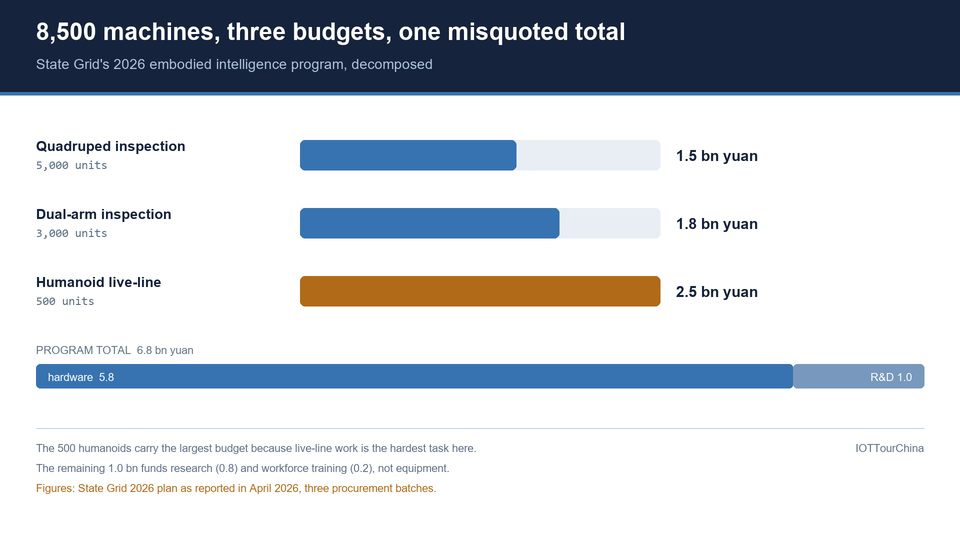
The third distortion is a single procurement that gets described as a special-purpose robot order. The State Grid program for 2026 covers about 8,500 embodied intelligence devices with a stated total investment of 6.8 billion yuan. The hardware is 5.8 billion of that; the rest funds research and workforce development. The units are also not one category.
| Category | Units | Budget |
|---|---|---|
| Quadruped inspection robots | 5,000 | 1.5 billion yuan |
| Dual-arm inspection robots | 3,000 | 1.8 billion yuan |
| Humanoid live-line robots | 500 | 2.5 billion yuan |
| Hardware subtotal | 8,500 | 5.8 billion yuan |
| Research and training | not applicable | 1.0 billion yuan |
| Program total | 8,500 | 6.8 billion yuan |
Two details in that program matter more than the total. The 500 humanoid units carry the largest budget despite being the smallest quantity, because live-line work at distribution voltage and on ultra-high-voltage projects is the hardest task in the set. And the equipment has to conform to a grid-specific technical specification, with suppliers preferred if they can integrate with the utility's own large model and support local deployment. A generic humanoid that meets a general safety standard is not automatically eligible.
The standards arrive before the products do
Six national standards for humanoid robots were approved in mid-October and take effect on April 1, 2027. Five are a technical requirements series covering body composition, system architecture, environmental perception and decision-making, with performance indicators attached. The sixth is a specification for simulation test platforms, and it is the one that matters most for anyone building hardware.
A simulation test platform standard establishes a common architecture and test method so that a capability claim can be evaluated in an environment that is reproducible and trusted. That is precisely what has been missing: without it, every vendor benchmarks on its own scenes and the numbers cannot be compared. With it, a simulation result becomes a citable figure, which is also the point at which simulation stops being marketing.
The fragmentation problem the standards address is blunt. Across vendors, products differ in dimensions, performance, battery voltage and, most importantly for integrators, in communication and usage interfaces. China is early enough in the cycle that a national standard can still shape those interfaces rather than ratify a settled practice, and the stated goal is a system covering design, manufacturing, test and evaluation, and application.
For a foreign integrator this is the single most actionable item on this page. A standard for interfaces and a standard for simulation evaluation are documents you can read, and they will determine what a Chinese supplier can prove and how. They take effect in April 2027, which is inside most procurement planning horizons.
What the list does for a supplier outside China
Very little directly, and it is worth being clear about that. The open channel is described as publishing the technologies and products to be validated to Chinese private enterprises and small and medium firms, and the projects are domestic infrastructure with domestic implementing entities. Nothing in the published material describes a route for a foreign company to put its product forward.
The indirect effects are real. The list tells you which duty cycles Chinese vendors will be able to cite in a reference list eighteen months from now: tank farms, substations, mines, ports and parks. It tells you which constraints their next hardware generation will be designed against, which is explosion protection, insulation and clearance rather than payload. And the standards tell you what evidence they will be able to produce. If you are selecting a Chinese robot or IoT supplier for a hazardous-area deployment, the useful question is no longer whether they have a demo, but which listed project they have hours in.
The list will also be extended. The commission has said it will publish further batches, extract the technical solutions, business models and institutional rules that work, and promote them into national policy where conditions allow. A program that started as 136 projects is meant to become a standing mechanism, which means the reference duty cycles will keep expanding and the acceptance clauses written from them will keep getting more specific.