Nine minutes to full, three to swap, an hour on a pad: the arithmetic behind humanoid uptime
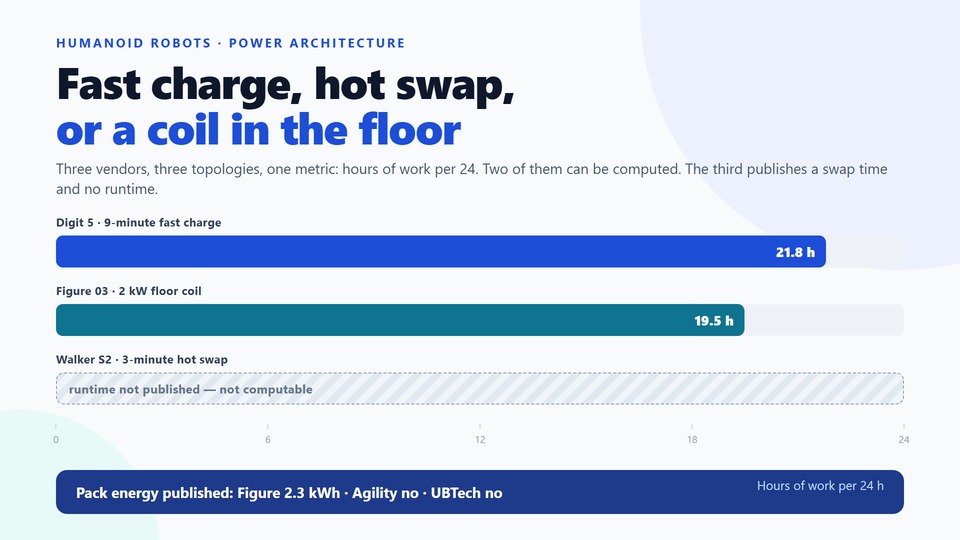
Three companies published three ways to keep a humanoid robot working, and each announcement reads as though the other two had not happened. Agility Robotics put a 90-minute pack and a 9-minute charge into Digit 5. UBTech put a 3-minute hot swap into Walker S2. Figure put 2 kW of inductive coils into the soles of Figure 03.
Read side by side, the three form a comparison none of them makes, and the comparison is where the engineering sits. All three are answering the same question: out of 1,440 minutes in a day, how many can the machine spend on the task. They answer it with three different topologies, three different maturity levels and three different things left out of the specification sheet.
The first thing that falls out of the comparison is a maturity order that runs the wrong way round, and the second is that the only field numbers in the set come from an earlier generation of one of these machines.
Three architectures, one metric, and one number nobody publishes
| System | Published runtime | Published recharge | Implied work in 24 h |
|---|---|---|---|
| Digit 5, fast charge | 90 min | 9 min | 21.8 h |
| Walker S2, hot swap | Not published | 3 min | Not computable |
| Figure 03, inductive | 5 h | About 69 min at 2 kW | 19.5 h |
The last two rows are the interesting ones. Digit 5's arithmetic is straightforward: a 99-minute work-and-charge cycle fits 14.5 times into a day, and 14.5 times 90 minutes is 21.8 hours. Agility's own sentence is more conservative, more than 20 hours of productive work in a 24-hour day, which is the same claim with the losses left in. Figure 03 works out at 3.9 full cycles and 19.5 hours, and Figure's wording is looser again: near-continuous operation as long as the robot can step onto a charging mat for a certain period during the use case. That sentence is doing real work. It describes opportunity charging rather than full cycles, and opportunity charging is a different mode of operation that needs a different calculation.
UBTech publishes the swap time and nothing else. Three minutes is a number, and it is the only number in the three announcements that has been produced by machines in customer hands rather than by a design team.
What a nine-minute charge does to the cell
The ratio is easy to state and hard to build. A 90-minute discharge is 0.67C. To refill the same energy in 9 minutes is 6.7C, an order of magnitude above discharge, sustained for nine minutes with the pack inside a sealed torso.
| Configuration | Charge rate into the pack | Full cycles per 24 h | Cycles per year at 300 days |
|---|---|---|---|
| Digit 5, 90 min run, 9 min charge | 6.7C | 14.5 | 4,365 |
| Digit 4, 90 min run at its published 2:1 | 1.3C | 10.7 | 3,200 |
| Figure 03, 2.3 kWh, 2 kW | 0.87C | 3.9 | 1,170 |
| Walker S2 | Set by the off-board charger | Not published | Not published |
The row that matters for a buyer is the comparison between the first two. Moving from Digit 4's 2:1 to Digit 5's 10:1 does not just cut dock time by a factor of five. It raises the number of full cycles the pack sees in a working year by about 36 percent, because the robot is no longer sitting still waiting. A pack that lasts four years at 3,200 cycles a year has to last the same four years at 4,365. The improvement in uptime is paid for in cycle life, and cycle life is the parameter that decides when a fleet buys batteries again.
Nyobolt's published numbers, read against that requirement, are less convenient than the round figure in circulation. Its FAQ lists two series: Ultra at 8,000-plus cycles in demanding applications, and Xtreme at 20,000-plus cycles in grid-scale rapid cycling duty. At 4,365 cycles a year, the Ultra figure is under two years of two-shift operation. The 20,000 figure that gets quoted as ten times ordinary lithium-ion belongs to the grid product, not to a robot pack, and the company does not publish a cycle rating for the Digit 5 pack at all. It also measures fast charge from 10 percent to 80 percent rather than from empty, which is the more honest way to state it and the version a charger specification has to match.
What Nyobolt does publish is the mechanism. Its founders traced the limit to the anode, where graphite accommodates lithium at a rate that plating and heat penalties make impractical above a few C. The company's replacement is a family of niobium tungsten oxides, identified by Clare Grey's group at Cambridge in 2018 and commercialised through Nyobolt from 2019. The open structure accepts a larger volume of lithium ions in and out at speed, which is the whole trick, and the reason the cycle-life question is the binding one rather than an afterthought.
There is a second constraint that never appears in a press release. A 9-minute charge needs a charger, and the charger needs a service. Without the pack energy, 9 minutes cannot be converted into kilowatts, and kilowatts are the only unit a facilities engineer can act on. At any pack size E, a 6.7C charge draws roughly 6.7 times E into the pack and about 7.4 times E at the wall once charger losses are counted. If E is 1.5 kWh that is 11 kW per robot, which is a dedicated three-phase circuit and a conversation with the building's electrical contractor. Agility publishes runtime, charge time and the ratio, and not the kWh.
The swap moves the battery out of the bill of materials
UBTech's approach is the only one of the three that has been in continuous production, and the mechanism is documented in more detail than the other two. Walker S2 carries two packs. The robot monitors state of charge, decides on its own whether to swap or to charge depending on the priority of the queued task, walks to a station, and uses both arms under a compliant control loop to pull the depleted pack and seat a charged one, with the second pack carrying the load while the first is out. The company's claim of a world-first autonomous hot-swappable system has held since the system shipped with the robot in July 2025.
The claim worth examining is the one about the pack doubling as a structural member. Figure makes the same claim about its own pack, which is built into the torso as a load path, and the two claims are in tension with each other. A structural battery is one whose enclosure carries bending and torsion from the robot's own body. A swappable battery is one whose mounting joint is opened and closed several times a day. Doing both means the swap interface has to transmit structural load through a repeatable, tool-free joint, and neither company publishes the stiffness of that joint, its wear rate, or how many swap cycles it is rated for. That is the number an operator with a three-shift factory actually needs, because it decides the maintenance interval on the robot rather than on the battery.
What the swap architecture does change is where the money goes. The battery stops being a component of the robot and becomes a stock item with a rotation schedule, a charger rack, a station footprint and a person who owns the inventory. UBTech's own materials describe the system as dual-battery balancing plus a standardised bay plus coordinated swapping, and the word standardised there means standardised within the product line. Nothing about the bay, the pack voltage or the connector is published as an interface another vendor could build to.
Two kilowatts is a floor-space decision
Figure's number is the smallest of the three by an order of magnitude and that is the point of it. The F.03 pack is 2.3 kWh and delivers 5 hours at peak performance, which puts average draw at about 460 W, and it charges at 2 kW through coils in the robot's feet standing on a pad. The charge rate is 0.87C, so gentle that the pack needs forced-convection cooling rather than anything exotic, and the whole thing runs off a circuit a domestic kitchen could supply.
The cost of that choice is duty cycle. A full cycle from empty takes about 69 minutes at 2 kW, which is why the 24-hour arithmetic gives 19.5 hours rather than 22, the worst of the three on paper. Figure's answer is not to charge from empty. At 2 kW and 460 W average draw, one minute on a pad returns about 4.3 minutes of runtime, so a ten-minute top-up during a task gap is worth 43 minutes of work. That is a legitimate architecture, and it is the only one of the three that assumes the robot will be idle often enough to steal power, which is a reasonable assumption in a house and a questionable one on an assembly line.
The published specification stops exactly where a facilities team would start. There is no pad alignment tolerance, so floor flatness and pad spacing cannot be specified. There is no coil efficiency figure, so the heat rejected into the floor and into the foot is unknown. There is no foreign-object detection statement, which matters for a 2 kW coil embedded in a floor that people walk on. And there is no pad count, which is the number that decides whether wireless charging at a warehouse scale is one pad per robot or one pad per work area.
The most-publicised deployment ran about half a shift
Set the three architectures against the only long-duration humanoid deployment with published hours. Figure 02 ran at BMW Group Plant Spartanburg for 11 months on a 10-hour shift, Monday to Friday, loading sheet metal into a welding fixture. The company's own retrospective gives 1,250-plus hours of runtime, 90,000-plus parts loaded, 30,000-plus X3 vehicles and an estimated 200-plus miles of walking.
Eleven months of weekday shifts is roughly 239 working days. At 10 hours a day that is 2,390 scheduled hours, against 1,250 hours of runtime, so the robot was working about 5.2 hours a day on average, or a little over half of the shift it was booked for. Some of the gap is bring-up and some is task availability, and the exact split is not published. What is published is enough to say that the machine never needed more than one pack's worth of energy per day, and that the constraint on the deployment was somewhere other than the battery.
The KPIs Figure chose for that deployment say the same thing. The requirement was an 84-second cycle with 37 seconds of loading, three parts placed within 5 mm in 2 seconds each, above 99 percent placement accuracy per shift, and zero human interventions. None of those is an energy metric. The company's own list of lessons learned is about a forearm that was the top hardware failure point and got re-architected for the next generation, not about charging.
Digit's installed base tells a similar story at a different scale. Agility reports more than 65,000 hours across Digit 4 machines at GXO, Schaeffler, Amazon and Toyota Motor Manufacturing Canada over nearly three years. Divide by a 20-hour working day and that is the equivalent of about nine robot-years of near-continuous operation spread across the whole fleet. It is a real number and it is not a large one. The gap between 65,000 fleet hours and the 20-hour days in the Digit 5 launch material is the gap between what has been deployed and what is being sold.
The only cross-vendor interface in the stack is the gripper flange
Digit 5's end effectors mount on ISO standard flanges, so a customer can buy a gripper from a third party and bolt it on. Agility lists that as a headline upgrade. It is also the only open interface anywhere near the energy stack, which is worth stating plainly: the tool at the end of the arm is interchangeable across vendors, and the pack that powers the arm is not.
On the safety side there is real standardisation and it is not about interchange. Figure's F.03 pack is certified to UN38.3 for transport and UL2271 for light electric vehicle batteries, and the company says it worked with a nationally recognised testing laboratory to develop a UL standard for the humanoid application because none existed, then passed the 23 primary tests in it. Agility is a project leader on ANSI/A3 TR R15.108 and a contributor to ISO 25785-1, both of which are about safe operation rather than about plugs. UBTech's standardised bay, again, standardises inward.
So the integration surface that actually exists for a systems integrator is not the battery. It is the fleet layer. Agility Arc exposes uptime, throughput and mean time between incidents, and connects to warehouse management, warehouse execution and manufacturing execution systems. That is where a facility's software meets the robot, and it is a software interface with a published shape. Everything below it, from pack voltage to coil geometry to swap-bay footprint, is a vendor-specific black box with a service contract attached.
Six questions to put to a vendor before you size the service
The pattern across all three announcements is that the marketing number is the ratio and the engineering number is missing. A buyer who asks the right six questions will get a specification instead of a headline.
| Question | Why it decides something |
|---|---|
| Pack energy in kWh and nominal voltage | Converts a charge time into kW at the wall and into a breaker size |
| Is the charge time measured from empty or from a floor state of charge | A 10 to 80 percent figure is not the same charger as a 0 to 100 percent figure |
| Cycle life at your cycles per day, not at the datasheet rate | Decides the battery replacement interval and the true cost per operating hour |
| Per-robot electrical service and connector | Decides whether the line needs re-wiring, and who pays |
| Spare pack count, station footprint and swap joint rating | Decides the fixed asset and the maintenance interval on the robot itself |
| Fleet API protocol and telemetry set | Decides whether your WMS or MES can see the robot at all |
Two things follow from the comparison that are worth carrying away. The first is that the three architectures are not competing answers to one question, they are answers to three different questions about what a facility's idle time looks like. A line with a fixed takt cannot absorb a 69-minute charge no matter how gentle it is on the cell. A warehouse with scattered tasks cannot justify the fixed cost of a swap station for a machine that already has gaps to charge in. A home cannot have a swap station at all.
The second is that the maturity ordering runs against the headline ordering. Fast charge has the best ratio and the longest wait: Digit 5 with the Nyobolt pack enters early access in the first half of 2027 and general availability at the end of that year. Wireless has the weakest published duty cycle and is already running a pilot in a BMW assembly hall. Swap has no published runtime at all and has been shipping into factories since 2025. The number that reads best in an announcement is the one furthest from a production floor.