Jueying X50: Deep Robotics puts a 50 kg continuous payload in writing, with footnotes
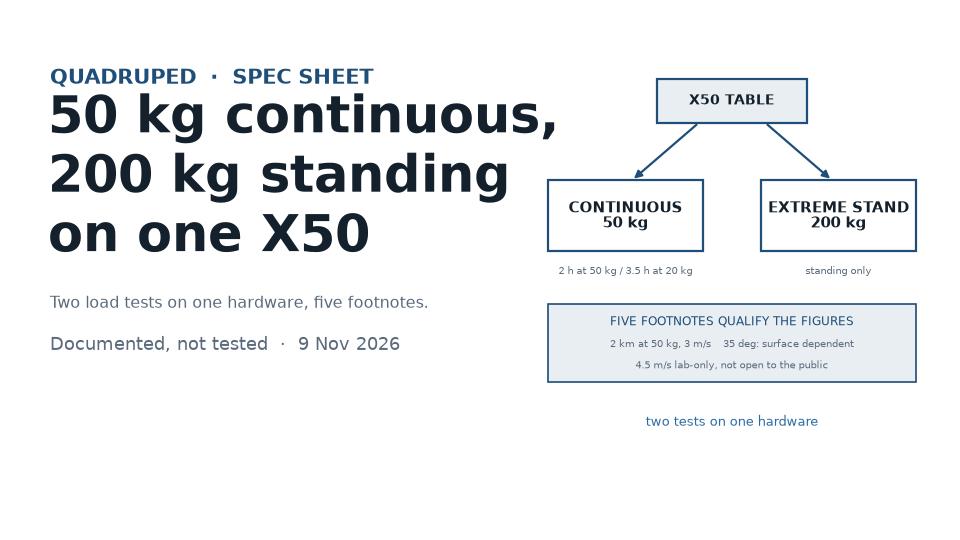
A quadruped that can carry 50 kg while running is a different machine from one that can hold 200 kg while standing still. Deep Robotics made that distinction explicit when it published the parameter table for the Jueying X50, and the table is a more useful document than the launch coverage around it.
The X50 was announced on 6 November 2026, with the company newsroom dating its launch note to 7 November. The launch article talks about endurance, terrain and real work sites. The official product page instead lists two variants, X50 and X50 Pro, with a parameter table and five footnotes that qualify almost every headline figure on it.
Two load numbers, and why the footnote matters
The table separates continuous running load from extreme standing load. Continuous running load is 50 kg on both variants. Extreme standing load is 200 kg on both, with a footnote saying this is the limit in a standing state and should not be treated as a normal operating condition.
That pairing is worth reading carefully. Coverage of the launch frames the 50 kg figure as a deliberate choice against an industry that advertises extreme standing load. But the vendor's own table also publishes a 200 kg standing figure; what makes the two numbers compatible is the footnote, which tells an integrator which one belongs in a duty-cycle calculation. A robot that carries 50 kg while walking and a robot that supports 200 kg without walking are not competing specifications. They are two different tests on the same hardware.
Endurance follows the same pattern. The table gives 2 hours at 50 kg and 3.5 hours at 20 kg, so a route plan built on unloaded runtime will be wrong by a wide margin.
The launch article describes one robot; the table describes two
The X50 Pro is absent from the WeChat launch article, but present in the official table. The differences are small in dimensions and meaningful in I/O:
| Property | X50 | X50 Pro |
|---|---|---|
| Standing height | about 0.685 m | about 0.705 m |
| Weight with battery | about 57.5 kg | about 60 kg |
| Compute | two high-performance 8-core processors | three high-performance 8-core processors |
| Power and data | 72 V BAT, Ethernet, Wi-Fi | 5 V, 12 V, 24 V, USB 2.0, USB 3.0, Ethernet, Wi-Fi |
Both variants list four lidars and one wide-angle camera, IP67, an operating range of minus 20 to 55 degrees Celsius, SLAM mapping and navigation, autonomous charging, secondary development and OTA updates. The temperature figure carries a footnote noting that performance may drop at the extremes.
For a developer choosing a payload to mount, the interface column is the part to read first. The 5 V, 12 V and 24 V rails and the USB ports appear only on the Pro row.
Speed and range are qualified by their test conditions
The table lists a maximum working walk speed of 1.5 m per second, a maximum sustained running speed of 3 m per second, a sustained running distance of 2 km, a maximum continuous stair height of 25 cm and a slope capability of 35 degrees.
Three footnotes do real work here. The 2 km figure was measured under 50 kg at 3 m per second, so it is not a general range. The 35 degree slope depends on the surface material. And the 4.5 m per second extreme speed was measured in a laboratory under a specific configuration and, in the vendor's words, is not open to the public for safety reasons. That last number should not appear in any integration plan.
The launch article also describes continuous climbing of open-riser steel stairs and surge stability under fire-hose recoil. Those are scenario descriptions rather than rated parameters; the table gives the stair height and leaves the rest qualitative.
Where the market numbers stop being product numbers
The launch article cites an IDC report, Global Quadruped Robot Market Share, 1H26, saying the industrial-application segment exceeded 270 million USD in the first half of 2026, up 125.1 percent year on year, and that Deep Robotics led that segment. Financial press reporting the same document describes the ranking as a revenue-share position in the industrial-application segment, and puts the whole quadruped market at over 400 million USD on more than 49,000 units shipped, with home and research models accounting for about 60 percent of units but under a third of revenue.
Two cautions follow. The 270 million USD figure is the industrial-application segment, not total market size. And a revenue-share ranking is not a unit-shipment ranking; the same report explicitly says lower-cost home and research machines dominate unit volume. The article also calls this a second consecutive year of the same recognition, pairing a 2025 Frost and Sullivan finding with a 2026 IDC one. Different firms, different periods and different scopes are not one continuous ranking.
Similarly, the claim that the Jueying series has cumulatively delivered more than a thousand units is a cumulative figure across a product line, not an annual sales number for the X50. Neither should be carried into a procurement model.
How this was checked
Parameters, variant differences and all five footnotes come from the vendor's own Jueying X50 product page. The 6 November announcement date comes from press coverage and the launch article; the newsroom entry is dated 7 November. Market figures are attributed to the IDC report as reported by financial press, not read from the report itself. The 50 kg continuous load, 200 kg standing limit, 2 km range and 4.5 m per second extreme speed are vendor-published figures with their stated test conditions, not independent measurements.
No X50 unit was handled, powered on or measured for this article.
Source: Robotics Lecture Hall (Jiqiren Dajiangtang), WeChat, 9 November 2026.