Pudu's one brain, four bodies: three layer diagrams and one fully specified robot
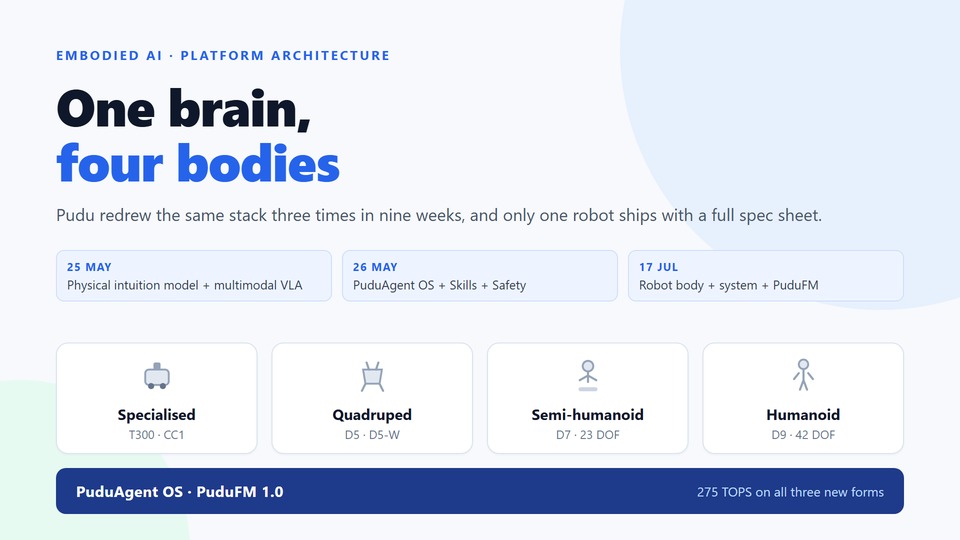
Pudu Robotics sells four kinds of robot and one story about them: a single intelligence layer, described in its own materials as "One Brain, Multiple Embodiments", that is meant to sit under specialised delivery and cleaning machines as well as a quadruped, a semi-humanoid and a full-sized biped. The commercial argument for that breadth is easy to state and hard to check, because a claim about shared software can only be tested against the documents that describe the software.
Those documents are unusually specific, and they do not agree with each other. Within nine weeks Pudu published three different ways of cutting the same stack into layers, and its four robot families disclose wildly different amounts of information about what a buyer can actually control and what the machine can actually do for a shift.
Three documents, three different sets of layers
| Document | Date, 2026 | How the stack is divided |
|---|---|---|
| PuduFM 1.0 launch | 25 May | Physical intuition model as the cognitive layer, multimodal VLA as the execution layer |
| PuduAgent launch | 26 May | System layer (PuduAgent OS), capability layer (Skills), safety layer |
| Physical Agent briefing | 17 Jul | Robot body layer, system layer (PuduAgent OS), skill layer (PuduFM) |
The constant across all three is PuduAgent OS in the middle, holding task comprehension, planning, memory and execution timing. Everything else moves. In the first version safety is its own layer, and the capability layer is a library of atomic skills. In the third version there is no safety layer at all; safety has folded into the operating system as guardrails, the robot body has appeared at the bottom, and PuduFM has moved from being the foundation underneath everything to being the skill layer on top of the system.
None of that is dishonest. Architectures get redrawn as products ship, and a briefing slide is not a specification. It does mean that a procurement document which says "the skill layer" or "the platform layer" is ambiguous when it reaches Pudu, and the answer will depend on which of the three decks the sales engineer happened to bring.
The distinction that matters commercially is the one the three versions agree on. PuduFM is a model, and a model is not a platform. PuduAgent is the platform, and the model runs inside it. Buying the second without the first is possible; buying the first expecting a platform is not.
What Pudu says is shared, and what stays with the legs
PuduFM 1.0 is built from two modules joined by hierarchical injection. The physical intuition model captures object kinematics and physical interaction in a latent space using a causal-attention transformer, and predicts sparse state rather than dense pixels, which is how Pudu gets it to run as a fast pre-check on an action sequence rather than a heavy video predictor. The multimodal vision-language-action module puts language, vision and action in one feature space so that navigation and manipulation are planned by the same loop instead of by two modules handing off.
Training is three staged: pre-training on image, text and video, reinforcement learning inside a world simulator, then fine-tuning on real deployments with human correction captured as structured data. That last stage is where the fleet becomes an asset rather than a cost.
PuduAgent OS carries the parts that are expensive to rebuild per robot: a planner that works across timescales, a memory that separates working state from episodic history and compresses both so that a task can run longer than a decision window, and a runner that guarantees millisecond-level dispatch. The skills layer wraps navigation, obstacle avoidance and elevator interaction into atomic units with a uniform interface, so a new body does not need the floor logic rewritten.
What none of this covers is the part an integrator spends the most time on. Force per leg, joint coordination, and adaptation to a different dynamic model stay with the body's own motion control, and Pudu says so directly: capabilities are decoupled from hardware, differences are not erased. A single brain plans what to do. It does not tell a 56 kg quadruped and a 65 kg biped how to stay upright.
The one number that is identical on all three new forms
| Robot | Computing | Runtime published | Developer entry point on the page |
|---|---|---|---|
| PUDU D5, quadruped | 275 TOPS | 2 to 2.5 h, or 2 to 3 h | None |
| PUDU D7, semi-humanoid | 275 TOPS | 4 h or more, hot-swap | SDK and API, end-to-end toolchain |
| PUDU D9, full-sized biped | 275 TOPS | Not published | None |
Three different bodies, launched across eighteen months at three different price points, and the compute tier does not move: 275 TOPS on every one of them, on an NVIDIA Jetson Orin paired with an RK3588 on the two that publish the chipset. That is the most concrete evidence of a shared platform in the whole portfolio, and it is a spec line rather than a strategy slide.
The rest of the table is where the story thins out. D9, the full-sized biped, publishes height, weight, 42 degrees of freedom, a 352 N·m peak joint torque, a 20 kg maximum payload qualified as a test-environment figure, a 2 m/s walking speed and a 0.72 kWh battery. It does not publish an operating time. A 65 kg biped with a 720 Wh pack is the configuration whose endurance a site planner needs first, and it is the one number missing.
D7 is the opposite case and the most integration-ready of the three. Its page names SDKs and APIs, lists motion control, perception, manipulation and human-robot interaction as exposed surfaces, and describes a toolchain that runs from data collection through cleaning, training, evaluation, quantization and compilation to deployment. It also gives the operating envelope that a commissioning engineer would otherwise have to discover: 175 cm tall, 140 kg, 0.5 to 2 m working height, 7 kg rated and 10 kg peak per arm, 20 kg maximum, 70 cm passages, 8 degree slopes, two batteries with hot swap.
Note how the 14 kg payload quoted at the World Artificial Intelligence Conference in July reconciles with the 20 kg on the product page. Fourteen is two arms at rated capacity, seven each. Twenty is the peak figure. Both are on the record, they measure different things, and a tender that asks for "payload" without saying which will get whichever number is convenient.
The quadruped's specification got smaller after launch
The D5 launched on 3 December 2025 at iREX in Tokyo. The launch release is more generous than the current specification sheet, field by field.
| Parameter | Launch release, 3 December 2025 | Specification sheet, current |
|---|---|---|
| LiDAR | Dual 192-line, front and rear | Dual 96-line standard, 192-line on request |
| Payload | Up to 30 kg | 20 to 30 kg continuous walking |
| Endurance | More than 2 h at full load | 2 to 2.5 h, or 2 to 3 h |
| Inspection range | Up to 14 km, single continuous run | Not stated |
| Joint torque | Not stated | 165 Nm maximum |
The LiDAR change is the substantive one. The launch described dual 192-line units as standard equipment. The current page footnotes dual 96-line as the shipped configuration and offers 192-line as an upgrade on request, which is a different product at a different price. Everything else still holds: 80 cm climbing, 45 degree ascent and descent, IP67, cold start below minus 10 and operation from minus 20 to 55 degrees, 1,000 Wh, 56 kg with battery, four fisheye cameras, six-microphone array, a million square metre map.
The 14 km figure is the most quoted number about this robot and the hardest to find. It appears in the launch release and in Pudu's Chinese announcement, and nowhere in the specification table. A number that lives only in a press release should be treated as a claim about a configuration, not a property of the product.
The page also contradicts itself in a small way that matters for site surveys. The headline copy says the robot handles 25 cm steps, while the specification area carries two blocks under a section headed "Two Forms" that differ in exactly two fields: one gives 30 cm steps with 2 to 2.5 hours, the other 25 cm with 2 to 3 hours. Neither block is labelled with a model name. The wheeled variant is the one the IFA release calls D5-W, and the longer endurance and shorter step height point at it, which would make the headline copy a description of the wheeled robot on a page whose title describes the legged one. Confirm the mapping in writing before it goes into a tender.
What the market research supports, and what it does not
Frost and Sullivan's 2025 report on commercial service robotics puts Pudu first globally in revenue at roughly 25 percent share and first in shipments at roughly 23 percent. The same report ranks it first among Chinese companies by overseas share and first worldwide in commercial cleaning revenue at about 29 percent. Counterpoint put it first in cleaning shipments and revenue in August 2026.
The same research house published a white paper on quadrupeds and wheeled-legged robots on 14 September 2026. Its public excerpt names four companies as best-practice cases: Unitree, Jiwei, DEEP Robotics and Weilan. It describes the competitive tiers only in aggregate, as scaled, vertical and exploratory groups, and the company names in the tier chart are masked in the released material. Pudu is not among the four named cases.
Chinese commentary that cross-matched the masked profiles against the published company descriptions placed Pudu in the third of the three tiers, at roughly 2.2 percent of China's quadruped and wheel-legged market. That placement is a reconstruction, not the white paper's own text, and it should be cited as such.
Both sets of numbers can be true at once, because they describe different product categories. What they do not support together is the sentence that Pudu now leads in every form it sells. It leads where it has been shipping since 2016, and it is a new entrant where it started shipping in December 2025. The multi-form strategy is the attempt to move the second position toward the first, and the honest way to read the portfolio is that the strategy is real and the second position is not yet a leadership position.
Why the breadth still matters to a buyer
The asset being reused is not market share. It is the fleet. Pudu reports over 130,000 robots shipped, three factories, and a data stream the PuduFM release quantifies: 36.5 million hours of navigation data a year and 15.8 million hours of manipulation data a year. Those two add to 52.3 million hours, which is the number that circulates as "over 50 million hours of real operating data" once the two categories are merged into one.
That merge is worth flagging. Navigation hours and manipulation hours are not the same commodity, and the second is the scarce one: Pudu describes collecting it passively during ordinary operation, which is the only way to get manipulation data at that volume without a teleoperation programme. For a buyer the practical consequence is that the D5 inherits a navigation and scheduling stack that has been running in commercial buildings for a decade, while the legs, the joint modules and the whole-body control are new.
One number moved without a statement. The PuduFM release in May says 80-plus countries and regions. The company page currently says 85-plus. Neither is dated in the sentence that contains it. Ask for a dated figure rather than quoting the larger one.
Five things to confirm in writing
- Which D5 specification block belongs to the legged model and which to D5-W. They differ in step height and endurance and neither is labelled.
- Whether the shipped D5 has 96-line or 192-line LiDAR, since the launch release and the current footnote disagree.
- D9 operating time, and the conditions attached to the 20 kg test-environment payload.
- Whether D7 payload should be read as 14 kg rated or 20 kg maximum in a tender.
- SDK availability per form. D7 names an SDK, an API and a toolchain; D5 and D9 name none; PuduAgent promises SDKs, a simulator and a SkillHub marketplace, and the launch release points at no download location.
The architecture claim is the easy part to accept. The harder question is which of the four bodies a project can start building on next quarter, and on the published evidence that answer is D7 and then D5, not D9.