VisionAir.Tech sells the brain, not the dog: a bolt-on inspection payload for quadrupeds
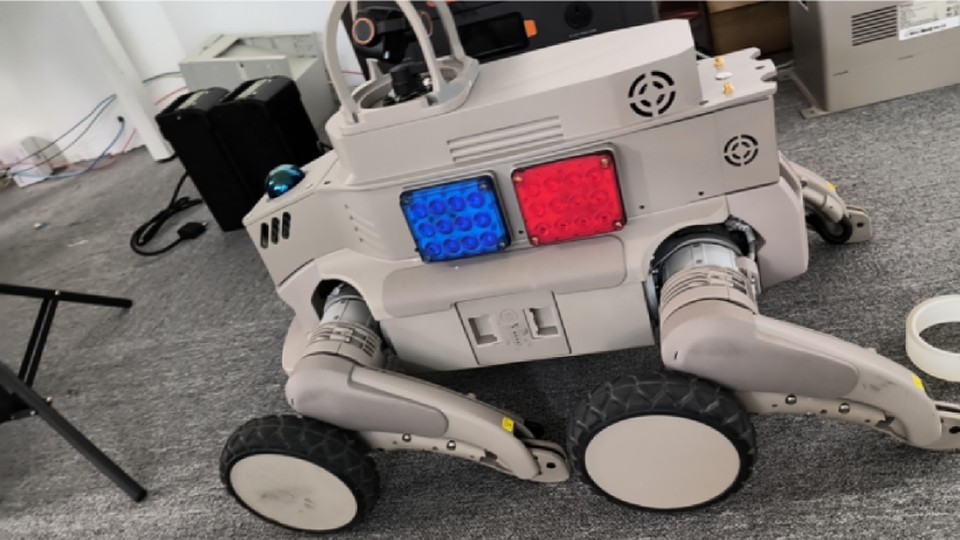
A quadruped that walks, climbs stairs and recovers from a shove is a solved product in China. What is not solved is the part that turns the walk into an inspection round: the lidar, the thermal camera, the edge computer, the speaker, the strobes and the software that stitches a route, a schedule and an alarm log together. Buyers usually assemble that themselves, or pay an integrator to do it.
Shanghai VisionAir.Tech Co., Ltd. is now selling that layer as a product. Its launch post, published on 19 October 2026, pitches a quick-release payload module — the company calls it a "brain" — plus a cloud dispatch platform, aimed at operators who already own a robot dog and at integrators who want to resell one under their own brand.
The pitch is deliberately modular: the body is somebody else's problem, the inspection stack is theirs.
What is actually in the module
The launch post's block diagram splits the module into hardware and function. On the hardware side it lists an industrial PC, a router, a lidar, a dual-light gimbal, a loudspeaker, red-and-blue strobes and a computing board; on the function side, autonomous navigation, path planning, 3D mapping, obstacle avoidance, platform remote control, video return, remote loudspeaking, status monitoring and AI algorithm hosting.
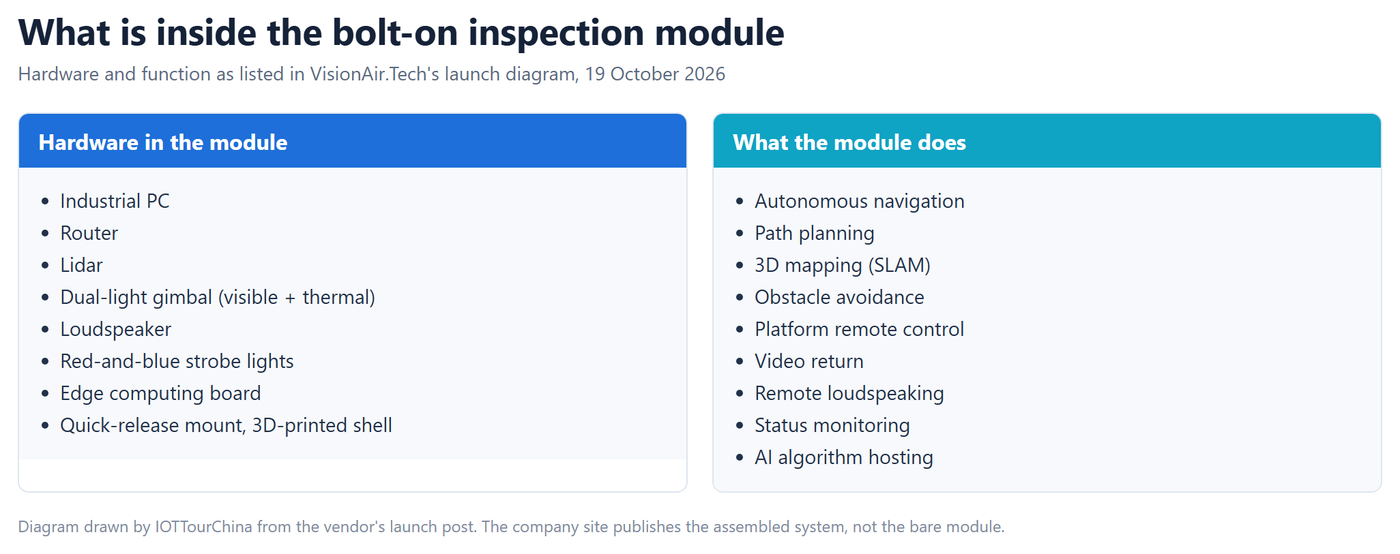
That list matches the specification the company publishes on its own site for the assembled inspection system, which is more compact and worth quoting directly:
| Area | Published specification |
|---|---|
| Imaging | Dual-light camera — visible light plus thermal imaging, for day and night monitoring |
| Compute | Deep neural network computing centre — built-in AI chip for real-time analysis and edge processing |
| Navigation | Autonomous navigation module supporting SLAM mapping and path planning, indoors and outdoors |
| Audio | Siren speaker with remote voice broadcast and two-way intercom |
| Warning | High-brightness strobe light, combined with voice for multi-mode response |
| Operating hours | 24/7 |
| Positioning accuracy | Centimetre level |
| Floor coverage | All floors |
| Control | Mobile app plus platform |
Two claims do not survive a cross-check inside the vendor's own material. The first is size. The launch post publishes a dimensioned drawing that gives the module as 40 x 19 x 22 cm, and a second drawing in the same post dimensions the same assembly at 50 cm wide and 25 cm tall. The company site publishes neither figure. The second is the operating temperature and ingress rating of the module itself: the site gives -10 to 45 degrees Celsius for the Q1 body and -15 to 50 degrees for the Y1, but no figure at all for the payload, which is the part that carries the lidar and the compute board.
Two bodies, one spec table
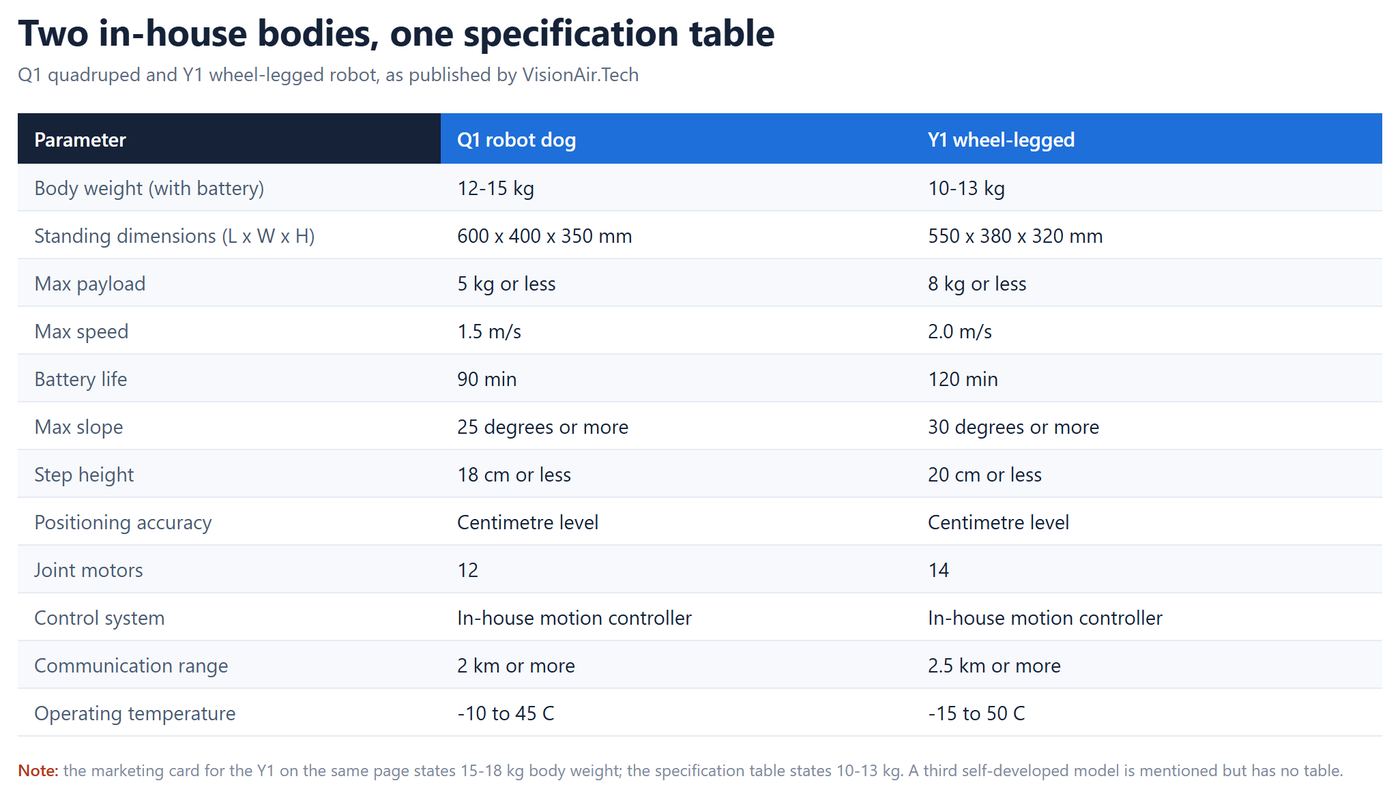
VisionAir.Tech is not only a payload vendor. The site states that three robot dog models are fully self-developed and in small-batch delivery, and publishes a spec table for two of them: the Q1 quadruped and the Y1 wheel-legged body.
| Parameter | Q1 robot dog | Y1 wheel-legged robot |
|---|---|---|
| Body weight with battery | 12-15 kg | 10-13 kg |
| Standing dimensions (L x W x H) | 600 x 400 x 350 mm | 550 x 380 x 320 mm |
| Max payload | 5 kg or less | 8 kg or less |
| Max speed | 1.5 m/s | 2.0 m/s |
| Battery life | 90 min | 120 min |
| Max slope | 25 degrees or more | 30 degrees or more |
| Step height | 18 cm or less | 20 cm or less |
| Positioning accuracy | Centimetre level | Centimetre level |
| Joint motors | 12 | 14 |
| Control system | In-house motion controller | In-house motion controller |
| Communication range | 2 km or more | 2.5 km or more |
| Operating temperature | -10 to 45 degrees Celsius | -15 to 50 degrees Celsius |
The arithmetic here is the interesting part. Two bodies with a 2 to 3 kg weight difference carry a 3 kg payload difference and a 30-minute endurance difference, which is roughly what a wheel-legged chassis buys you: the wheels carry the mass, so the same motors move more. For a payload vendor, that matters because the module is dead weight on every step the robot climbs.
The Q1 and Y1 numbers also disagree with the marketing cards above them on the same page. The card for the second body states 15-18 kg body weight; the spec table states 10-13 kg. Both are on the vendor's homepage, one screen apart, and the third self-developed model is mentioned in the copy but has no specification table at all.
The platform is the other half
A payload without a scheduler is a camera on a moving stick. The company's other product is the dispatch layer, which it calls the Air-Ground Integrated Control Platform and describes as unified dispatch for UAVs, UGVs, robot dogs and USVs, with protocol-agnostic integration and workflow-based task orchestration.
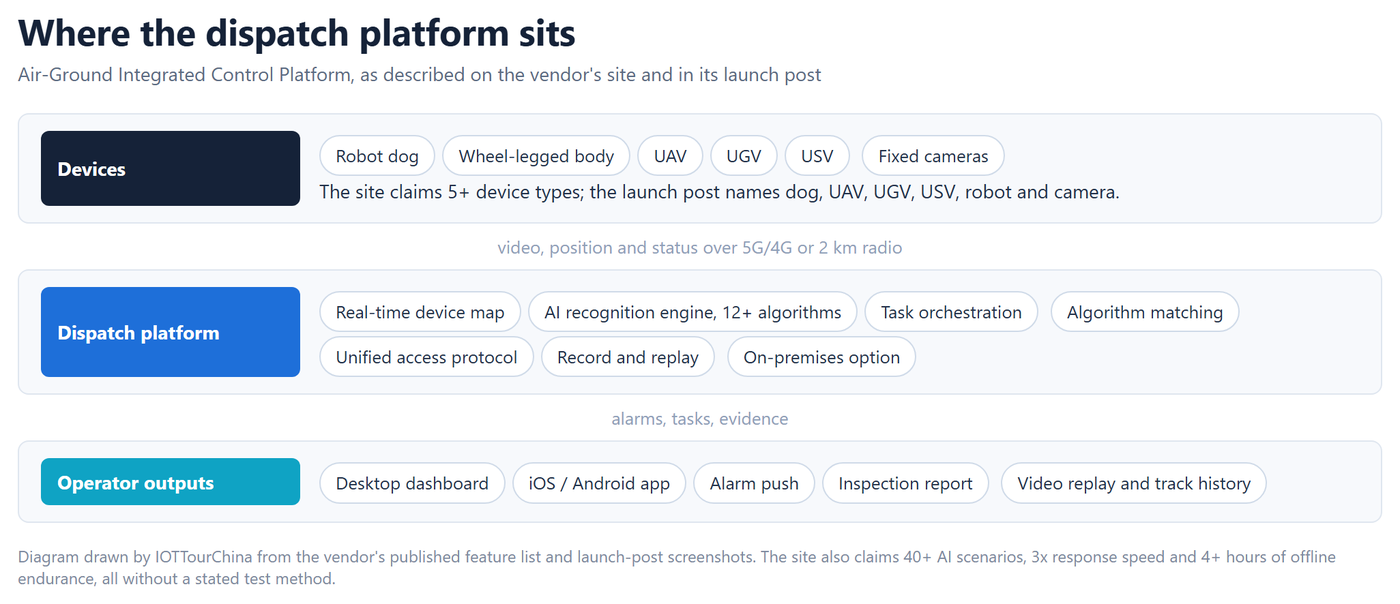
The published feature list is conventional but specific enough to be useful:
- Device management — every unmanned asset plotted in real time, on a desktop dashboard and in a mobile app.
- AI recognition engine — 12 or more built-in algorithms: illegal parking, fire and smoke, falls, construction safety, vessels, crowd density.
- Task orchestration and replay — task setup, algorithm matching, air-ground linkage, alerts, and replay of the record.
- Unified device interface — a standardised access protocol for UAVs, UGVs, robot dogs and USVs.
- Mobile control — iOS and Android, remote device view, task dispatch, alarm receipt.
The launch post's screenshots fill in the scheduling model that the feature list only hints at: a task carries a name, an associated algorithm, a description, an execution time, a validity window, and one of four execution modes — immediate, scheduled, recurring or linked. Recurring tasks carry a period (daily, weekly, monthly) and a day selection. A dispatch target is picked per task, so the same route can be pushed to a specific body rather than to the fleet.
Two more numbers are published on the site, and they need care. The homepage states 40 or more AI scenarios, 5 or more device types, a 3x response-speed gain and 4 or more hours of offline endurance. The same page also states 12 or more recognition algorithms, and the offline endurance figure appears a second time attached to the UAV edge-computing box rather than to the platform. There is no test report, no methodology and no date attached to the 3x and the 40 percent task-efficiency figures, so treat all four as vendor claims rather than measurements.
What the launch post adds that the site does not
The post is more expansive than the website, and the gap between the two is where a buyer should slow down.
Three bodies that are not in the spec table. The post shows three weight classes with a payload module fitted — a 15 kg light body with 7 to 15 kg payload, a 37 kg industrial body with 25 kg payload, and a 60 kg heavy body with 40 kg payload, all returning video over 5G or 4G. None of these three appears in the Q1 and Y1 table, and none is named as a model. They are presented as the bodies the payload is fitted to, which suggests a mix of in-house and partner hardware.
Compatibility shown as a photograph, not a list. The post states that the payload has been adapted to "mainstream" robot dog brands, illustrated with a photo of four bodies captioned with three Chinese vendors — Unitree, DEEP Robotics and AgiBot. No compatibility matrix, firmware version or mechanical interface drawing is published for any of them.
Commercial terms. The post offers 3D-printed shells in custom colours and strobe configurations, white-label/OEM supply under the buyer's brand, and on-premises deployment of the platform so that data stays inside the site network. It also promises standard kits "from stock" with customisation limited to the parts that need changing. None of this appears on the company site, and no price is published anywhere: the post closes by asking readers to request a quote and a demo video.
What can and cannot be verified
The company describes itself as a Ministry of Public Security certified enterprise — the English page renders it as "Ministry of Public Security Certified" — and lists academic partners including Shanghai Jiao Tong University, Chongqing University, the National University of Defense Technology, UESTC, Dalian University of Technology, Changsha University of Science and Technology, Shanghai Maritime University and Southwest University, plus strategic partners including State Grid, China Unicom, China Tower, DJI and two municipal bodies. No certificate number, certificate scope or partner agreement is published, so all of it should be read as company statement.
What is absent is as telling as what is present. There is no API reference, no SDK, no protocol document and no developer portal for the "open interface" the post advertises. The entire public web presence is a single scrolling page with an embedded English translation and an APK download link; there is no sitemap, no news section and no documentation centre. For a product whose selling point is an open payload interface, that is the first question to put to the vendor: what exactly is open, at which layer, and under what licence.
Why a payload-only product makes sense now
China's quadruped supply chain has separated into layers over the past two years. Bodies are sold by a handful of volume manufacturers; inspection software, algorithms and vertical integration are sold by everyone else. The layer in between — a certified, quick-release payload that turns any of those bodies into an inspection asset — has mostly been custom work priced per project.
Selling it as a catalogue item changes the economics on both sides. An integrator no longer needs a SLAM team to bid on a patrol project, and a body vendor no longer needs to build a thermal pipeline to win a security tender. The catch is that the payload becomes the integration surface: the mechanical quick release, the power budget, the network path and the vendor's own API all have to line up with a body the payload vendor did not design. VisionAir.Tech controls two of those four because it builds the Q1 and Y1; on third-party bodies, it is adapting.
Practical notes
- No price, no datasheet, no compatibility list. Everything specific about the payload — dimensions, weight, power draw, IP rating, mounting pattern — is either absent or contradicted between the launch post and the site. Ask for a drawing pack before a site visit.
- The 40 or more AI scenarios and the 12 or more algorithms are both published on the same page. They are probably "scenario templates" versus "shipped models", but the vendor does not say so.
- The offline figure is attached to two different products. The 4-hour endurance appears both in the platform's core advantages and in the UAV edge box specification. Clarify which component keeps working when the network drops.
- Payload weight matters more than body weight. On a 5 kg payload budget, the module, the gimbal and the compute board compete for the same kilograms. Get the module weight in writing against the Q1 and Y1 limits.
- The 5G/4G path in the launch post is not in the site specification. The three weight-class bodies return video over cellular; the Q1 and Y1 table lists a 2 km radio range and says nothing about a cellular module.
- White-label and on-premises deployment are launch-post claims. If either is a requirement, ask for the deployment topology and the licence terms in writing, not the marketing copy.
IOTTourChina covers hardware and integration stories from the China-made IoT ecosystem as part of its developer resource. This is editorial coverage, not an endorsement or an advertisement; specifications, availability and pricing should be confirmed with the vendor before purchase.