AGV wheels vs epoxy floors: the contact-pressure maths behind a cracked factory floor
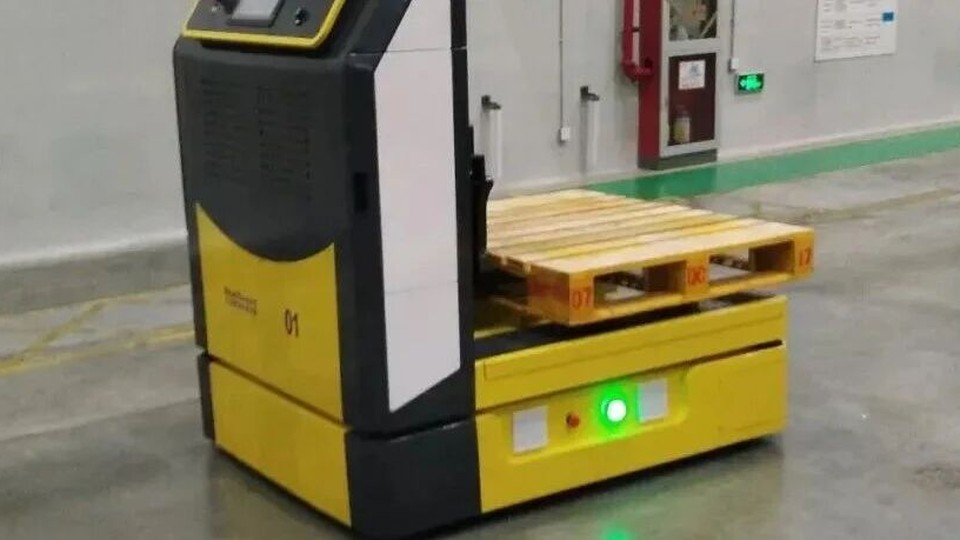
A latent-lift AGV is sold as the flexible layer of a modern warehouse: no rails, no fixed conveyors, just a fleet of low-profile robots sliding under pallets and running an aisle at a time. What the sales deck rarely covers is what those robots do to the floor they run on.
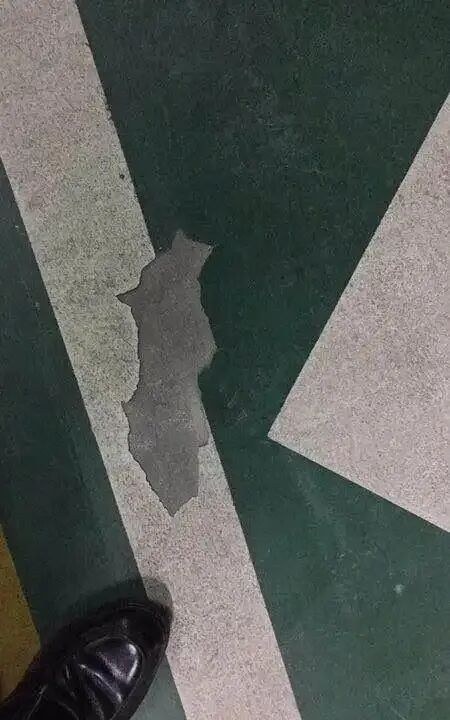
The damage is unmistakable on site. Along the main aisle there are dark lines running dead straight that open into concentric arcs at every junction and turn. They are not rubber scuff. The coating is worn through and, in places, grooved several millimetres deep. In the worst spots the epoxy has broken into thumbnail-sized flakes with lifted edges, exposing grey concrete underneath.
The explanation is not that AGVs are heavy in absolute terms. A 5-tonne forklift is far heavier, and the same floor survived it for years. The difference is contact pressure, and how it is applied.
Point load: why a small hard wheel beats a big soft tyre
A counterbalance forklift rides on pneumatic rubber tyres over 500 mm across. Under load the rubber flattens, the contact patch spreads, and the transient pressure at the ground stays around 0.5-0.8 MPa.
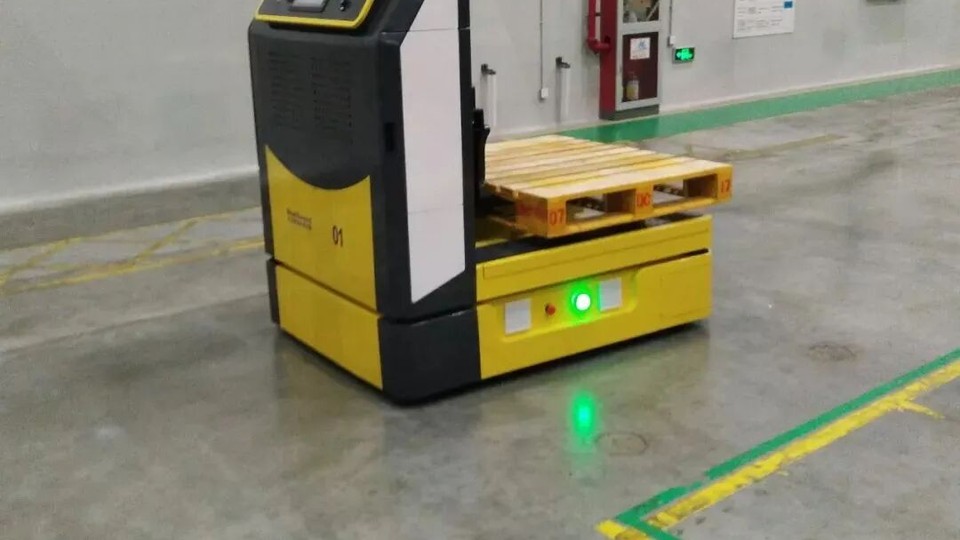
A latent-lift AGV has to slide under low racks, so its wheels must be small: typically 150-200 mm across and only 50-80 mm wide. To hold positioning accuracy and keep the wheel from sinking into the coating, the material is a hard polyurethane at roughly Shore 95A. A hard wheel barely deforms.
The arithmetic then follows. An 800 kg AGV lifting a 1,200 kg pallet is a 2-tonne vehicle, and on a two-drive, two-caster chassis a single drive wheel can carry 700-800 kg. That load passes through a microscopic patch of one or two square centimetres. Measured transient pressure reaches 3.5-5.5 MPa.
An ordinary 2-3 mm epoxy self-levelling floor has a long-term compressive fatigue limit of only 2.5-4.0 MPa. The number on the AGV side is larger than the number on the floor side, and it is applied thousands of times a day. The fleet is not a set of small carts. It is a row of miniature static rollers, crushing the coating's polymer chains past their limit on every pass.
Pivot steering: a torsion cutter pressed against the floor
If vertical load is already at the edge of what the floor can take, the way AGVs turn pushes it further.
The sales line is that dual-wheel differential drive gives a 360° turn in place with a zero turning radius, saving aisle width. Mechanically that is the opposite of how a vehicle normally turns. A conventional vehicle rolls, and its contact patch is instantaneously at rest against the ground. A differential AGV pivoting in place drives one wheel forward and the other backward, with the rotation centre locked at the axle. Wheel surface and floor are forced into relative slip under high torsional load: not rolling, but twisting.
Dry friction between polyurethane and a smooth coating is 0.6-0.8. Under several hundred kilograms of vertical load, two hard wheels twisting in opposite directions convert that downward compression into a large horizontal shear. The tensile bond between a standard epoxy and the concrete beneath it is only 1.5-2.0 MPa, while the peak shear of an in-place hard turn routinely exceeds 2.0 MPa. Picture a flat steel scraper twisted against the film. A few fatigue cycles are enough to lift the brittle epoxy layer off the concrete.
Fixed tracks: a millimetre-wide hammer, hundreds of thousands of times
A forklift's path is random. One driver drifts 10 cm left, the next 10 cm right, so a 3-metre aisle shares the load across its full width and the floor recovers between passes.
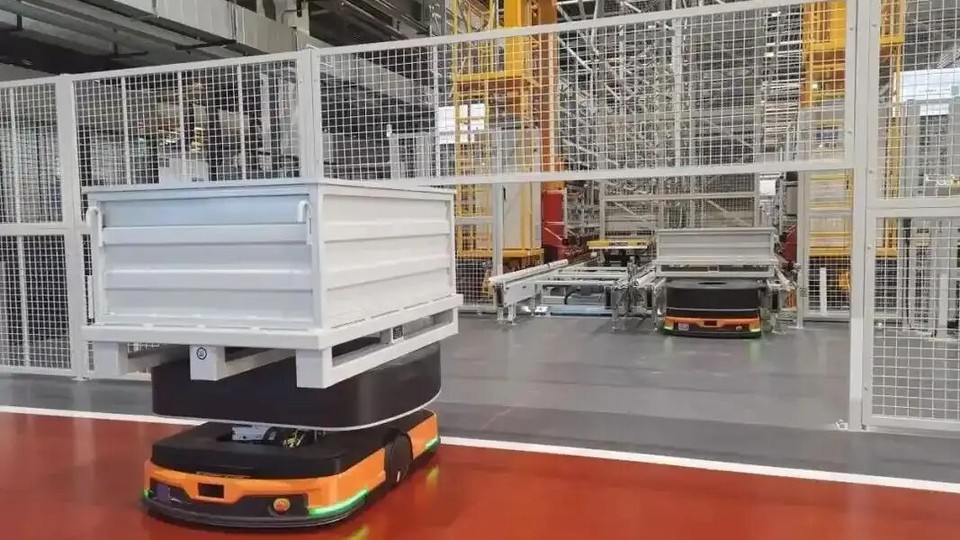
An AGV does the opposite. Whether it navigates by QR code or laser SLAM, the control objective is to hold the centreline, with repeat positioning accuracy of ±5 mm to ±10 mm. Across 365 days and thousands of trips a day, that is hundreds of thousands of multi-tonne impacts landing on a track only 50-60 mm wide, with no lateral spread at all.
Epoxy is rigid, brittle and poor in fatigue. Under that many concentrated cycles the failure runs in order: a whitening blush, then a network of cracks, then flaking, and finally the concrete beneath crumbling to powder as two deep ruts are rolled into the aisle.
A bad floor breaks the automation, not just the floor
Cosmetic damage is the least of it. A failing floor feeds back into the automation stack:
- Dust blinds the sensors. Once the coating is gone, the concrete dusts. Fine particles settle on the obstacle-avoidance LiDAR and the code-scanning cameras at the base of each vehicle, cutting their reflectivity until the AGV treats a film of dust as an obstacle and stops for no visible reason.
- Slip destroys positioning. Flaked coating scatters like ball bearings. A wheel that rolls over chips slips momentarily, the encoder counts wrong, and the vehicle weaves from side to side until it declares its path lost and stops, blocking the whole aisle.
- Pits wreck the drivetrain. A 3-5 mm crater is a deep pothole to a small hard wheel. The impact debonds and chunks the polyurethane, and the resulting high-frequency vibration is passed straight into the gearbox, which is how motors reach end of life years early.
Settling the account at design time
When a floor fails, the flooring contractor blames the equipment vendor for overloading it, the integrator blames the concrete slab, and the operator lives with production stops while it is repaired. The only place to break that loop is pre-sales planning, while the load case is still open.
1. Drop brittle epoxy and pick the subfloor to match the load.
- General manufacturing and heavy automotive zones: a non-metallic or metallic emery dry-shake wear-resistant floor, monolithic with the concrete and finished with a lithium-silicate densifier. The aggregate is cast into the slab, so there is no film to delaminate, it polishes rather than wears, and it costs 20-30% less than self-levelling.
- Pharma and battery-cell clean zones: a 4-6 mm water-based polyurethane mortar. Its micro-elastic network gives roughly four times the shear-tear resistance of ordinary epoxy and absorbs the torque of differential pivot steering instead of cracking under it.
2. For existing plants, groove and inlay the traffic route. Ripping out a whole floor is not realistic. The practical fix is to cut a 5-8 mm deep, 150 mm wide channel along both sides of the AGV trunk route, prime it, and press in a high-strength polymer mortar or polyurethane repair compound finished flush with the surrounding epoxy. Local mechanical interlock protects the part of the floor that actually carries the fleet.
3. Scatter the tracks in software. In the fleet manager's route model, add a random Gaussian lateral drift of ±30 mm to ±50 mm along trunk paths so vehicles wander slightly within a band instead of following one line. A few millimetres of knife-edge contact becomes a few tens of centimetres of gentler loading, and fatigue life stretches out several-fold. Turning logic should be tightened at the same time: a fully loaded vehicle should never spin in place at a fixed point, but take a curved, gradual transition instead.
What it means for an automation project
Warehouse automation is not a box of parts, where you buy some carts, lay some network and connect. It is a system in which civil materials, wheel-contact mechanics and dispatch software are mechanically coupled, and the floor is the member that carries all three. The dark lines in the aisle are the visible output of a load case that was never written down. For anyone specifying a fleet, the cheapest place to fix it is the first day of planning, in the specification of the slab.
Deployment detail of this kind sits alongside the rest of our industrial coverage:
- Modbus data acquisition on the factory floor
- Edge gateways that host the fleet's own building blocks
- Open-source HMI and SCADA layer that an operator actually watches.