TE100: a fanless Rockchip edge box that ships with a full IoT platform — and an on-device AI agent
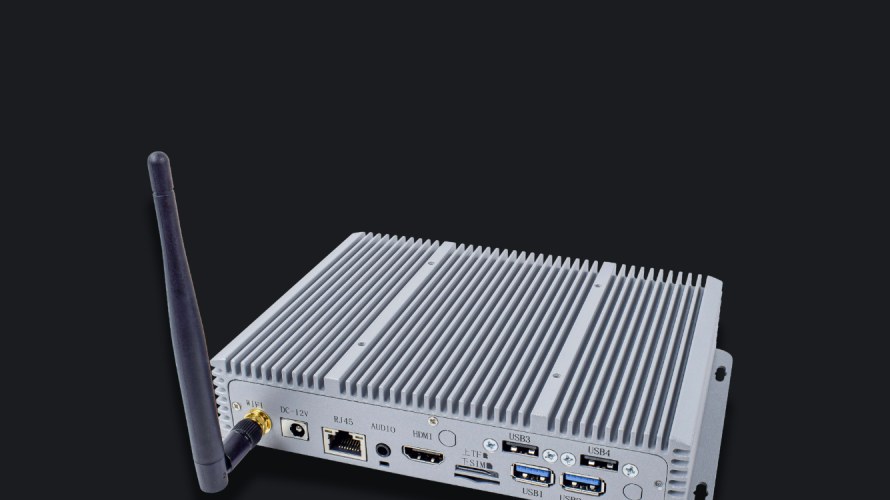
A factory floor rarely fails for lack of data. It fails because the data is scattered across five boxes that do not speak to one another: a protocol gateway that turns Modbus into MQTT, a small industrial PC that runs the database, a laptop somewhere holding the HMI project, a screen on the wall showing a dashboard, and a separate appliance providing remote access. Each part looks cheap on its own and expensive together — five firmwares to patch, five devices to explain to the electrician, five places for a fault to hide.
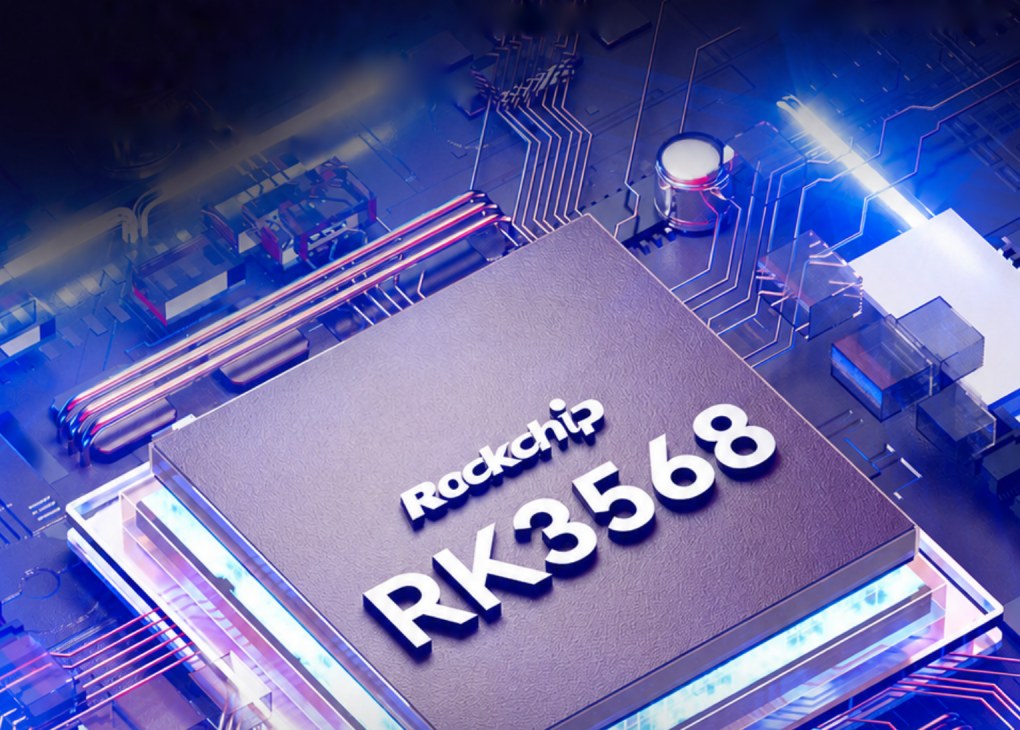
Chinese edge hardware has spent the last few years quietly collapsing that stack into a single fanless chassis, and the TE100 is the most recent example to cross our desk. It is an edge computing gateway from the vendor behind the ThingsKit platform, and its pitch is unusually concrete: a Rockchip RK3568 running Ubuntu 20.04, with an entire IoT platform already installed, and — on the optional agent edition — a natural-language assistant that configures the box by conversation.
What it is
In one sentence: the TE100 is a DIN-rail industrial gateway that arrives with the software layer most projects end up assembling by hand. The hardware is a mid-range, fanless ARM box; the interesting half of the product is what is already running on it.
The vendor's own summary is that the device combines protocol conversion, device management, a rule engine, local alarms, data storage and visualisation, and store-and-forward buffering for network outages. The control loop does not have to reach the cloud to be useful: an alarm can fire, a relay can close and a screen can update entirely on the box, which is what makes a device like this worth having on a plant network at all.
The hardware
The specification is solidly mid-range industrial rather than exotic, which is the right target for a gateway that sits between legacy machines and a network.
| Item | TE100 |
|---|---|
| SoC | Rockchip RK3568, 4 × Cortex-A55 @ 2.0 GHz |
| GPU / NPU | ARM G52 2EE / 1 TOPS |
| Memory | 4 GB RAM |
| Storage | 32 GB eMMC |
| OS | Ubuntu 20.04 |
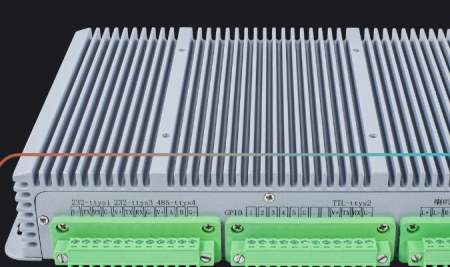
| Serial | 1 × RS-485, 2 × RS-232 |
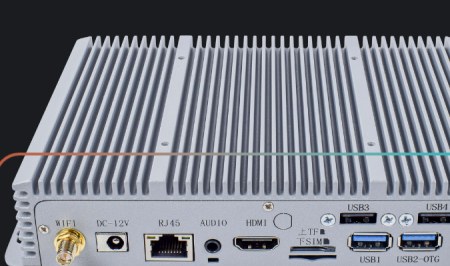
| Display | 1 × HDMI |
| USB | 2 × USB 3.0, 2 × USB 2.0 |
| Network | 100 M WAN; Wi-Fi + Bluetooth; 4G optional |
| Audio | 8 Ω 10 W speaker pair, mic input / line out |
| Other | RTC, expansion IO |
| Power | 12 V DC, 3 A |
| Operating range | −20 °C to +70 °C |
| Dimensions | 184 × 120 × 35 mm |
Two details are worth singling out. The first is the 1 TOPS NPU sitting inside the RK3568 — modest by AI-accelerator standards, but enough to run lightweight vision or anomaly-detection models at the edge without sending a video stream to the cloud. The second is the pair of isolated RS-485 and RS-232 ports with screw terminals, because a very large share of the machines this class of product is bought to connect have no Ethernet port at all.
The protocol list
This is where a gateway lives or dies, and the TE100's coverage is broad enough for mixed-vendor plants.
| Layer | Protocols |
|---|---|
| IoT / cloud | MQTT, HTTP, TCP, UDP |
| Industrial | Modbus RTU and Modbus TCP, OPC-UA, BACnet/IP, IEC 104 |
| Utility / environmental | DL/T 645, HJ 212 |
| Vendor PLCs | Siemens, Mitsubishi, Omron, Rockwell, Schneider, Panasonic, and proprietary dialects |
For plant integrators the vendor-specific column matters more than the standards list. Real workshops are full of machines from a handful of PLC brands, several generations old, some without a standard network interface — and a gateway that cannot parse those dialects is an expensive paperweight. The vendor's own documentation makes the sensible argument that the box is not a DTU or RTU replacement but a higher tier: because it connects over Ethernet and its hardware is far above a classic serial bridge, the practical device and tag ceiling is an order of magnitude higher.
Node-RED as the soft gateway
Underneath the dashboards, the device ships with Node-RED, the flow-based programming tool that has become the de-facto glue in industrial IoT. The vendor uses it in three roles at once: as a protocol converter, as a database bridge, and as the place where custom business logic lives.
That choice is more significant than the marketing bullet points suggest. Node-RED has thousands of community-contributed nodes, so the long tail of "our PLC speaks something unusual" problems is often already solved by someone else's flow, and a systems integrator who has used Node-RED before can be productive on this box on the first day. It also means data can be forwarded onward to almost any third-party platform — the vendor's cloud is the default destination, not a mandatory one.
Data is persisted locally and buffers during outages, then replays to the cloud when the link returns. For a remote pumping station or a machine on a flaky mobile connection, store-and-forward is not a nice-to-have; without it, half the telemetry simply never arrives.
The agent edition: configuring a gateway by talking
The feature that makes this product newsworthy is the optional agent edition. Beyond the platform, it adds ThingsKit Claw, a natural-language assistant that runs on the gateway itself.
The intended workflow is straightforward. An engineer describes what they want — connect this Modbus controller and raise an alarm if the temperature exceeds a threshold — and the agent produces the device template, the collection points and the alarm rule, then pushes them to the local runtime. The same mechanism generates dashboard widgets and can run maintenance analysis over stored data. Model inference is split between a cloud large language model and a local model, with the design goal that basic tasks keep working when the site loses its uplink.
It is worth being precise about what this is and is not. It is not an autonomous control system, and the vendor's own material frames it as a configuration and operations assistant — a way to skip the repetitive screen-filling work of onboarding a hundred tags. Channels for WeCom, DingTalk, QQ and Feishu are available for notifications and queries. If you have spent an afternoon mapping registers in a web form, the appeal is obvious.
Editions, pricing and the honest caveats
The product comes in two editions: a standard version with the platform, Node-RED and dashboards, and the agent edition that adds ThingsKit Claw. Critically, the agent features are exclusive to the agent edition — if natural-language configuration is why you are interested, the standard box will not do it.
Three caveats belong in any fair review. First, this is a commercial, closed product: unlike the open-source firmware projects we usually cover, nothing here can be inspected, forked or self-maintained, so the vendor relationship matters. Second, pricing is quoted on request rather than published, which makes it hard to reason about value before contacting sales. Third, the agent depends on an external large language model for the harder tasks, so the quality of the experience is partly a function of a service you do not control.
How it compares
| Approach | Cost | Strengths | Trade-offs |
|---|---|---|---|
| TE100 (agent edition) | Quoted by vendor | Platform, protocol stack, Node-RED and an agent in one box; edge alarms and store-and-forward built in | Closed product; agent features edition-gated; pricing opaque |
| Open box + ThingsBoard / Node-RED | Cheap hardware, free software | Full control; nothing locked in; you choose every component | You build and maintain the image, the updates and the recovery plan |
| Classic protocol gateway (DTU / RTU) | Low | Simple, rugged, well understood | No local database, dashboards or rule engine; low device ceiling |
| Cloud-only platform | Subscription | Nothing to install on site | Unusable when the link drops; recurring cost per device |
If your requirement is a managed, alarm-capable edge node in a mixed-protocol plant and you would rather buy the software layer than build it, a box like the TE100 is a reasonable answer, and the RK3568 gives it real headroom beyond pure protocol conversion. If you need code you can audit and patch yourself, or you are allergic to sales-quoted pricing, an equivalent single-board industrial PC running Node-RED plus an open platform will get you most of the way there — with more work and more control.
Practical notes
- The agent features require the agent edition; confirm the SKU before ordering if that is the deciding factor.
- Check that your specific PLC dialect is on the supported list, and ask for a written confirmation rather than assuming the brand name is enough.
- Store-and-forward and edge alarms live on the device — verify how much local storage is reserved for buffering and what happens when it fills.
- Industrial cabinets are electrically noisy; confirm the isolation rating on the RS-485 and RS-232 ports against your installation.
- The 100 M WAN port is adequate for telemetry but is not a gigabit link; plan camera or high-volume traffic accordingly.
- Anything that leaves the site — to a vendor cloud or to an external model provider — deserves a data-protection review before it is switched on.
IOTTourChina covers open-source IoT projects and China-made devices as part of its developer resource. This is editorial coverage, not an endorsement or an advertisement; specifications, editions and pricing should be confirmed with the vendor.