A 60 GHz 1T2R AiP module measures breathing and heart rate at 30 cm, on a dual-channel phase chain
Vital-sign radar has an odd cost structure. The algorithm work is public and well documented — TI's lab guide, the academic literature on phase-based displacement, several open repositories. What changes a design's economics is the front end, and the front end is where suppliers differ most.
This build starts from that observation. Instead of Infineon's BGT60TR13C, a 60 GHz antenna-in-package part with one transmit and three receive channels, it uses an Airtouching 60 GHz 1T2R AiP module: one transmit, two receive, antennas inside the package. The author's stated reason is price. The engineering consequence is that two phase observations, not three, have to carry the fusion.
The acquisition chain
Frames arrive on a fixed 50 ms period, which is 20 Hz. Each frame gets a 256-point range FFT, and the host keeps complex IQ — both I and Q — for 128 range bins on each of the two receive channels. Nothing is discarded at the chip boundary; the chip does the range transform, and the host does phase, frequency estimation, display and recording.
Keeping complex IQ matters because every later step is a phase question. The receiver also checks frame sequence numbers and timestamps, and drops interrupted or repeated frames before they enter the slow-time series. A gap of a few frames is not a small error here: it corrupts the phase continuity that everything downstream depends on.
The default range gate is 0.2 to 2 metres, adjustable. The processing keeps two branches off the same FFT: one with background subtraction for the range-time spectrogram that shows where the target is and whether it is moving, and one with raw complex IQ for the vital-sign phase.
Choosing a range bin, and then leaving it alone
A human body returns energy across several adjacent range bins, and the instantaneous maximum wanders between them frame to frame. Following the strongest bin looks correct and is wrong: the phase reference jumps with it, and the displacement waveform acquires discontinuities that no filter can remove afterwards.
The build fixes the phase bin from several seconds of observation, weighing return strength across both receive channels and ignoring short excursions. The bin is re-confirmed when the target actually moves. This is the least glamorous part of the pipeline and the one that decides whether the output is usable.
Phase to displacement
Within the chosen bin, each channel's phase is reconstructed from the complex IQ along slow time. The implementation takes the conjugate product of adjacent frames, extracts its angle as a phase increment, and accumulates. Under the assumption that the dominant scatterer is stable and the phase can be tracked continuously, the accumulated phase converts to radial micro-displacement.
The arithmetic that makes this work at 60 GHz: wavelength is about 5 mm, so 0.1 mm of radial movement produces roughly 0.25 rad of phase. Chest wall motion during breathing and the smaller surface motion accompanying each heartbeat both sit well inside what the phase can resolve — provided the phase stays continuous.
Isolated phase glitches are suppressed, and the two channels are fused by quality: return amplitude, direction and consistency of phase change set the weight, with a stable weighting so the waveform does not jump as the better channel alternates. A quality ordering that flips every few frames produces exactly the artifact it is meant to prevent.
Breathing: the easy branch
Respiration gets a band-pass at 0.10 to 0.50 Hz, corresponding to 6 to 30 breaths per minute. The filter is stateful and each new sample enters it once, so scrolling the display does not re-filter history and change numbers that were already shown.
Rate estimation uses two independent readings — the dominant spectral peak and the interval between time-domain peaks — and fuses them when they agree. The respiration spectrum of neighbouring range bins is a cross-check: if the bin's own spectrum disagrees with its neighbours, the bin choice is suspect.
Heart rate: where the design effort goes
Heart rate uses 0.80 to 2.00 Hz, and that band is not clean. Breathing harmonics land inside it. At 17 breaths per minute, the third harmonic falls near 51 per minute and the fourth near 68 — both squarely in the heart-rate search range. When a harmonic is momentarily stronger than the cardiac component, picking the highest spectral peak reports a plausible-looking wrong number, which is worse than reporting nothing.
The build therefore keeps multiple spectral candidates rather than one, and compares them across both receive channels, across adjacent range bins near the target, and by cross-channel coherence. A separate respiration reference branch estimates the fundamental and the harmonic positions, and candidates with obvious harmonic ambiguity are not allowed to start or pull a heart-rate track.
Frequency alone cannot always settle the question, because a real heart rate can coincide with a breathing harmonic. In that case the answer has to come from other channels and later windows, not from the peak position.
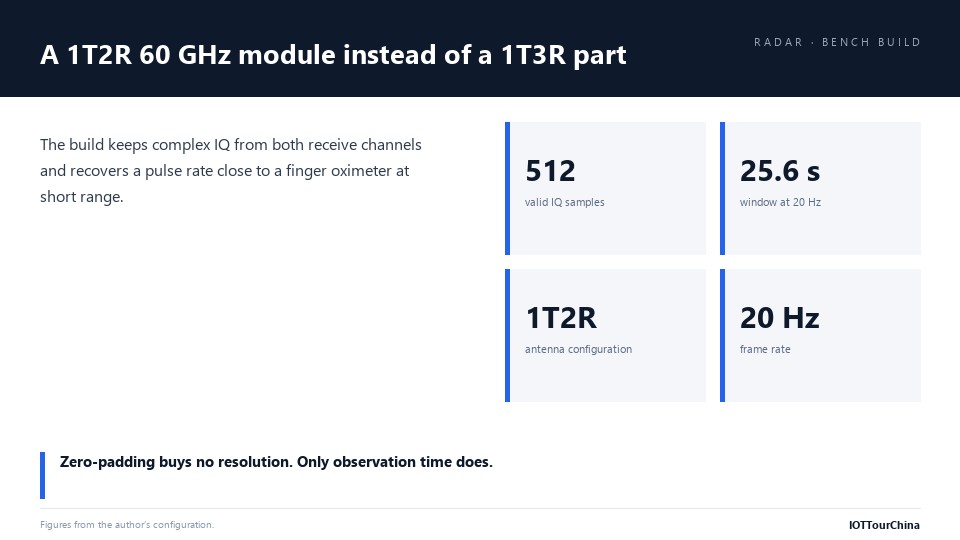
The IQ window holds 512 valid samples, about 25.6 seconds at 20 Hz. Peak interpolation refines the peak position; zero-padding the FFT does not add observation time and does not buy resolution that is not there.
The decision layer updates every 0.5 seconds and maintains up to 60 seconds of candidate history. Each update takes a bounded weighted median over candidates, then applies mild recursive smoothing. A single very strong peak does not override the history, and a transient competing peak does not move the displayed value. Initialisation requires a minimum observation length, a minimum candidate count and internal agreement. A persistent, high-quality, signal-supported new frequency can re-establish the track; small real changes arrive with a little smoothing delay, which is the intended trade.
Motion is a state, not an outlier
Gross body movement produces phase excursions far beyond breathing and heartbeat. Rather than filtering them out, a state machine handles them: on detecting significant motion, vital-sign updates pause and cached results are retained. When the target comes to rest, a new phase anchor is established from the current complex IQ, and accumulation restarts. Computing a phase difference across a motion gap would produce a number with no meaning.
The host displays four states — waiting for target, waiting for stillness, paused for motion, and measuring. The reference oximeter keeps refreshing throughout, so the comparison data does not stop when the radar does.
What the build demonstrates, and what it does not
The author reports stable respiration and a heart rate that narrowed noticeably once candidate screening and cross-window statistics were added, with radar and oximeter values displayed side by side and the difference plotted on the same screen. Distance-time spectrogram, chest displacement, respiration waveform, cardiac waveform and spectra are all retained for inspection, which is what makes the numbers checkable rather than merely displayed.
Three limits are worth stating plainly. The working range in this configuration is quoted at 30 cm, which is a proximity application, not room monitoring. There is no accuracy figure against a clinical reference across a population — one bench comparison against a finger oximeter is a sanity check, not validation. And the source is a public technical post with code available on request, not a dataset and not a reproducible benchmark.
For an integrator, the useful takeaways are structural rather than numerical: a two-channel AiP part is adequate if the phase bin is held stable; harmonic rejection deserves its own reference branch; and motion must be modelled as a state with an explicit re-anchor, not as noise to be averaged away.
This article is part of the mmWave Radar channel.