Seeed's MR60BHA2 sells breathing detection for USD 25 — the algorithm inside is the part you cannot open
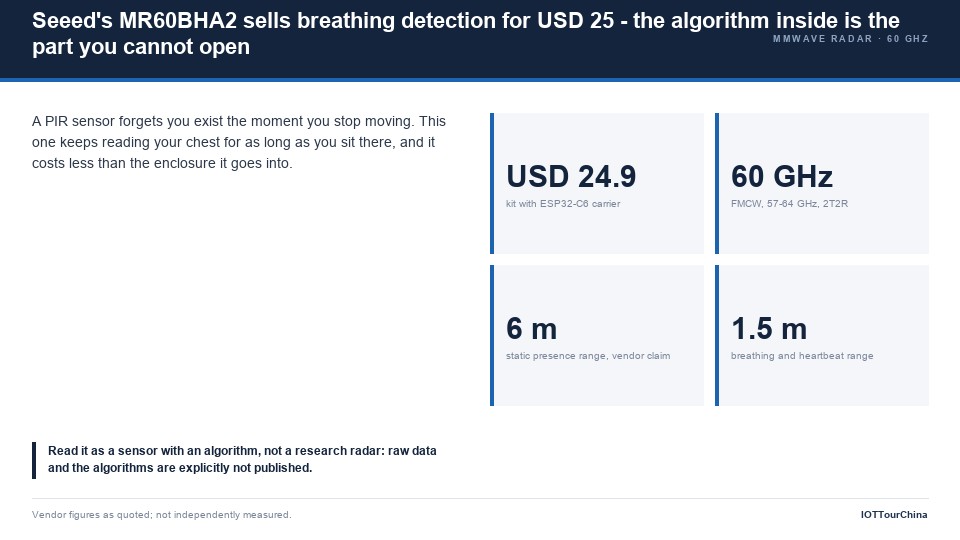
A passive infrared sensor answers one question: did something warm move across its field of view. Sit still in a chair for twenty minutes and the answer becomes no. That is why PIR-controlled lights switch off on people who are reading, and why every "occupancy" automation built on PIR eventually gets a mmWave sensor bolted next to it.
Seeed Studio's MR60BHA2 is one of the cheapest ways to make that upgrade. It is a 60 GHz FMCW radar module that outputs presence, breathing rate and heartbeat rate as finished numbers over a serial port, and it ships on a carrier board with an ESP32-C6, a light sensor and a RGB LED. The vendor lists it at USD 24.9 for the kit. The bare module is smaller than a business card.
The numbers Seeed publishes are 6 m for static human presence and 1.5 m for breathing and heartbeat detection, with a 120 × 100° detection angle and 2T2R antennas. Those are vendor figures measured in an empty room; we have not reproduced them. The 6 m and 1.5 m distinction matters more than it looks: the radar can tell that a body is in the room from far away, but it needs the chest cavity well inside the beam to see the millimetre-scale displacement that breathing produces.
What is actually on the board
The module integrates a 57–64 GHz RF transceiver, a 2T2R PCB microstrip antenna array, a radar signal processing unit and an ARM Cortex-M3 core. The source article gives the bare module as roughly 25 × 31.5 mm at 3.3 V; the kit as sold runs from USB-C at 5 V / 1 A and draws about 0.5 W idle, 0.8 W when active and 1.4 W with a Grove relay attached.
Two interface groups are worth memorising, because everything else on the module is either power or debug:
- UART0 (RX0/TX0) — the main data path. Radar results come out here as framed packets.
- I2C (SDA/SCL) — a second control/configuration bus.
- TX2 — usable as GPIO or UART2 TX, generally for a control output.
- RST and SWDIO/SWCLK — reset, and SWD debug on the internal MCU.
If you are designing a custom carrier, that list is the whole integration surface: 3.3 V, ground, UART0, reset, and optionally SWD. Everything else — the light sensor, the LED, the Grove connector, the USB-C front end — belongs to the evaluation board, not to the sensor.
The kit, and why it is the right place to start
Seeed built the carrier around a XIAO ESP32C6, added a BH1750 ambient light sensor (1–65,535 lux, extendable to 100,000), a WS2812 RGB LED and one Grove GPIO port. The radar talks to the ESP32 over UART, so from firmware's point of view the whole assembly is a serial device that emits presence, breath and heart rate values.
Firmware ships pre-flashed as ESPHome, which means the first useful result — a Home Assistant entity that says whether someone is in the room — arrives in minutes rather than in a compiler session. Arduino library support exists for the same reason, with the radar library and example sketches published on GitHub.
The schematic is public: Seeed publishes the mmWave Sensor SCH V1.0, which shows the USB-C input, the power tree, the XIAO socket, the radar connector, the BH1750, the RGB LED, the Grove port and the test points. For a product team this is enough to lift the reference design into a custom board without reverse-engineering anything.
What is not public is the interesting part. Seeed states plainly that the raw data and algorithms inside the mmWave radar are not open source. You get the results, not the signal. That is the correct way to read this product: it is a sensor with an algorithm attached, not a research radar you can retrain.
Where it earns its place
The obvious use is presence detection that does not fail on stillness — a study, a bathroom, a meeting room where the lights should stay on while someone sits at a desk and should not stay on for an empty room. Because the radar responds to chest movement rather than to gross motion, the false-off problem that plagues PIR largely disappears, at the cost of a sensor that needs a clear line of sight and does not see through the body.
The second use is the bedside. Pointed at the chest from about a metre — Seeed suggests either side-mounting at chest height or mounting 1 m above the head of the bed and tilting down 45° — the module reports presence and breathing-related micro-motion without a camera and without anything worn on the wrist. That combination is why sleep and elder-care monitoring keeps landing on 60 GHz radar: it is the only sensing modality that gets respiratory information with no image and no contact.
The third use is fusion, and it is the one most projects underrate. A single radar answers "is a body present". Radar plus illuminance plus a door contact plus temperature answers "is the room occupied but idle", "did someone get out of bed at night", "how long has this room been empty before we cut the HVAC". The MR60BHA2 is a reasonable source for the first of those, and its light sensor gives you the second input for free.
Buying notes
Two model numbers get confused. MR60BHA2 is the breathing and heartbeat variant discussed here. MR60FDA2 is the fall-detection variant, same carrier, different firmware and different output set. Searching for "60 GHz presence radar" will surface both, plus 24 GHz parts, so buy by model number.
Within MR60BHA2 there are also two products: the bare module and the kit with the ESP32-C6 carrier, case and USB-C. The kit is the correct purchase unless you are laying out your own board, because the carrier is what makes the module usable on day one.
One expectation to set before ordering: this is a single-person sensor. Seeed specifies breathing and heartbeat detection for one stationary person, and the wiki warns against multiple radars mounted close together, moving curtains, water surfaces, large metal or mirror reflections, glass and thin wooden boards in the detection path, vibration-prone mounting and low-quality power supplies. A fan, a swinging curtain or a badly filtered 5 V rail will produce exactly the kind of slow periodic signal the breathing estimator is looking for.
For a device team the interesting question is not whether this module works — Seeed has shipped it for long enough that the ESPHome path is well trodden — but whether the closed algorithm is acceptable. If the product needs a respiratory rate trace you can calibrate and defend, the module's output is a black box. If it needs presence and a coarse breathing signal at a USD 25 bill of materials, it is close to the cheapest credible option on the market.
This article is part of the mmWave Radar channel.