A 60 GHz radar reads wrist pulse at 10 cm, and the hard part turns out to be presence gating
Chest vital-sign radar and wrist pulse radar look like the same problem at two distances. They are not, and this experiment is useful mainly because it shows where the analogy breaks.
The setup is deliberately constrained: forearm resting on a table, radar mounted above the wrist at under 10 cm, torso kept away from the antenna so that chest and shoulder movement cannot couple in. Against that, the author runs a dual-receive 60 GHz AiP front end and records a finger oximeter in parallel.
The result is modest and credible. Periodic components close to the reference pulse rate appear in the recorded echoes, and after offline processing some intervals hold a rate near the reference value. The reported failure mode is more instructive than the success: the arm is plainly still there, and the pulse rate keeps dropping out.
Raising the sensitivity of the presence detector does not fix it. That is the finding worth taking away, because it identifies three questions that a single presence gate silently conflates — whether the arm is present, whether the pulse signal is currently clear, and whether the current frequency estimate can be trusted. Each needs its own evidence.
Micro-motion, and how small it is
A fingertip feels a pulse because arterial expansion moves local tissue and skin. Radar sees the modulation that this displacement imposes on the echo, and estimates rate from its periodicity. Published 60 GHz wrist work has extracted skin displacement in the micrometre range, and reports that alignment and individual variation strongly affect signal quality.
At 60 GHz the wavelength is about 5 mm. Under the usual single-dominant-scatterer model, 10 µm of radial displacement produces roughly 1.44° of echo phase, and 0.1 mm produces about 14.4°. The first number is why pulse measurement is possible at all. The second is why a movement that looks negligible to the eye can bury the pulse component.
Range resolution and displacement sensitivity are separate capabilities and should be reasoned about separately. The range FFT assigns returns to bins on a centimetre scale; the phase of a stable return within a bin still carries motion far smaller than the bin spacing.
Acquisition choices that matter
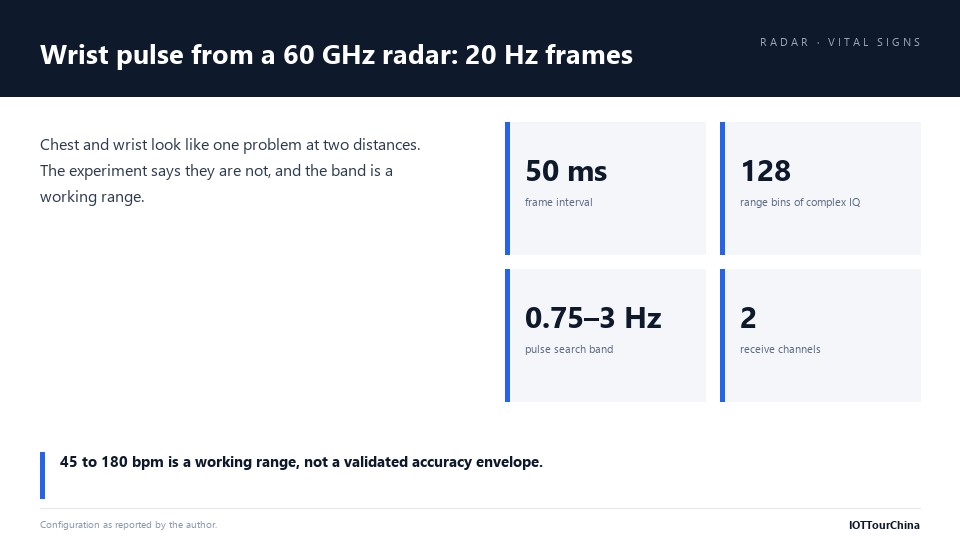
Frames arrive every 50 ms — 20 Hz — and both receive channels keep 128 range bins of complex IQ per frame. The pulse path uses the raw range-FFT I/Q; the MTI result is used only to watch how returns change in range and time.
Keeping raw I/Q is a deliberate choice rather than a shortcut. Pulse motion on a resting arm is tiny, and if background suppression is strong, or if a threshold tuned for moving targets is applied first, the micro-motion can be attenuated before the pulse estimator ever sees it.
Pulse processing is limited to 300 mm, while the MTI plot still draws all ranges so that distant objects and environmental change remain visible. Bins outside the gate take no part in presence or rate estimation; bins inside it contribute candidate signals jointly.
A gate only restricts which bins are computed on. Skin over the radial artery, surrounding tissue and other near reflections can still share a bin or fall into neighbours, and finite bandwidth and sidelobes mean the real spatial boundary is not as tidy as the software condition. Alignment, antenna illumination and placement stability therefore still decide whether a pulse is observable at all.
The zero-range bin is excluded from phase processing because it carries strong DC and coupling; near-range micro-motion comes from the bins after it.
Presence: why chest logic does not transfer
The original presence gate came from chest monitoring, where sustained low-frequency micro-motion is strong evidence of a person. On a wrist that logic fails: a forearm can be extremely still while the local pulse is weak, and once the gate loses its supporting motion, downstream processing has no continuous data to accumulate.
In the current chain, respiration monitoring is removed entirely. The presence branch watches near-range echo change; the pulse branch independently judges the quality of periodic signal. When a pulse peak temporarily weakens, only the confidence state of the pulse output changes — raw I/Q keeps accumulating.
To detect a stably placed forearm the software adds about two seconds of empty-scene calibration. With the arm removed it records the near-range background complex echo and its fluctuation; with the arm in place it compares the change against that background. When the added reflection stays above background fluctuation and satisfies entry conditions, acquisition starts. Exit uses different thresholds and a different duration, which is the standard way to stop a detector chattering at the boundary.
The presence waveform displays near-range echo change relative to the noise floor, so insertion, removal and small adjustments are visible as changes in the detection evidence. It reports that a near reflector exists inside a fixed measurement zone; it does not identify a person.
Rate extraction
Once in near-range acquisition, phase processing advances continuously and each I/Q sample enters the phase and filtering chain exactly once. When quality drops, the sliding window keeps taking new data. After a clear movement or a sampling break, phase is reconnected and frequency estimation uses only the continuous segment after recovery — compressing a gap into apparent continuity would manufacture a pulse train that never existed.
Nearby static reflectors push the I/Q trajectory off its ideal circle, and small motion often traces only a short arc, where fitting a circle freely amplifies noise. Static-component compensation therefore has to be quality-gated rather than applied unconditionally to every short window. Frequency candidates are also required to find support in the modulation spectrum of the raw complex I/Q, which limits the failure mode where one phase branch makes a wrong pick and then reinforces itself.
Two receive channels provide a second observation. A periodic component appearing on both channels and in several adjacent bins is more persuasive than an isolated spike in one. The combination uses power evidence rather than summing phase directly, since opposing phase would cancel. Cross-channel agreement can still come from common motion, so spectral contrast, fundamental-to-harmonic relationships and persistence over time are all weighed as well.
The search range is 0.75 to 3 Hz, or 45 to 180 beats per minute — a working range, not a validated accuracy envelope. Cycles per second times 60 gives the displayed rate, so 1.4 Hz reads as 84.
Short windows of roughly 5 to 8 seconds run alongside a 20-second window, with the judgement updated every 0.5 seconds. Agreement between them raises confidence; disagreement leaves the reading flagged as a candidate. A peak that departs sharply from the recent reading has to be supported repeatedly before it becomes the new output state.
At 20 Hz slow-time sampling, a rate of 85 per minute spans about 14 samples, which is enough for a mean-rate estimate. A 20-second window gives a Fourier spacing near 0.05 Hz, or about 3 beats per minute. Peak interpolation helps on high-SNR, near-stationary signals, but zero-padding does not add observation time and does not by itself deliver ±1 bpm.
Where this can and cannot go
There is published ground to build on. A 2025 study using a 60.5 GHz radar, with seated subjects, the wrist about 10 cm from the antenna and a 20-second processing window, reported a mean absolute error of 0.97 bpm and an RMSE of 2.98 bpm. Different bandwidth, sampling and spatial processing, but the same conclusion: wrist micro-motion carries usable rate information.
For this prototype the honest starting point is a fixed measurement zone — forearm supported, radar-to-wrist geometry stable, the user placing the arm and taking a short measurement. Whether a valid position is easy to re-establish, whether signal quality holds across different people, and how long the output stays valid will decide whether it moves from an experiment to something repeatable.
If the device ultimately shows only a rate number, radar also has to justify itself against contact methods. Desktop wrist cradles, fixed-position terminals and research rigs that combine it with other sensors are all plausible first venues, and their value still depends on repeatability, mechanical design and cost.
Beyond rate, waveform and beat-to-beat variation are the obvious next questions — but the current recording stores oximeter numbers, not a synchronised reference waveform, so waveform detail cannot be validated yet. That needs higher slow-time sampling plus a synchronous PPG or comparable physiological reference. Blood pressure is a further step involving its own modelling, calibration and validation, and cannot be derived accurately from rate alone.
The experiment's real contribution is division of labour: near-range presence, range estimation and rate processing separated into branches with their own evidence. The next concrete task is repeating the same result across people, placements and independent sessions while improving coverage and error control.
This article is part of the mmWave Radar channel.