Radar Dev Kits
Seeed Studio MR60FDA2 Fall Detection Kit
60 GHz radar kit with a XIAO ESP32C6 host pre-flashed with ESPHome, reporting presence and fall events.
Capabilities below are vendor-documented. We have not tested this device or its integrations.
Sources checked:
Also known as: MR60FDA2, XIAO 60GHz fall detection kit
Suitable projects
- Fall-event automation in Home Assistant through the pre-flashed ESPHome firmware.
- Evaluating a 60 GHz kit before designing a module into a product.
Before you buy
- Seeed states that the raw data and algorithms in its mmWave sensors are non-open source.
- Point-cloud and interference-region configuration are offered as a customisation service, not as a public API.
- No FCC or RED certificate number is listed on the official kit pages.
Official resources
Related guides
- Fall-detection radar: the MR60FDA2 type
- From radar UART frames to Home Assistant entities
- Tuning distance gates to remove radar false triggers
- 24 GHz or 60 GHz radar: what the band actually changes
- Power and UART bring-up for mmWave radar modules
- Radar output types and the data contract with your host
- Two radars in one home: coexistence without invented spacing numbers
- Reading a mmWave radar datasheet: what each number actually allows
- Band
- 60 GHz
- Transceiver
- 2T2R
- Host
- XIAO ESP32C6
- Input
- 5 V / 1 A
- UART default
- 115200
- Motion range (vendor claim)
- 6 m
- Presence range (vendor claim)
- 3 m
- Detection angle (summary table)
- 120 x 100 degrees
- Fall coverage (getting started)
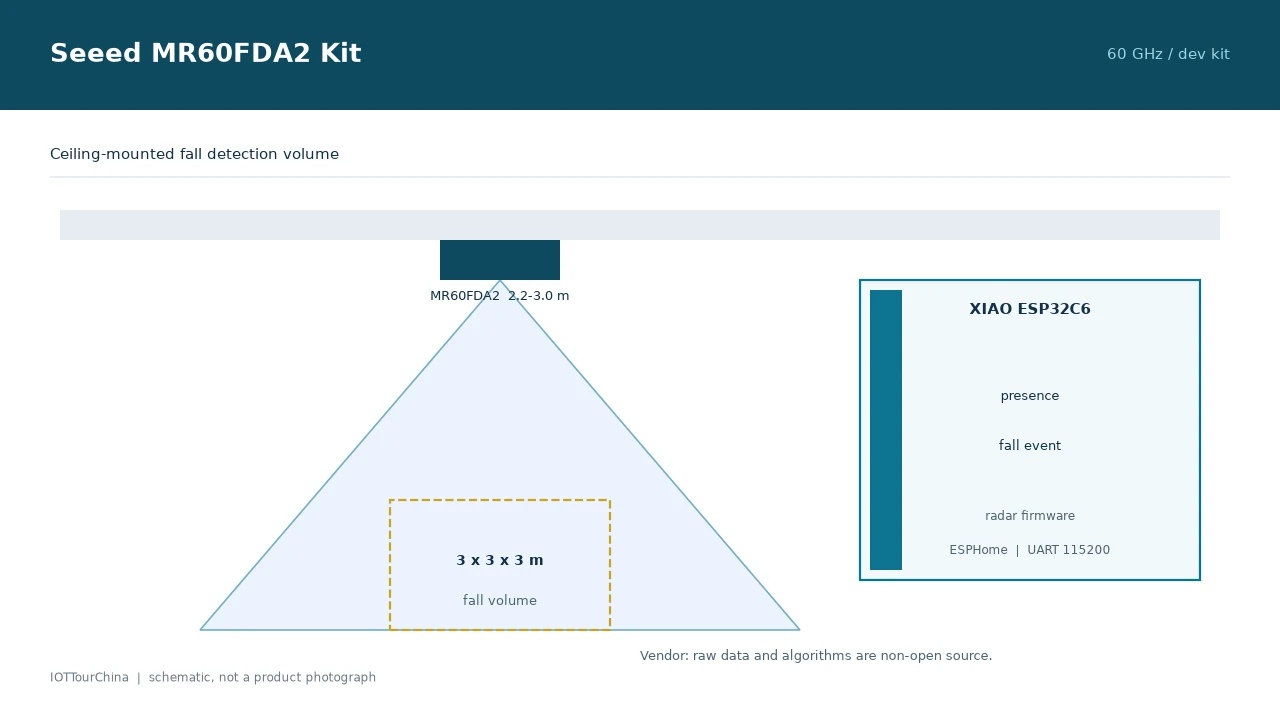
- 3 x 3 x 3 m
- Fall angle (getting started)
- 100 x 40 degrees
- Size
- 30 x 48 mm
- Top mounting height
- 2.2-3.0 m
Choosing the Seeed Studio MR60FDA2 Kit
This profile is based on official documentation, not our own device testing.
MR60FDA2 is a 60 GHz fall-detection kit built around a XIAO ESP32C6 host that ships with ESPHome firmware. It is an evaluation kit with a radio, a host, a light sensor, an RGB LED and Grove ports on one board.
Published figures
| Item | Value |
|---|---|
| Band | 60 GHz |
| Transceiver | 2T2R |
| Host | XIAO ESP32C6 |
| Input | 5 V / 1 A |
| UART default | 115200 |
| Motion range (summary table) | 6 m |
| Presence range (summary table) | 3 m |
| Detection angle (summary table) | 120 x 100 degrees |
| Fall coverage (getting started) | 3 x 3 x 3 m |
| Fall angle (getting started) | 100 x 40 degrees |
| Size | 30 x 48 mm |
| Top mounting height | 2.2-3.0 m |
Two official pages, two sets of figures
The parameter summary gives 120 x 100 degrees and a 3 m presence range, while the getting-started page gives a 3 x 3 x 3 m fall volume at 100 x 40 degrees and up to 6 m for static presence. They describe different functions or test setups. We publish both with their sources rather than choosing one for the vendor.
What is open and what is not
Seeed states that the raw data and algorithms in its mmWave sensors are non-open source. The XIAO host runs ESPHome that you can configure, the Tiny Frame interface and firmware upgrade tool are public, and 3D point-cloud or interference-region settings are offered as a customisation service rather than a public API.
Choosing it
- Home Assistant integration is the goal and a pre-flashed host is worth more than firmware freedom.
- Fall events and static presence are the outputs that matter.
- Ceiling installation between 2.2 and 3.0 m is possible.
Limits
Seeed lists nearby radars, glass, thin wooden boards and vibration as interference scenarios. The official kit pages list no FCC or RED certificate number.
Quick Start — Seeed Studio MR60FDA2 Kit
This profile is based on official documentation, not our own device testing.
This brings the kit into Home Assistant and puts the radar in a position where its published fall volume applies.
1. Power the kit
Use the 5 V / 1 A input. The XIAO ESP32C6 USB-C port handles firmware and serial debugging; the radar UART runs at 115200 with no parity and one stop bit.
2. Join ESPHome to Home Assistant
The XIAO ships with ESPHome firmware. Adopt the device in the ESPHome dashboard, confirm the sensor entities appear, and only then add automations. The radar firmware itself is separate from the host firmware.
3. Mount before configuring thresholds
Seeed gives a 2.2-3.0 m ceiling height with a maximum sensing radius of 2 m, and a 2.4-3.0 m height threshold for fall detection with a 0-0.6 m fall decision band. Align the sensor side with the area to be watched.
4. Clear the interference list
Keep other radars away, and avoid glass, thin wooden boards and vibrating mounts inside the detection volume. These are the scenarios listed in the official guide.
5. Validate presence, then falls
Confirm that the presence binary sensor follows a person entering and leaving. Fall detection is a separate function with its own installation height and sensitivity, so do not treat a working presence entity as proof that fall events are configured.
6. Be careful with firmware upgrades
Seeed publishes an OTA tool and firmware images, and warns that an interrupted upgrade can leave the radar unrecoverable. Archive the working firmware version before starting an upgrade.
FAQ — Seeed Studio MR60FDA2 Kit
This profile is based on official documentation, not our own device testing.
Is the firmware open source?
The XIAO host runs ESPHome and is configurable. Seeed states that the raw data and algorithms in its mmWave radar sensors are non-open source, so the signal processing is not yours to change.
Why do two official pages give different angles?
The parameter summary lists 120 x 100 degrees with a 3 m presence range; the getting-started page lists a 3 x 3 x 3 m fall volume at 100 x 40 degrees and up to 6 m for static presence. They describe different functions or setups. We show both with their sources instead of reconciling them.
Can I get point-cloud data?
Not from the public documentation. Seeed offers 3D point-cloud generation and interference-region configuration as a customisation service.
Is the kit certified?
The official kit pages list no FCC or RED certificate number. Do not assume a grant from the presence of a compliance statement elsewhere on the vendor site.