Radar Dev Kits
Seeed Studio MR60BHA2 Breathing and Heartbeat Kit
60 GHz radar kit with a XIAO ESP32C6 host pre-flashed with ESPHome, reporting breathing and heart rate values.
Capabilities below are vendor-documented. We have not tested this device or its integrations.
Sources checked:
Also known as: MR60BHA2, XIAO 60GHz breathing kit
Suitable projects
- Sleep-scene breathing and heart rate reporting into Home Assistant.
- Evaluating contactless vital-sign sensing without a camera.
Before you buy
- Seeed recommends the breathing and heart rate functions for sleep scenarios only and warns about seated or exercising subjects.
- Seeed states that the raw data and algorithms in its mmWave sensors are non-open source.
- These are sensing outputs, not medical measurements, and no certificate number is listed on the kit page.
Official resources
Related guides
- Breathing and heart-rate radar: the MR60BHA2 type
- From radar UART frames to Home Assistant entities
- 24 GHz or 60 GHz radar: what the band actually changes
- Radar output types and the data contract with your host
- A repeatable validation checklist for radar installations
- Reading a mmWave radar datasheet: what each number actually allows
- Band
- 60 GHz
- Transceiver
- 2T2R
- Host
- XIAO ESP32C6
- Input
- 5 V / 1 A
- UART default
- 115200
- Motion range (vendor claim)
- 6 m
- Presence range (vendor claim)
- 1.5 m
- Detection angle (summary table)
- 120 x 100 degrees
- Breathing and heartbeat range
- 1.5 m
- Size
- 30 x 48 mm
- Inclined mounting height
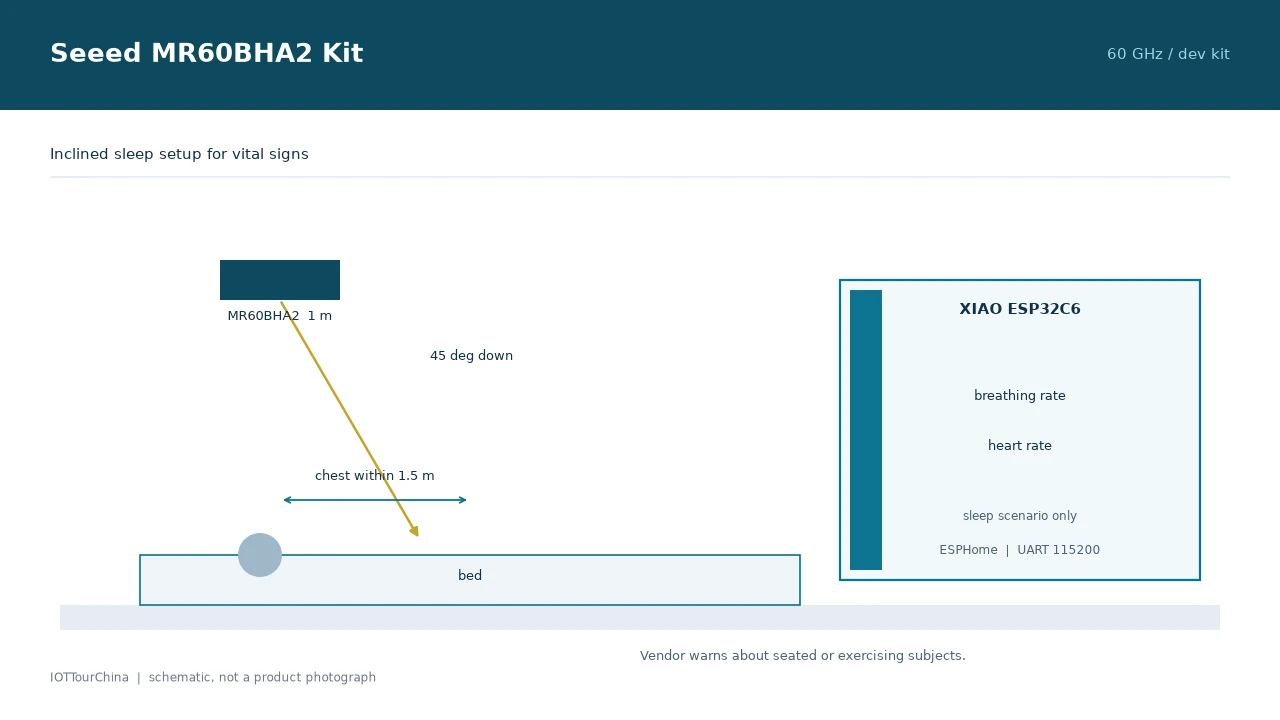
- 1 m above the bed head, 45 degrees down
Choosing the Seeed Studio MR60BHA2 Kit
This profile is based on official documentation, not our own device testing.
MR60BHA2 is the 60 GHz breathing and heartbeat member of the same XIAO ESP32C6 kit family as MR60FDA2. It shares the host, the pre-flashed ESPHome firmware, the 5 V / 1 A input and the 115200 UART, but its documented job is vital-sign sensing during sleep.
Published figures
| Item | Value |
|---|---|
| Band | 60 GHz |
| Transceiver | 2T2R |
| Host | XIAO ESP32C6 |
| Input | 5 V / 1 A |
| UART default | 115200 |
| Motion range (vendor claim) | 6 m |
| Presence range (vendor claim) | 1.5 m |
| Detection angle (summary table) | 120 x 100 degrees |
| Breathing and heartbeat range | 1.5 m |
| Size | 30 x 48 mm |
The installation is part of the specification
Seeed describes an inclined mount 1 m above the bed head, tilted 45 degrees down toward the middle of the bed, with the chest within 1.5 m. It also states that the respiratory and heart rate functions are recommended for sleep scenarios only and that seated or exercising subjects produce significant inaccuracy.
What is open and what is not
Seeed states that the raw data and algorithms in its mmWave sensors are non-open source. ESPHome on the host is configurable, and the Tiny Frame manual, firmware images and upgrade tool are public.
Choosing it
- A sleep-scene setup with a fixed bed position can be built and left in place.
- The output needed is breathing and heart rate values rather than fall events.
- Home Assistant is the destination and a pre-flashed host is acceptable.
Limits
These are sensing outputs, not medical measurements. The official page does not publish accuracy tolerances for the current firmware and lists no certificate number.
Quick Start — Seeed Studio MR60BHA2 Kit
This profile is based on official documentation, not our own device testing.
This brings the kit into Home Assistant and sets up the sleep geometry that the vendor documentation assumes.
1. Power and connect
Use the 5 V / 1 A input. The XIAO ESP32C6 USB-C port is for firmware and debugging, and the radar UART runs at 115200 with no parity and one stop bit.
2. Adopt the ESPHome device
The host ships with ESPHome firmware. Adopt it in the dashboard and confirm that breathing and heart rate entities appear before writing automations.
3. Build the inclined mount
Place the radar 1 m above the bed head, tilt it 45 degrees down toward the middle of the bed, and keep the chest within 1.5 m. Align the radar normal with the main detection position.
4. Test with a lying subject only
Seeed recommends these functions for sleep scenarios and warns about seated or exercising subjects. A desk test is not a valid acceptance test for this kit.
5. Clear the interference list
Keep other radars away and avoid glass, thin wooden boards and vibrating mounts in the detection volume. These are the scenarios listed in the official guide.
6. Record the firmware version
The vendor notes continuing work on breathing and heart rate accuracy and publishes firmware images plus an OTA tool. Archive the version you validated, and treat an upgrade as a change that requires revalidation.
FAQ — Seeed Studio MR60BHA2 Kit
This profile is based on official documentation, not our own device testing.
Can it measure a person sitting at a desk?
Seeed recommends the respiratory and heart rate functions for sleep scenarios only and warns that seated or exercising subjects can produce significant inaccuracy. Use a different sensor for desk occupancy.
How accurate are the readings?
The official pages do not publish an accuracy tolerance for the current firmware, and the vendor notes that the algorithm has been under refinement. We do not quote an accuracy figure that is not in the documentation.
Is the radar firmware open source?
No. Seeed states that the raw data and algorithms in its mmWave sensors are non-open source. The XIAO host runs configurable ESPHome firmware.
Are these medical measurements?
No. They are contactless sensing outputs for prototyping, not diagnostic results, and no certificate number is listed on the kit page.