A 24 GHz radar wakes the screen of a wall switch, it does not expose a presence sensor
A wall switch is an unusual place to find a radar. The product in question keeps the familiar four button layout, adds a small colour display, and uses a radar to decide when that display should light up. It is a neat piece of interaction design. It is also a good example of a distinction that matters to integrators: having a radar inside a product is not the same thing as the product publishing radar data.
What the vendor says the radar does
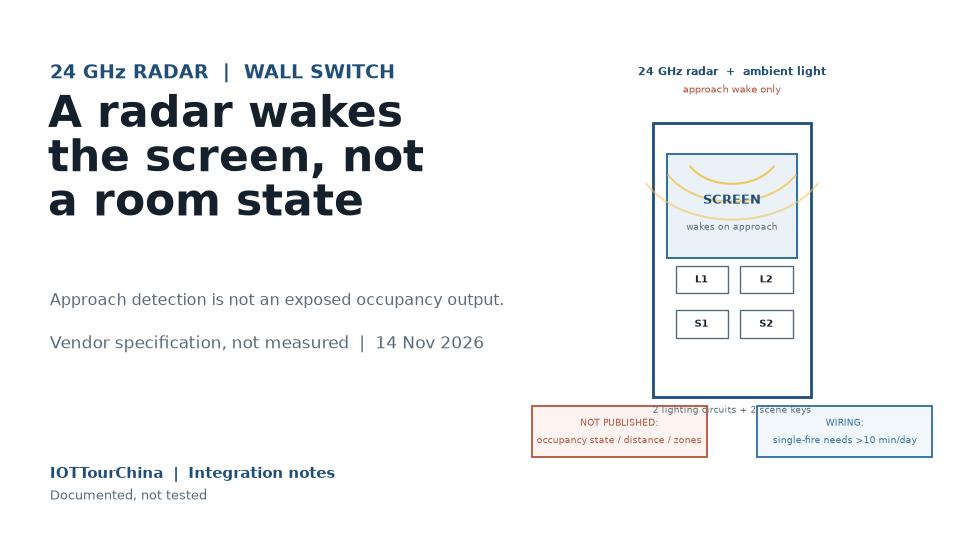
The public material describes a 24 GHz radar paired with an ambient light sensor. A person approaching the switch wakes the screen, and the screen brightness follows the light level in the room. The claimed detection angle is 90 degrees. No detection distance is given, and no sensitivity figure at different angles is published.
| Element | Published role |
|---|---|
| 24 GHz radar | Detect a person approaching and wake the screen |
| Ambient light sensor | Adjust screen brightness to the room |
| Colour display | Show button names, time, date, weather and themes; not a touch control surface |
| Lower two buttons | Relay switches controlling two lighting circuits |
| Upper two buttons | Wireless scene buttons with single, double and long press actions |
| Wiring | Works with either single-fire or neutral wiring |
The two wireless scene buttons need a Bluetooth Mesh gateway for their scene bindings. The display is an information panel rather than a control panel, which is an important distinction when comparing this device with a home control screen.
There is also a wiring condition worth reading closely. In single-fire installations the product uses a built in storage module to power the display, and the vendor states that the light must be on for more than ten minutes a day for the wake feature to work reliably. An always on screen is not supported in that wiring mode. With a neutral wire present, those limits do not apply. The wake behaviour therefore depends on the electrical installation, not only on the radar.
Band wording matters
Chinese product material calls this a millimetre wave radar. That is a common marketing label for 24 GHz presence devices, but the 24 GHz ISM band is not the 57-64 GHz band used by 60 GHz sensors. The two bands have different regulatory paths, different antenna and bandwidth constraints, and different typical data products. A 24 GHz module is often chosen because it can publish target coordinates, while a 60 GHz finished sensor often publishes only an occupancy bit.
For this switch, the safest reading is literal: a 24 GHz radar performs a short range approach detection. It should not be described as a 60 GHz millimetre wave device, and it should not be filed in a directory of 60 GHz sensors. The site guide on choosing between 24 GHz and 60 GHz covers the underlying trade off.
Hardware present versus capability exposed
The most common question from a smart home integrator is whether this switch can replace a dedicated presence sensor and drive an automation such as turning off the lights when a room is empty. The public material does not support that conclusion.
| Question | What the published material says |
|---|---|
| Does it detect a stationary person in a room | Not stated |
| Is a radar state exposed as an automation trigger | Not stated |
| What is the detection distance | Not published |
| Can sensitivity, hold time or zones be configured | Not stated |
| Can the radar data be read by another system | Not stated |
What a radar can do depends on the antenna, the mounting position, the signal processing, the product policy and whether the application exposes the resulting state. Waking a screen when someone approaches is a local, short lived event. Continuously deciding whether a room is occupied, keeping that state through long periods of stillness, and offering it to other devices are different requirements. The first does not imply the second, and the presence of the radio does not tell you which of them the firmware implements.
Integration questions to answer before specifying it
Wall switches are fixed to a surface near a doorway or along a corridor. People approach them head on, walk past them sideways, or pass them without intending to use them at all. That geometry is quite different from a ceiling mounted sensor looking down into a room.
| Question | Why it matters |
|---|---|
| Does a sideways approach still wake the screen in time | Switches are usually mounted at the edge of a room |
| Does simply walking past cause repeated wake events | Hallways and doorways create constant traffic |
| Do two adjacent switches interfere with each other | Multi gang installations are common |
| Do day and night behaviour match | Ambient light and activity patterns differ |
| Which wiring mode is installed | Single-fire mode carries the daily light-on condition |
Mains wiring should be handled by a qualified installer. That is a separate concern from the sensing question, but it is the reason a specification decision about this kind of product cannot be made from the radar specification alone.
Why the product is still interesting
For anyone working with radar, the notable change is where the sensor is going. Sensing is no longer sold only as a standalone box. It is being built into switches, displays and luminaires, each solving one narrow interaction problem. The user is not expected to think about the radar at all.
That makes the engineering constraints more specific rather than less. The mounting position is fixed, the available space is tight, the user action is predictable, and tolerance for false triggers is low. A radar that reliably wakes a small screen without lighting it up all night is a modest application, but it is a real one. What it is not, on the published evidence, is an open presence sensing platform.