Shelly Presence Gen4 and Aqara FP400: two routes to zone-based presence sensing
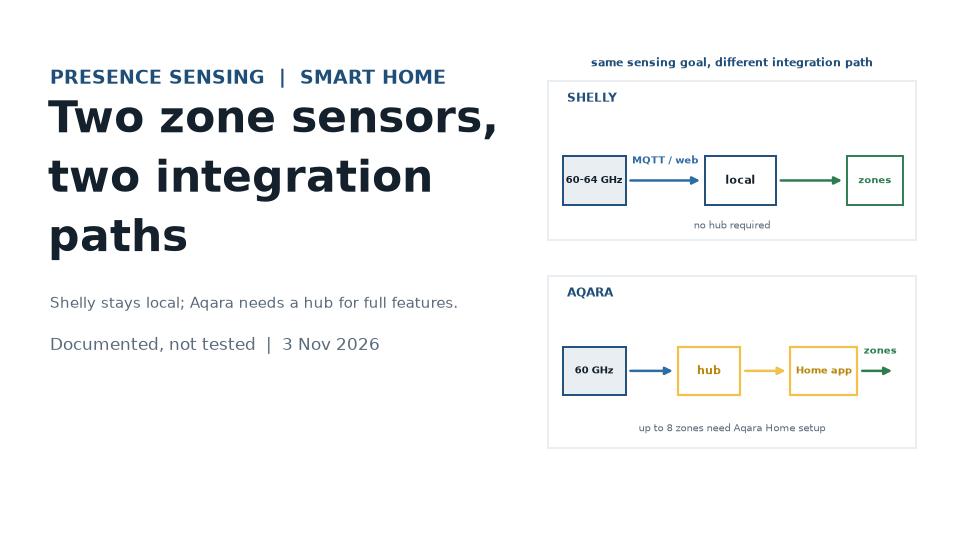
Two presence sensors released in 2026 put zone-based millimetre-wave sensing on the same shortlist. Shelly Presence Gen4 and the Aqara Spatial Multi-Sensor FP400 both track several people at once and let an automation react to which part of a room is occupied, rather than only whether anybody is moving. For an integrator the interesting difference is not the radar band. It is what each device exposes to the automation layer, and what has to be installed before those features appear.
A passive infrared sensor detects a moving heat source. Someone reading on a sofa, sitting at a desk or lying still eventually disappears from its view, which is why occupancy-driven lighting can switch itself off around a stationary person. Millimetre-wave radar resolves much smaller motion, including the chest movement of breathing, so presence can be held without continuous movement. Dividing the covered area into zones then turns one occupied-or-empty signal into a set of location-linked signals.
Shelly Presence Gen4: configuration stays on the device
Shelly documents the Presence Gen4 as model S4SN-0U61X, powered by 5 VDC over USB-C at 1 A, drawing 2.5 W nominal and 3.5 W maximum, with an ESP-Shelly-C68F microcontroller and 8 MB of flash. The radar specification lists a 60-64 GHz band, object detection, wall-mount coverage of 140 degrees horizontal and 120 degrees vertical over 8 by 8 m, corner-mount coverage of 90 degrees over 7 by 7 m, and still detection out to 3 m. The device ships on a free-standing base, but also supports adhesive and screw mounting, and the documentation recommends an installation height around 2 m with a tilt of roughly 15 degrees.
Connectivity is where the device is unusual. Wi-Fi 6, Bluetooth 5 LE and Zigbee 3.0 are all listed, along with Matter-over-Wi-Fi. Gen4 devices boot into Matter firmware; five rapid presses of the button switch that to Zigbee firmware and back. There is an embedded web interface for direct configuration, plus scripting, MQTT, webhooks, UDP, a key-value store and local scheduling. No hub is required to run automations locally, and Shelly lists Home Assistant among the supported integrations.
The documented feature list quotes up to 10 customised detection zones and up to 10 simultaneously tracked people, with filtering options that ignore near-ground movement and small objects such as pets or robot vacuum cleaners. Two caveats are worth carrying into a design review. The radar specification table says up to 6 objects rather than 10, and the feature list quotes coverage of up to 42 square metres while the same page describes an 8 by 8 m wall-mount envelope. Shelly's own materials are not internally consistent on those two numbers, so a deployment should be sized from the angular and range figures rather than the marketing summary.
Aqara FP400: a denser point cloud, with conditions
Aqara announced worldwide availability of the FP400 on 16 September 2026. Its release describes a next-generation 60 GHz radar, simultaneous tracking of up to 10 people, up to 8 user-defined zones, coverage up to 10 by 8 m with a 120 degree field of view, a built-in ambient light sensor, AI Spatial Learning, native Thread and Zigbee, and Matter support. The sensor can be mounted on a wall, in a corner or on a ceiling, and AI-assisted mapping detects room boundaries and entrances during setup.
The US product page adds the hardware detail: a 4T4R MIMO antenna array producing over five times denser point-cloud data than the previous generation, a 0.5 m by 0.5 m positioning grid, and an algorithm that distinguishes people from pets and robot vacuums while adapting to the surrounding space over time. This is a different engineering bet from a height threshold: more signal detail, more classification, and more dependence on the vendor's software stack.
Aqara also names a second variant, the FP400 Pro, for assisted living and specialised elder care. Its documentation lists posture recognition, assisted fall detection, entry and exit people counting, up to 8 custom zones built from 320 fine-grid divisions and tracking of up to 10 targets. The same page states that the Pro needs an Aqara hub for full functionality and that posture recognition, fall detection and people counting work only inside the Aqara ecosystem.
What the automation layer actually sees
This is the part most easily lost in a spec-sheet comparison. Aqara's US product page says the full set of up to eight custom zones is configured in the Aqara Home app with a compatible Aqara hub. It also says that with a pre-configured third-party Thread Border Router, the FP400 can be set up in Aqara Home without an Aqara hub, and that one whole-area occupancy sensor plus up to eight zone occupancy sensors can then be shared with a compatible Matter ecosystem. Direct pairing into a third-party Matter platform over Thread, without Aqara Home setup at all, is documented as exposing a single whole-area occupancy sensor with no custom zones; the launch announcement's footnote describes that case as one presence sensor and one illuminance sensor.
Those two official texts describe the third-party Thread case in slightly different terms, so the commissioning path has to be checked against the target controller before promising zone entities. A protocol badge does not tell you which entities will appear.
Shelly's path is shorter. Zones are configured on the device or through its web interface and consumed over local protocols; there is no gateway requirement in the documentation. The trade-off is that the richer classification and spatial-learning features Aqara advertises are simply not part of the Shelly feature list.
| Item | Shelly Presence Gen4 | Aqara FP400 |
|---|---|---|
| Radar | 60-64 GHz | 60 GHz with 4T4R MIMO |
| Tracked targets | up to 6 objects in the spec table, up to 10 in the feature list | up to 10 |
| Zones | up to 10 | up to 8 |
| Position grid | not stated | 0.5 m by 0.5 m |
| Connectivity | Wi-Fi 6, Bluetooth 5 LE, Zigbee 3.0, Matter-over-Wi-Fi | Zigbee, Matter over Thread |
| Hub requirement | not required for local control | required for full Aqara Home features |
| Still detection | up to 3 m | static presence supported, range depends on mounting |
| Local interfaces | embedded web UI, MQTT, scripting, webhooks | Aqara Home app and hub-based local automations |
| Care-oriented variant | not listed | FP400 Pro with assisted fall detection |
Where the claims stop
Static presence detection answers a different question from fall detection. To a presence radar, a person who has fallen and is lying motionless is still an occupied point in space, and neither base model's documentation describes a fall-detection classifier. Aqara places assisted fall detection on the separate Pro variant, and even there restricts it to its own ecosystem. Treating an occupancy zone as a safety alarm would be a category error, not a missing integration.
It is also worth separating manufacturer specifications from measured behaviour. Coverage figures in both datasheets are envelopes measured under stated mounting conditions; wall reflection, furniture layout and installation height all change what a real room looks like to the sensor. The FP400 Pro documentation explicitly notes that mounting too close to a wall can create multipath echoes, ghost targets and position jumps.
How this was checked
The WeChat source article was read as a lead, and every specification used above was checked against first-party material: Shelly's official Presence Gen4 documentation and product pages, Aqara's FP400 availability announcement, the Aqara US product page and the FP400 Pro documentation. Where Shelly's own pages disagree on tracked-target count or coverage notation, both figures are reported rather than one being chosen. The differences in zone exposure between Aqara Home setup and direct third-party Matter setup are taken from Aqara's own footnotes. List prices were left out because only one vendor's store price could be read directly at the time of checking. No device was purchased, installed or tested for this article, and no detection claim was independently verified.
Source: Sleep Smart Hardware, WeChat, 3 November 2026.
This article is part of the mmWave Radar channel.