A wall switch that sees: Inovelli's VTM32-SN brings mmWave to Matter
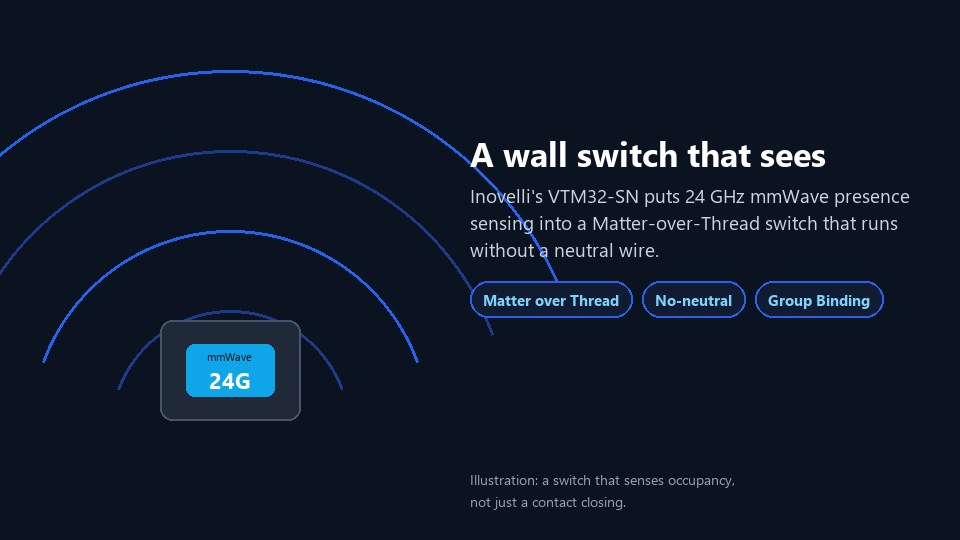
Late in September 2026, Inovelli, a smart-home company in Kalamazoo, Michigan, posted the first product requirements for its next switch on its own forum. The document describes a Matter-over-Thread wall switch with a built-in 24 GHz millimetre-wave radar for presence sensing. The model is VTM32-SN, fifteen beta samples are planned for November and December 2026, and mass production is currently targeted for 20 March 2027.
Inovelli is careful to say that features and dates may change, and there is no price or preorder date yet. The direction is what makes the announcement worth reading. The smart home has spent the past decade learning to make devices from different brands talk to each other; the next problem is making the switch on the wall understand the room it is wired into.
Who Inovelli is
Inovelli is not an electrical giant. It began in March 2016 as an MBA class project: the founder, Eric Hines, analysed the smart-home industry, concluded that the big brands were selling expensive look-alike products on brand name alone, and decided to build the switches he wanted in his own house. The company is still small — its team page lists five people in the United States — and it has been built almost entirely in public.
That community is the company's infrastructure. Inovelli found its CTO, Eric Maycock, in the SmartThings forums. Its users propose features, argue about them, test beta firmware and effectively co-write the products. An angel investment in early 2019 paid for the company's own hardware: the Z-Wave Red Series launched in February 2019 and took the Hubitat community's most-popular-switch and product-of-the-year awards; the Zigbee Blue Series followed in August 2022 and had become the best-selling line by 2024; the Matter-over-Thread White Series arrived in December 2023.
The pattern matters for what comes next, because mmWave presence sensing is not a specification you get right on paper. It is a tuning problem that needs thousands of real rooms, and Inovelli has thousands of rooms with opinionated owners in them.
What the VTM32-SN is
VTM32-SN takes the company's Project Linus presence-sensing design — already shipping in the Zigbee Blue Series and the Z-Wave Red Series — and moves it onto Matter over Thread for the first time. Inovelli describes the project as at an early stage: initial requirements and R&D analysis are done, and hardware and firmware development are under way.
| Parameter | Published target |
|---|---|
| Model | VTM32-SN, White Series |
| Wireless | Matter over Thread |
| Sensing | Built-in 24 GHz mmWave presence sensor |
| Modes | Dimmer or on/off |
| Wiring | No neutral wire required |
| Controls | Center-rest paddle, configuration and favourite button |
| Lighting | Fully addressable RGB LED bar |
| Under study | Built-in lux sensor, not yet confirmed |
| Planned features | Power monitoring, smart bulb mode, configurable ramp rates and dimming limits, leading- and trailing-edge dimming, over-the-air updates, multi-way installations |
| Schedule | Fifteen beta samples, November to 20 December 2026; certification to 1 February 2027; mass production targeted for 20 March 2027 |
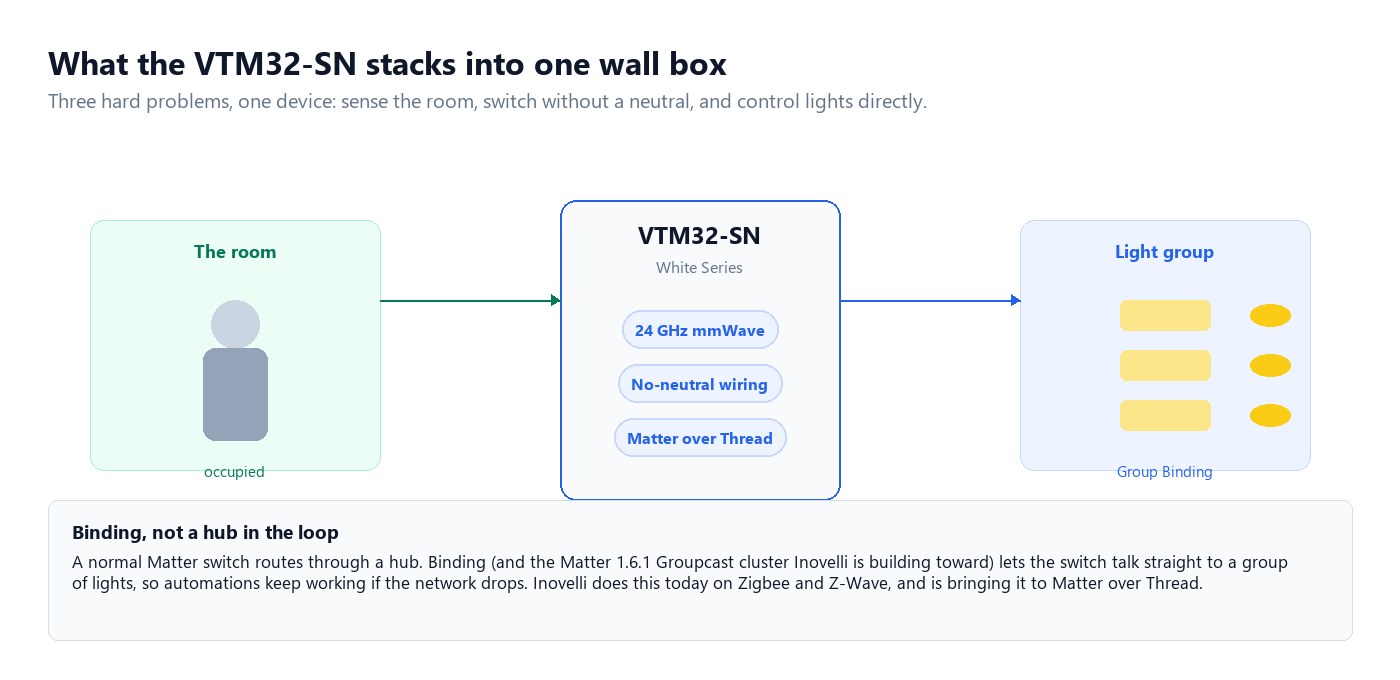
Three items in that table carry the story, and each is a hard engineering problem on its own.
The three hard problems
Millimetre-wave radar instead of PIR
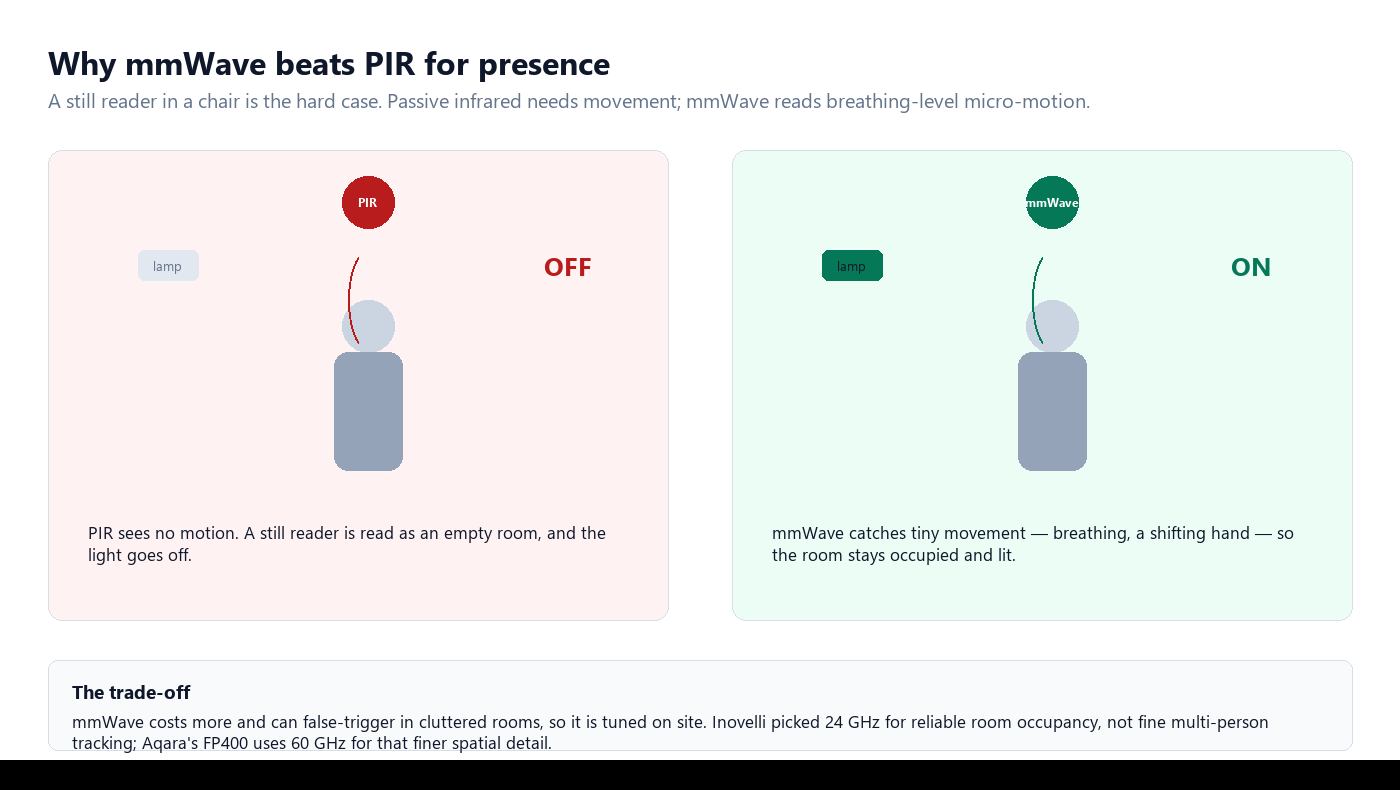
Most occupancy sensors to date are passive infrared. PIR sees movement, not people, so a reader sitting still in a chair drifts out of the picture and the light switches off over their head. mmWave radar reads much smaller motion — breathing, a shifting hand — so a still occupant still counts as present.
The trade-off is real. Radar costs more, reflects off glass and metal in ways that confuse it, and needs on-site tuning in cluttered rooms; false triggers in complex spaces are a documented weakness, which is exactly why the beta programme exists. There is also a frequency choice: 24 GHz favours range and penetration, while 60 GHz — the band Aqara uses in its FP400 — resolves space more finely. Inovelli's stated goal is reliable room occupancy, not multi-person tracking, which is why it picked 24 GHz.
No neutral wire, plus a radio that never sleeps
North American houses are full of wall boxes that contain only a live conductor and a switched loop, and retrofit buyers live in exactly those houses. A switch with no neutral can only siphon a tiny current through the lighting circuit to power itself, and it has to do that without leaking enough to make an LED flicker.
Stacking Thread on top makes it harder. A Thread device keeps its radio and processor alive, may relay mesh traffic for neighbours, and has to answer a hub at any hour. Squeezing all of that, plus a radar, into a no-neutral budget is the reason very few Matter-over-Thread switches attempt it. This is the part of the specification most likely to move between now and certification.
Binding: the switch talks to the lights directly
A normal Matter switch routes every press through a hub or controller. Binding lets a switch address another device directly, so the lamp still responds when the network or the hub is down. Inovelli is already one of the few Matter switch makers shipping device-to-device binding, and its recent White Series beta firmware added group binding — one switch addressing a whole Matter group of lights.
The standards work points the same way. Matter 1.6.1 introduces a newer Groupcast architecture, and Home Assistant is working on 1.6.1 compatibility. Inovelli has not confirmed that VTM32-SN will ship with Matter 1.6.1 or support the new Groupcast cluster — that remains a likely direction, not a feature — but the direction of travel is clear: the switch becomes a small automation engine, not a remote button.
The company it keeps
VTM32-SN is not arriving into a vacuum. The overseas market for Matter switches and sensing already has a map, and it is worth reading Inovelli against it.
| Company | Base | Protocol | mmWave or sensing | Positioning |
|---|---|---|---|---|
| Inovelli | United States | Z-Wave, Zigbee, Matter over Thread | VTM32-SN, 24 GHz, in development | Community-built; no-neutral plus radar plus binding |
| Aqara | China, global | Matter over Thread, Zigbee | FP400, 60 GHz, 10 people across 8 zones | Broadest Matter sensor and switch catalogue |
| Eve, part of ABB | Germany | Matter over Thread | Motion and environment sensors | Local-first, no cloud, no account |
| Shelly | Bulgaria | Matter over Wi-Fi | Relays, no radar | Very low cost, full local API |
| Ubisys | Germany | Matter, Thread | Design-led switches | German industrial design house |
| Leviton | United States | Matter, Decora Smart | None | Legacy electrical manufacturer, channel strength |
| Third Reality | United States | Matter over Thread | None | Affordable Thread devices |
Two neighbours define the spectrum. Aqara announced the FP400 at CES 2026 and released it worldwide on 16 September 2026: a 60 GHz sensor that tracks up to ten people across eight zones on a half-metre grid, covers ten by eight metres, and sells at 149 dollars in the United States. It is the parameter leader for spatial sensing, but it is a separate sensor on a shelf, not radar inside the wall control. Eve, acquired by ABB in 2023, sits at the opposite pole: the most consistent Matter-over-Thread, local-first, no-account brand in the market, and the one enthusiasts trust most on privacy.
What Inovelli is attempting — millimetre-wave presence, no-neutral wiring and community-written firmware, stacked on one Matter switch — has no direct equivalent on that map today. Whether the combination survives certification is exactly what the public beta is for.
Three signals in one switch
Read as an industry data point rather than a product announcement, the VTM32-SN requirements document says three things.
First, Matter is moving from interoperability towards sensing with local execution. The first generation of Matter products answered whether a lamp from one brand could be switched by an app from another. The next generation puts presence detection, edge processing and direct device-to-device control into base components, so the automation starts at the wall rather than in a cloud routine.
Second, small companies are using community development to cancel a resource gap. Inovelli has no electrical-giant marketing budget. What it has is a public process in which thousands of users do the slow, unglamorous work — tuning radar thresholds in real rooms, at their own cost, because they want the product to exist. Contributors whose ideas are adopted are credited and receive a free device.
Third, privacy and local-first have moved from selling point to requirement. A radar switch that judges occupancy locally and keeps working when the internet is down lines up with where the market already is: cameras face resistance, cloud-dependent devices face resistance, and local control has become a category rather than a feature.
What builders can take from this
- Presence sensing is becoming a standard component, not an accessory. mmWave modules have reached consumer price points, and the difference between a switch and a sensing switch is now a design decision rather than a product line.
- The no-neutral retrofit market is real and difficult. New builds in much of the world reserve a neutral wire, but existing housing stock in North America largely does not, and a vendor that can ship a stable no-neutral Thread device holds ground that is genuinely hard to take.
- Open development pays where specifications cannot. Radar tuning, like firmware behaviour, depends on real rooms and real habits; handing prototypes to a committed community converts a testing cost into a loyalty programme.
- Direct device-to-device control is becoming a selling point. Binding and group binding, moving towards the Groupcast architecture in Matter 1.6.1, let the simplest component in the house keep working when everything above it fails — which is the property end users actually notice.
IOTTourChina covers open-source IoT hardware and the silicon behind it as part of its developer resource. This is editorial coverage, not an endorsement or an advertisement; specifications, availability, licensing and pricing should be confirmed with the vendor before you buy or build.
This article is part of the mmWave Radar channel.