Apollo H-3 splits 37 LEDs into five zones and wakes for 90 seconds at a time
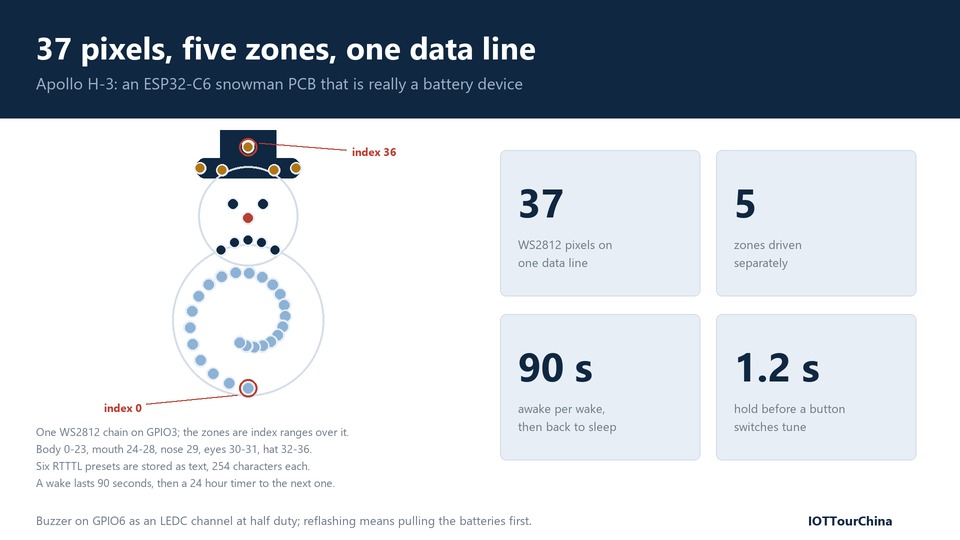
Most holiday ornaments are a plastic shell, a string of LEDs and a coin cell. The Apollo H-3 is a snowman-shaped circuit board instead: hat, head and body cut out of one piece of fibreglass, a hole through the hat to hang it by, and thirty-seven addressable pixels soldered across the face. Apollo Automation has shipped one of these per holiday season since 2024, and the third one is the first to divide its pixels into zones that can be driven separately.
The hardware is unremarkable, and that is not where the interest is. The ornament is a battery-powered device dressed as a decoration, and every part of its firmware bends around two AA cells: how long it stays awake, how a button press is interpreted, how loud the buzzer is allowed to get, even how long a song string is permitted to be. Apollo publishes the whole ESPHome configuration, so each of those decisions can be read in the code rather than inferred from a product page.
What is on the board
| Block | Detail |
|---|---|
| Module | ESP32-C6 with 8 MB of flash, declared in firmware as the esp32-c6-devkitm-1 profile on ESP-IDF |
| Pixels | 37 WS2812 parts in a single chain on GPIO3 |
| Buzzer | GPIO6, driven as an LEDC PWM channel at half of maximum duty |
| Buttons | Three song buttons on GPIO4, GPIO5 and GPIO7, and one further button on GPIO9 |
| Power | Two AA cells, or USB-C |
The module is more capable than the product needs. The ESP32-C6 carries Wi-Fi 6 on 2.4 GHz, Bluetooth LE and an 802.15.4 radio, and the firmware uses the first two and leaves the third alone. What the C6 does buy is a RISC-V core and enough flash for the dual-channel firmware update path described further down.
Thirty-seven pixels is fewer than the fifty-eight on last year's H-2. The count came down rather than up because this version was redrawn around five regions that each mean something, so the smaller board buys more control than the larger unzoned one did.
Five zones are index ranges, not five chains
Every pixel sits on the same data line, so the zones are nothing more than index ranges that the firmware hands to five separate light entities. The order matters the moment you write your own effect, because the chain does not run the way the ornament reads.
| Zone | Indices | Count |
|---|---|---|
| Body | 0 to 23 | 24 |
| Mouth | 24 to 28 | 5 |
| Nose | 29 | 1 |
| Eyes | 30 to 31 | 2 |
| Hat | 32 to 36 | 5 |
The chain is wired in that order, body first and hat last, which is neither the order a reader would guess from looking at the ornament nor the order the zones are listed on the product page. Anyone copying the layout should keep the mapping in one place, as this firmware does: the five entities are declared as partitions of one chain, and no script reaches for a raw pixel index.
There is also a sixth entity called All Lights, and its history is the useful part. Two changes in the current release moved it from a partition over the zones to the chain itself, so it now sits above them rather than beside them. That creates a conflict the code has to handle explicitly: an effect running on All Lights and an effect running on a zone write the same buffer, and the result is whichever one ran last. Every song script therefore switches All Lights off before it starts any zone effect, and the comment in the file says exactly that.
The firmware is written around two AA cells
The sleep configuration is the part worth copying. A wake lasts 90 seconds, whether the device came up from a button or from the timer, and then it goes back down. When asleep it wakes on a 24 hour timer by default, which gives it a daily window to reconnect, check for firmware and go quiet again. That timer is exposed as a number entity from 1 to 800 hours, with a guard that refuses a zero because a zero-length timer wake is an unrecoverable boot loop.
Wake-on-button uses the external wake circuit rather than a single pin, with any-high logic across the three song buttons. Two of those three, GPIO4 and GPIO5, are strapping pins on the C6, so the firmware has to suppress the strapping warning and rely on internal pulldowns instead of external resistors. That is the kind of detail that bites a port to another chip.
Two power settings sit in the Wi-Fi block: power save set to high, and transmit power pinned at 10 dBm rather than the maximum. Neither is unusual for a battery device. The second one says something about intent, though: the radio is sized to reach one access point and hold that link, not to serve anything.
The awkward part is the default. The Prevent Sleep switch ships on, and the boot sequence reaches for it before deciding whether to allow sleep at all, so a freshly flashed ornament stays awake until someone turns that switch off. Apollo's own FAQ answers "my battery drains too fast" with exactly that instruction. In other words the 90 second cycle is opt-in, and the shipping state is the one that flattens cells.
Three buttons carry six songs
The button grammar is more elaborate than the product page suggests, because three buttons have to reach six tunes. Each button has a short press and a hold, and a hold is measured at 1.2 seconds.
| Button | Short press | Hold | Double press |
|---|---|---|---|
| GPIO7 | Frosty the Snowman | Blue Christmas | Blue Christmas |
| GPIO5 | Rudolph the Red-Nosed Reindeer | Do You Want to Build a Snowman | Do You Want to Build a Snowman |
| GPIO4 | Jingle Bells | Barbie Girl | Barbie Girl |
The double press column is redundant. It exists, it is debounced at 20 milliseconds, and it lands on the same tune as the hold, so a double press buys nothing that a hold does not already give. Nothing in the repository explains why both paths are wired up; what it means in practice is that one of the two gestures is dead weight.
The fourth button is the one with real range. Short presses run a status check and an LED test; three seconds arms Prevent Sleep; ten seconds triggers the factory reset switch, which wipes the Wi-Fi credentials. The pause is measured on release, so the three behaviours are distinguished by how long the contact was held, not by how many times it was pressed. The source has one comment about that button worth repeating: only the short press path is suppressed when a song is starting, because reset has to work regardless of what the device thinks it is doing.
The buzzer is a PWM channel with a cubic volume curve
There is no audio codec and no amplifier. The buzzer hangs off a single LEDC channel on GPIO6, capped at half duty, and the tunes are RTTTL strings played through the same component that any ESPHome buzzer uses.
Volume is not linear. The number entity runs 0 to 100 and defaults to 50, but the gain applied to the output is the cube of the percentage divided by a hundred, so 50 percent is roughly one eighth of full scale and the top half of the slider does most of the audible work. For a piezo element that is a sensible mapping, since perceived loudness is closer to a power law than a straight line, and it keeps the quiet end of the range usable.
The songs are text entities rather than constants, which means they live in the preferences partition and can be replaced from Home Assistant without reflashing. That comes with a ceiling worth knowing about: the firmware notes that one of the presets occupies 247 of the 254 characters available to a stored string. Anything longer has to be shortened before it will fit, and the limit is a property of the storage layer, not of the decoder.
Each preset pins one effect to all five zones
Every tune arrives with a light pattern, and the patterns are named rather than scripted by hand.
| Song | Effect |
|---|---|
| Frosty the Snowman | RainbowWave |
| Rudolph the Red-Nosed Reindeer | TwinklingWhite, with the nose alone on TwinklingRed |
| Jingle Bells | RedGreen |
| Blue Christmas | TwinklingBlues |
| Barbie Girl | PinkParty |
| Do You Want to Build a Snowman | Snowfall |
Only the Rudolph preset splits the zones, and it splits them by exactly one pixel: the nose runs TwinklingRed while the other four zones run TwinklingWhite. It is the only joke in the file, and it is the clearest demonstration of what the zones are actually for. Everything else writes one effect across all five, so the ornament reads as a single object until something outside it takes over. That is a division of labour rather than a shortcoming: the button path has to work with no configuration at all, and the zone separation only earns its keep once something is driving it.
The song state also has a bug fix worth noting in the changelog. Starting a song while one was already running used to do nothing, because the play call returns early when the buzzer is busy; the current version stops the previous tune first. A playback that fails to start never fires the end-of-song callback, so the firmware checks whether the buzzer is actually playing after the call and tears the lights down if it is not.
Reflashing means pulling the batteries first
Two firmwares ship for the same board. The basic one runs as a standalone ornament: buttons, songs, lights, no Home Assistant. The smart one joins Home Assistant, exposes five zone lights, six text entities, the volume and sleep controls, a Bluetooth proxy switch and a tracker, and it is the version with a documented sleep path, which is what the whole power budget above refers to.
Moving between them is not a matter of holding a button while the cable goes in. The vendor's own boot mode instructions start by removing the cells, and the reason is a power path rather than a button sequence: with batteries installed the board stays powered, so plugging in USB never restarts it and the download mode is never entered. The order is batteries out, hold the boot button, plug in a data cable, release.
Once in boot mode there are two routes. The web installer flashes from a browser over Web Serial, and the firmware also updates itself over the air from a manifest published on GitHub Pages. That manifest is worth a look because it carries the changelog and hashes for the current build, version 26.10.12.1 on an ESP32-C6 target, and the firmware keeps a Stable and a Beta channel as a select entity that repoints the update source. The HTTP client is sized at 5120 bytes for receive and 2048 for transmit, which the comments attribute to the length of GitHub's redirect URL and its content security headers.
The minimum ESPHome version is pinned to 2026.8.0 in the current configuration, for a colour feature in the light platform that the changelog calls channel_colors. Anyone building from this repository on an older install will get a compile error rather than a runtime surprise, which is the right way round.
Where the source material disagrees with itself
The ornament is a real product with a real repository, but three things around it do not line up as cleanly as the marketing does.
The first is the charity claim. The README headline says a hundred percent of profits are donated, and lists two recipients; the second recipient's own bullet then says a portion of profits from every unit sold, which is not the same promise. The FAQ repeats the hundred percent figure for both. The split between the two is not published anywhere we could find.
The second is how active the project is. The repository carries 65 commits, 54 of them in a single month while the board was being brought up, and a handful since; the last push was in mid October. It also carries one star, against five for last year's ornament and four for the year before. Firmware work here is finished rather than continuous.
The third is certification. The configuration is clearly written against the Made for ESPHome rules, and the comments say so twice, including a note that the programme forbids baked-in API keys, which is why the API block has no encryption key. We could not find the H-3 on any published list of badge holders, so the honest statement is that the firmware is built to that checklist and the badge itself is unconfirmed.
Files worth opening first
| File | Why |
|---|---|
| Integrations/ESPHome/Core.yaml | The zone partitions, the gesture map, the RTTTL presets and the sleep configuration in one place |
| Integrations/ESPHome/H-3.yaml | The product-level layer: proxy switch, OTA channels, Improv and the boot-time sleep decision |
| firmware/manifest.json on the Pages site | The current build, its hashes and the changelog that explains the All Lights rework |
Read in that order, the three files answer what a buyer would ask and what a porting engineer would ask, and nothing in one contradicts the others. For a product this small it is an unusually clean paper trail, and that is the reason the ornament is worth writing about at all: the constraint that shaped it, two AA cells and a buzzer, is the constraint most battery-powered sensor products are still working around rather than designing for.